

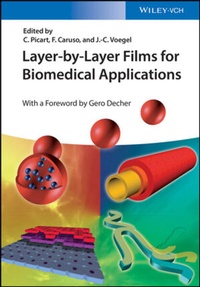
Layer-by-Layer Films for Biomedical Applications
1st Edition
Published on 30. January 2015
592 pages
978-3-527-67589-0 (ISBN)
Description

The layer-by-layer (LbL) deposition technique is a versatile approach for preparing nanoscale multimaterial films: the fabrication of multicomposite films by the LbL procedure allows the combination of literally hundreds of different materials with nanometer thickness in a single device to obtain novel or superior performance. In the last 15 years the LbL technique has seen considerable developments and has now reached a point where it is beginning to find applications in bioengineering and biomedical engineering.
The book gives a thorough overview of applications of the LbL technique in the context of bioengineering and biomedical engineering where the last years have witnessed tremendous progress. The first part familiarizes the reader with the specifics of cell-film interactions that need to be taken into account for successful application of the LbL method in biological environments. The second part focuses on LbL-derived small drug delivery systems and antibacterial agents, and the third part covers nano- and microcapsules as drug carriers and biosensors. The fourth and last part focuses on larger-scale biomedical applications of the LbL method such as engineered tissues and implant coatings.
The book gives a thorough overview of applications of the LbL technique in the context of bioengineering and biomedical engineering where the last years have witnessed tremendous progress. The first part familiarizes the reader with the specifics of cell-film interactions that need to be taken into account for successful application of the LbL method in biological environments. The second part focuses on LbL-derived small drug delivery systems and antibacterial agents, and the third part covers nano- and microcapsules as drug carriers and biosensors. The fourth and last part focuses on larger-scale biomedical applications of the LbL method such as engineered tissues and implant coatings.
More details
Other editions
Additional editions
Software
01/2015
Wiley-VCH
€247.83
No shipping information available
Catherine Picart | Frank Caruso | Jean-Claude Voegel
Layer-by-Layer Films for Biomedical Applications
Book
12/2014
Wiley-VCH
€179.00
Article exhausted; check different version
Persons
Catherine Picart is full Professor of Bioengineering and Biomaterials at the Grenoble Institute of Technology, France, and former junior member of the Institut Universitaire de France (2006-2011). She obtained her PhD in Biomedical Engineering from the University Joseph Fourier, Grenoble, and did post-doctoral research at the University of Pennsylvania, USA. Afterwards she joined the University Louis Pasteur, Strasbourg, as Assistant Professor and later the Department of Biology and Health at the University of Montpellier 2 as Associate Professor. Catherine Picart's research focuses on the assembly of biopolymers, protein/lipid interactions, and musculo-skeletal tissue engineering. She has authored more than 90 original articles and 6 reviews in international peer-reviewed journals. She received two ERC Grants from the European Research Council: a starting grant at the consolidator stage in 2010 and a Proof of Concept in 2012 to further develop osteoinductive layer-by-layer films for orthopedic and dental clinical applications. In 2013, she was nominated "Chevalier de l'ordre National du Merite" by the French Ministry of Research
Frank Caruso is a Professor in the Department of Chemical and Biomolecular Engineering at the University of Melbourne, Australia. He was awarded an Australian Research Council Laureate Fellowship 2012 for recognition of his significant leadership and mentoring role in building Australia's internationally competitive research capacity. He has published over 350 peer-reviewed papers and is on ISI's most highly cited list, ranking in the top 20 worldwide in materials science in 2011. Frank Caruso is also included in Thomson Reuters' 2014 World's Most influential scientific minds. He was elected a Fellow of the Australian Academy of Science in 2009. Prof. Caruso is also the recipient of the inaugural 2012 ACS Nano Lectureship Award (Asia/Pacific) from the American Chemical Society for global impact in nanoscience and nanotechnology, the 2013 Australian Museum CSIRO Eureka Prize for Scientific Leadership, and the 2014 Victoria Prize for Science and Innovation. His research interests focus on developing advanced nano- and biomaterials for biotechnology and medicine.
Jean-Claude Voegel was until end of 2012 head of the INSERM (French National Institute for Health and Medical Research) research unit "Biomaterials and Tissue Engineering" at the University of Strasbourg, France. His scientific activities were based on a research project going from fundamental developments to clinical applications, the preparation of materials and modification of biomaterial surfaces using functionalized architectures mainly prepared with the aid of polyelectrolyte multilayers obtained by the LbL technology. Jean-Claude Voegel published more than 130 papers in high-impact factor journals in the last decade around these projects and belongs to the top scientists in chemistry and materials science in terms of citations in this field.
Frank Caruso is a Professor in the Department of Chemical and Biomolecular Engineering at the University of Melbourne, Australia. He was awarded an Australian Research Council Laureate Fellowship 2012 for recognition of his significant leadership and mentoring role in building Australia's internationally competitive research capacity. He has published over 350 peer-reviewed papers and is on ISI's most highly cited list, ranking in the top 20 worldwide in materials science in 2011. Frank Caruso is also included in Thomson Reuters' 2014 World's Most influential scientific minds. He was elected a Fellow of the Australian Academy of Science in 2009. Prof. Caruso is also the recipient of the inaugural 2012 ACS Nano Lectureship Award (Asia/Pacific) from the American Chemical Society for global impact in nanoscience and nanotechnology, the 2013 Australian Museum CSIRO Eureka Prize for Scientific Leadership, and the 2014 Victoria Prize for Science and Innovation. His research interests focus on developing advanced nano- and biomaterials for biotechnology and medicine.
Jean-Claude Voegel was until end of 2012 head of the INSERM (French National Institute for Health and Medical Research) research unit "Biomaterials and Tissue Engineering" at the University of Strasbourg, France. His scientific activities were based on a research project going from fundamental developments to clinical applications, the preparation of materials and modification of biomaterial surfaces using functionalized architectures mainly prepared with the aid of polyelectrolyte multilayers obtained by the LbL technology. Jean-Claude Voegel published more than 130 papers in high-impact factor journals in the last decade around these projects and belongs to the top scientists in chemistry and materials science in terms of citations in this field.
Content
Foreword
Preface
PART I. CONTROL OF CELL/FILM INTERACTIONS
Controlling Cell Adhesion Using pH-Modified Polyelectrolyte Multilayer Films
The Interplay of Surface and Bulk Properties of Polyelectrolyte Multilayers in Determining Cell Adhesion
Photocrosslinked Polyelectrolyte Films of Controlled Stiffness to Direct Cell Behavior
Nanofilm Biomaterials: Dual Control of Mechanical and Bioactive Properties
Bioactive and Spatially Organized LbL Films
Controlling Stem Cell Adhesion, Proliferation, and Differentiation with Layer-by-Layer Films
PART II. DELIVERY OF SMALL DRUGS, DNA and siRNA
Engineering Layer-by-Layer Thin Films for Multiscale and Multidrug Delivery Applications
Polyelectrolyte Multilayer Coatings for the Release and Transfer of Plasmid DNA
LbL-Based Gene Delivery: Challenges and Promises
Subcopartmentalized Surface-Adhering Polymer Thin Films Toward Drug Delivery Applications
PART III. NANO- AND MICROCAPSULES AS DRUG CARRIERS
Multilayer Capsules for In vivo Biomedical Applications
Light-Addressable Microcapsules
Nanoparticle Functionalized Surfaces
Layer-by-Layer Microcapsules Based on Functional Polysaccharides
Nanoengineered Polymer Capsules: Moving into the Biological Realm
Biocompatible and Biogenic Microcapsules
Three-Dimensional Multilayered Devices for Biomedical Applications
PART IV. ENGINEERED TISSUES AND COATINGS OF IMPLANTS
Polyelectrolyte Multilayer Film - A Smart Polymer for Vascular Tissue Engineering
Polyelectrolyte Multilayers as Robust Coating for Cardiovascular Biomaterials
LbL Nanofilms Through Biological Recognition for 3D Tissue Engineering
Matrix-Bound Presentation of Bone Morphogenetic Protein 2 by Multilayer Films: Fundamental Studies and Applications to Orthopedics
Polyelectrolyte Multilayers for Applications in Hepatic Tissue Engineering
Polyelectrolyte Multilayer Films for the Regulation of Stem Cells in Orthopedic Field
Axonal Regeneration and Myelination: Applicability of the Layer-by-Layer Technology
Index
Preface
PART I. CONTROL OF CELL/FILM INTERACTIONS
Controlling Cell Adhesion Using pH-Modified Polyelectrolyte Multilayer Films
The Interplay of Surface and Bulk Properties of Polyelectrolyte Multilayers in Determining Cell Adhesion
Photocrosslinked Polyelectrolyte Films of Controlled Stiffness to Direct Cell Behavior
Nanofilm Biomaterials: Dual Control of Mechanical and Bioactive Properties
Bioactive and Spatially Organized LbL Films
Controlling Stem Cell Adhesion, Proliferation, and Differentiation with Layer-by-Layer Films
PART II. DELIVERY OF SMALL DRUGS, DNA and siRNA
Engineering Layer-by-Layer Thin Films for Multiscale and Multidrug Delivery Applications
Polyelectrolyte Multilayer Coatings for the Release and Transfer of Plasmid DNA
LbL-Based Gene Delivery: Challenges and Promises
Subcopartmentalized Surface-Adhering Polymer Thin Films Toward Drug Delivery Applications
PART III. NANO- AND MICROCAPSULES AS DRUG CARRIERS
Multilayer Capsules for In vivo Biomedical Applications
Light-Addressable Microcapsules
Nanoparticle Functionalized Surfaces
Layer-by-Layer Microcapsules Based on Functional Polysaccharides
Nanoengineered Polymer Capsules: Moving into the Biological Realm
Biocompatible and Biogenic Microcapsules
Three-Dimensional Multilayered Devices for Biomedical Applications
PART IV. ENGINEERED TISSUES AND COATINGS OF IMPLANTS
Polyelectrolyte Multilayer Film - A Smart Polymer for Vascular Tissue Engineering
Polyelectrolyte Multilayers as Robust Coating for Cardiovascular Biomaterials
LbL Nanofilms Through Biological Recognition for 3D Tissue Engineering
Matrix-Bound Presentation of Bone Morphogenetic Protein 2 by Multilayer Films: Fundamental Studies and Applications to Orthopedics
Polyelectrolyte Multilayers for Applications in Hepatic Tissue Engineering
Polyelectrolyte Multilayer Films for the Regulation of Stem Cells in Orthopedic Field
Axonal Regeneration and Myelination: Applicability of the Layer-by-Layer Technology
Index
