

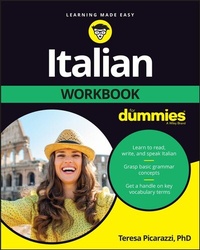
Italian Workbook For Dummies
Description

Italian Workbook For Dummies is for beginners who want to get started learning Italian. Packed with foundational grammar and integrated vocab, Italian Workbook For Dummies will set new language learners on their way to a wonderful experience learning this beautiful romance language. This book provides valuable practice lessons and exercises so that you can learn to write and communicate in Italian with confidence. Italian Workbook For Dummies is also an excellent supplement for any student looking to boost their classroom learning. With the tried-and-true expertise of Dummies, you'll move through the Italian basics with ease.
* Get introduced to the Italian language, including basic grammar and pronunciation
* Complete exercises to improve your ability to write and speak in Italian
* Learn important phrases for travelling, doing business, and studying in Italy
* Build your vocabulary, discover common slang, and learn authentic expressions
This is the perfect Dummies guide for those who are brand new to the Italian language, regardless of age or background. Gain the confidence you need to interact in Italiano!
More details
Other editions
Additional editions
Person
Content
Part 1: Getting Your Bearings with the Basics 5
Chapter 1: Greetings! Getting to Know You 7
Chapter 2: Embedded Gender and Number: Nouns and Articles 19
Chapter 3: Putting Two and Two Together: Numbers, Dates, and Time 33
Part 2: Verbs as Building Blocks 45
Chapter 4: Noting to Be or to Have with Essere and Avere 47
Chapter 5: Forming the Present 61
Chapter 6: Going and Coming with Irregular Verbs 73
Part 3: Building Beautiful Sentences: Parts of Speech 87
Chapter 7: Enriching Adjectives and Adverbs 89
Chapter 8: Comparisons and Superlatives 103
Chapter 9: Prepositions, and Then Some 113
Chapter 10: La Mia Famiglia: Possessive Adjectives and Pronouns 127
Chapter 11: Asking with Interrogatives; Pointing Out with Demonstratives 139
Part 4: More Verb Tenses 149
Chapter 12: Glancing Back at the Past: The Passato Prossimo 151
Chapter 13: Once Upon a Time: The Imperfect 167
Chapter 14: Looking Ahead: The Future Tense 183
Chapter 15: Commanding and the Imperative 195
Chapter 16: Forming and Using Conditional Verbs 211
Chapter 17: Everyday Communication with Reflexives 223
Part 5: The Part of Tens 237
Chapter 18: Ten Practice Dialogues for When You're Out and About in Italy 239
Chapter 19: Ten Common Word Swaps to Avoid 251
Part 6: Appendixes 255
Appendix A: English-Italian Dictionary 257
Appendix B: Italian-English Dictionary 261
Index 265
Chapter 1
Greetings! Getting to Know You
IN THIS CHAPTER
Speaking formally and informally
Pronouncing and stressing words
Working with gender
You've picked up this book because you're interested in learning Italian - molto bene! (great!) Whatever your reasons - heritage, travel, work, food, Italophilia, love of languages - you're in the right place: Benvenute/Benvenuti! (Welcome!)
What are some essential first steps in getting your feet wet in another language? Communication, making yourself understood, and understanding throughout a variety of social situations, as well as creating a solid foundation on which to build.
This chapter provides you with some Italian basics on using formal and informal conventions. I illustrate the formal and informal with communicative exercises that can help you confidently express - whether you're speaking or writing in Italian - greetings and salutations, and forms of courtesy. This chapter also provides a preliminary consideration of pronunciation and gender, two elements you can't do without.
Deciding between Formal and Informal
The Italian language clearly recognizes and requires two different conventions of address, formal and informal, depending on whom you're addressing and also the situation. When you understand what convention to use, you're better equipped to communicate meaningfully, to convey respect for the person, and to also show regard for cultural differences.
The informal is usually designated with the pronouns tu/voi (you) and the formal Lei (you): These pronouns connect concretely to verb forms (see Chapter 4) and possessive adjectives (see Chapter 10). In Italian, you generally use the formal address to write or speak to a stranger, teacher, business acquaintance, customer, waitstaff, salesperson, or boss. You usually use the informal address with family members, friends, people your same age or younger, or children.
Italian is a living language. I can't emphasize enough how important it is for you to practice saying and hearing Italian while you go through this book. Although you need to approach the language holistically and in context, you also need a grasp on the individual parts of the whole, which is where this book comes in.
When meeting someone for the first time, Italians customarily shake hands. When you see someone whom you haven't seen in a while, or when you stop by your aunt's house, Italians customarily kiss each other on both cheeks, first on one side, then the other.
To put formal and informal conventions to use, the following sections walk you through Italian greetings and phrases.
Formal greetings
Use the following formal phrases when you want to meet and greet a stranger, someone whom you don't know very well, and/or someone to whom you should show respect. Use titles when you know what titles apply, such as Dottore/Dottoressa (Doctor), or either Signore (Mr.) or Signora (Mrs.).
Table 1-1 provides you with some terms generally associated with greetings and salutations. While you go through this table, make a mental note (or even underline and highlight) some of the differences and similarities between Table 1-1 and Table 1-2 (in the next section), which provides the informal phrases.
You use buona notte when you know it's actually bedtime; consider it another way of saying, "Have a good sleep." Start to use buona sera in the late afternoon until you go to bed. For example, say it's 10 p.m. and you walk into your hotel. You first greet the concierge by saying, "Buona sera." After you get your key and are on your way to your room, you can say, "Buona notte."
Cut off the final e when using a last name with masculine titles:
- Signore becomes Signor Tarroni.
- Dottore becomes Dottor Costa.
- Professore becomes Professor Gambi.
The title Ms. doesn't exist in Italian, so you use either Signora (Miss) or Signorina (Mrs./Ma'am).
For female professional titles of doctor and professor, you use Dottoressa and Professoressa.
Table 1-1 Formal Greetings and Salutations
English
Italian
Hello/Good morning
Buon giorno/Buongiorno
Hello
Salve
Good afternoon
Buon pomeriggio
Good evening
Buona sera/Buonasera
Good night
Buona notte/Buonanotte
Miss (young woman)
Signorina
Mrs./Ma'am (older married or unmarried woman)
Signora
Mr./Sir
Signore
My name is .
Mi chiamo .
What's your name?
Come si chiama?
How are you?
Come sta?
Where are you from?
Di dov'è?
Sono di .
I'm from .
Well.
Bene.
Very well.
Molto bene.
So-so.
Così così.
Fair/pretty well.
Abbastanza bene.
(I'm) not well.
(Sto) male.
Not bad.
Non c'è male.
Thank you, and you?
Grazie, e lei?
Nice to meet you.
Piacere (di conoscerla).
It's a pleasure.
È un piacere.
It's a great pleasure.
Molto piacere.
The pleasure is mine.
Il piacere è mio.
Goodbye.
Arrivederci.
See you later.
A dopo.
See you soon.
A presto.
See you tomorrow.
A domani.
Have a good day.
Buona giornata.
Have a good evening.
Buona serata.
Here are a few more titles in both their masculine and feminine forms:
- Avvocato/Avvocata (Attorney)
- Giudice (Judge)
- Sindaco/Sindaca (Mayor)
The title Dottore/Dottoressa can have two meanings in Italian: You can use it for someone who has a university degree (meaning a B.A. or a B.S.), as well as for a medical doctor and a person who has a Ph.D. In the United States, the word doctor is reserved for medical doctors and people who have Ph.D.s.
Informal greetings
Use informal phrases when you want to meet and greet a friend, relative, child, people who are younger than you, and (of course) your beloved pet. Notice that you find some overlap between some of the terms in the formal list (see Table 1-1) and the informal list in Table 1-2.
A good rule of thumb is that you use the informal when on a first name basis with someone.
Table 1-2 Informal Greetings and Salutations
English
Italian
Hi.
Ciao.
My name is .
Mi chiamo .
I'm (meaning My name is .)
Sono.
What's your name?
Come ti chiami?
How are you?
Come stai?
Thank you, and you?
Grazie, e tu?
Well.
Bene.
Very...
