

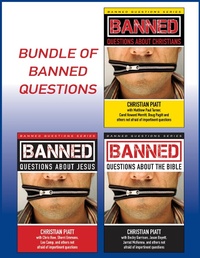
Bundle of Banned Questions
Published on 13. December 2013
644 pages
978-0-8272-0297-9 (ISBN)
Description

Ever get the feeling that you can't ask the hard questions at church? But if we can't ask the tough, keep-you-awake-at-night questions within our faith communities, then what good are those communities? The Banned Question series addresses more than 100 questions about the Bible, Jesus, and Christians from multiple views'and gives you the courage to ask even more questions. Listen in as more than a dozen contributors'whose ranks include a recovering consumer, a religious satirist, and a seminary president'discuss the questions your Sunday school teachers were afraid to answer.
More details
Language
English
Place of publication
Ashland
United States
File size
1,77 MB
ISBN-13
978-0-8272-0297-9 (9780827202979)
Copyright in bibliographic data and cover images is held by Nielsen Book Services Limited or by the publishers or by their respective licensors: all rights reserved.
Schweitzer Classification
Content
- Banned Questions
- Banned Questions About Christians
- Title
- Copyright
- Contents
- Introduction: Why a book about Banned Questions?
- 1. Can you be LGBTQ and be a Christian? A minister? More denominations and Christian communities are welcoming LGBTQ people, as well as ordaining LGBTQ as ministers. Is this really possible?
- 2. Preachers such as Joel Osteen preach about Jesus wanting us to be rich. Where does this belief come from? Wasn't Jesus poor? Didn't he tell rich people to give everything away?
- 3. Where did all of the pictures of the blonde-haired, blue-eyed Jesus come from? Do Christians really think Jesus was white?
- 4. Why do some Christians not seem to believe in science? Can a scientist be a Christian? Have there been famous scientists that were Christians?
- 5. In too many instances, the most gracious, gentle, peaceful, thoughtful, patient, kind, generous, and steadfast people in my life have been non-Christians. Does it really take being a Christian to be Christlike?
- 6. Is Christianity really just about fire insurance? Are we just trying to make sure we don't go to hell when we die? And if personal salvation is a once-and-for-all event, why bother taking part in church after that?
- 7. Some Christians believe the Bible is without error and the only real authority for living, but they ignore parts of the Old and New Testament. Why hold on to six verses on homosexuality but ignore books and chapters about slavery?
- 8. Are Mormons, Jehovah's Witnesses, Seventh Day Adventists, Spiritists, Christian Scientists, etc., really Christians? Who gets to decide?
- 9. Do Christians have to be baptized? Why do some sprinkle while others immerse? Which one is "right"?
- 10. It seems like there's a lot of conflict between Christians and Jews. Wasn't Jesus Jewish? Aren't Christians technically Jewish too?
- 11. If all Christians basically believe the same thing, why do they have so many different denominations? And if there are so many denominations struggling to survive, why don't they just combine with other ones?
- 12. Can someone be both an atheist and a Christian? If "Christian" actually means "follower of Christ," could someone be a student of the life of Jesus without accepting the claims of his divinity, or claims of the existence of any divinity at all?
- 13. Why do so many churches do communion in different ways and on such different schedules? Who is allowed to serve communion? And do all Christians believe the bread and wine/juice actually become the body and blood of Jesus? Why?
- 14. What do Christians believe about disaster and suffering in the world? If God has a plan, why is suffering part of it? How do Christians reconcile suffering in their own lives?
- 15. I've met lots of people who say they are Christian but haven't been to church in a long time. I've even met some who say they were raised Christian but never went to church. Can you be Christian outside of a community of Christians?
- 16. When a baby is conceived, where do Christians believe that soul comes from? Is it created at that moment or has it been floating in existence in the universe from the beginning of time?
- 17. It seems like most Christians focus a lot more on issues of sex and sexuality than any other issues. Why?
- 18. Why does "living a Christian lifestyle" mean people quit drinking alcohol, or cussing, or watching R-rated movies, or listening to secular music?
- 19. I hear Christians say all the time that, good or bad, everything happens for a reason. What about genocide? Famine? Rape? What could the reason possibly be? Does there have to always be a reason?
- 20. What defines someone as an emergent Christian? Is it a worship style? A theology? What is it trying to achieve? Is there a difference between "emerging" and "emergent," or are they synonymous?
- 21. Where does the idea that so many Christians and political leaders maintain about the United States being a Christian nation come from? Do all Christians believe this?
- 22. How is it that so many Christians support-or even call for-wars when one of the names for the Christ they supposedly follow is "Prince of Peace," and Jesus urged love for enemies and nonviolent responses?
- 23. Does somebody have to believe in the literal Resurrection in order to be a Christian?
- 24. Why do Christians focus on the Ten Commandments, but not any of the other laws found in the Old Testament, like those found in Leviticus?
- 25. How do some Christians use their faith to oppose abortion, while also supporting the death penalty or personal gun rights?
- 26. Many Christians describe themselves as "evangelical." What does that mean? Is that the same as being conservative?
- 27. What's different about postmodern Christianity? I hear the word "postmodern" used a lot among Christians, especially younger ones, but it's not clear what is meant by it.
- 28. What do Christians believe about the nature of God? Do they believe that God is a transcendent "Other" that sits out there beyond this reality? If so, does God bridge the gap to deal with human affairs? Can we bridge the gap to reach God? Or is God not a transcendent Other but a part of us? Or some middle ground, something else altogether? Are we a part of God?
- 29. There has been a lot of media attention paid to "end times." What do Christians really believe about the so-called apocalypse described in Revelation?
- 30. Do Christians still believe that wives should submit to their husbands? What do they mean by "submit"?
- 31. Is the Christian God the same God as the God of Islam and Judaism? If not, what's the difference? If so, why have three separate religions?
- 32. Why do so many churches not allow women to serve in positions of leadership? Have they not read the scripture in Galatians 3:28 stating that "there is neither male nor female"?
- 33. Some Christians consider tithing-giving a tithe, or a tenth, of their income-as an obligation. Others have different views about giving. Why the difference of opinion? And does it matter?
- 34. Why are many Christian holidays, such as Christmas and Easter, so closely related to pagan holidays? Are Christians actually pagans?
- 35. What does "ordained" mean with respect to ministry? How does someone get ordained, or get the power to ordain someone else? What, if anything, does it have to do with a perceived call from God? Some churches ordain within the church themselves and other have committees and such. Why are they different?
- 36. What do Christians believe happens after they die, and why? Do they believe they are judged immediately and are ferried off to heaven or hell? What about purgatory?
- 37. To be a Christian, is it necessary to believe that Jesus really (as in factually) healed the blind, made the lame to walk, rose from the dead, and ascended into somewhere called heaven, where he sits with someone he calls his Father? And, if not, why do Christians recite a creed that says that?
- 38. Many Christians believe that Halloween (at least in its present form) is Satanic or the Devil's birthday. Why? Can Christians celebrate Halloween?
- 39. What's the deal with contemporary Christian music?
- 40. Christians talk about doing the will of God and use the Bible as a reason for their actions, but the Bible and tradition list so many things that one could not do all of them at once. Is there an actual Holy Spirit left by Jesus to provide guidance and counsel? If so, how does one "hear" this guidance, and what does it take to have access to it? Can one be led by the Holy Spirit without being a Christian?
- 41. Why is the church growing in Africa and Asia, but declining in Europe and the U.S.?
- 42. Some Christian teachings are easy, such as loving one's neighbor. Others, not so much. For example. the Trinity
- what happens at the end of time
- and salvation (from what? to what?). Can someone be Christian and not clear about very much?
- 43. Is faith healing really a part of the Christian faith today? What about speaking in tongues? Why do some do it and not others?
- 44. Why are there so many symbolic gestures and images throughout some Christian denominations while others claim such acts are akin to idolatry?
- 45. Why is personal/individual salvation emphasized so much more in modern Christianity than global transformation of the world into the just peace realm of God's commonwealth? How can one person be saved while others continue to suffer?
- 46. Why do so many evangelicals seem to feel the term "social justice" is a bad thing? Why is it generally associated with leftist political activism?
- 47. Many Christians read and study the King James Version of the Bible. Some believe it is the best and most accurate translation there is. Why? Can I read a different translation? What about paraphrases such as The Message?
- 48. What does it actually mean when Christians say they believe that Jesus is the Son of God? And how, if at all, is this different from when other people are called "children of God"?
- 49. Do all Christians believe Jesus died for their sins? What exactly does this mean, and where did the belief come from? If some Christians don't believe this, what do they believe about the crucifixion?
- 50. Why does it seem that Christianity gives rise to so many cults- such as Jonestown, the Branch Davidian compound, and so on?
- Contributor List, Bios, and Suggested Resources
- Banned Questions About Jesus
- Title
- Copyright
- Contents
- Introduction: Why a Book about Banned Questions
- 1. Why would God send Jesus as the sacrificial lamb of God, dying for the sins of the world, instead of just destroying sin or perhaps offering grace and forgiveness to the very ones created by God? Why does an all-powerful being need a mediator anyway
- 2. Many Christians embrace the phrase, "I believe Jesus is the Christ, the son of the living God, and I accept him as my personal Lord and Savior," but I can't find this anywhere in the Bible. Where did it come from
- 3. In John 14:6, Jesus says, "I am the way, and the truth, and the life. No one comes to the Father except through me." Do people have to choose to follow Jesus to go to heaven? And what does it mean to choose his way
- 4. Did Jesus ever have sex? Did he have sexual fantasies and desires
- 5. Why did Jesus have to suffer so much before he died? Or did he have to
- 6. What happened during the "missing years" of Jesus' life, unaccounted for in the Bible
- 7. How would we actually know if Jesus came again? Wouldn't we just kill him all over again
- 8. Why should I believe that Jesus was resurrected? What does it mean to the Christian faith if he wasn't resurrected
- 9. A woman in Mark 7:25-30 and Matthew 15:21-28 asks Jesus to heal her daughter, but his first response is to deny her help and call her a dog. Isn't this a cruel, and pretty un-Christlike, response
- 10. Does it really matter if Jesus was born to a virgin or not? What if Mary wasn't a virgin or if Joseph (or someone else) was the father
- 11. Did Jesus really live a life without any sin? What do we base this on? And does it matter? Why
- 12. Why did Jesus cry out "My God, my God, why have you forsaken me?" from the cross? Did God really abandon him? If so, doesn't this mean that Jesus wasn't actually God
- 13. Why doesn't there seem to be any physical evidence of Jesus' life
- 14. In Isaiah, Satan is referred to as the "Morning Star" and so is Jesus in Revelation. In 1 Peter, Satan is compared to a lion, and in Revelation, Jesus too is called a lion. Are these parallels intentional? Why
- 15. Aren't Jesus' miracles similar to other healings and miracles recorded outside the Jewish and Christian tradition
- 16. The Bible says that Jesus had siblings. Does that mean that there are people alive today who are from his family's bloodline? Where are they? Who are they
- 17. When Jesus participates in the Last Supper, doesn't that mean he's eating his own body and drinking his own blood
- 18. Mormons believe that Jesus appeared to thousands of North American natives. Why do so many other Christians not believe this happened
- 19. What's the big deal with the Shroud of Turin? Is it real or fake? If it's fake, why create it in the first place
- 20. Why did Jesus instruct people at times not to tell others who he was? Wasn't this contrary to the idea of spreading the good news of his presence on earth
- 21. Did Jesus understand himself to be God, like God, in line with God, or something else? Did he understand this from birth? If not, then when did he begin to understand it and how
- 22. Is it possible that Jesus married and had children
- 23. If Jesus could resurrect people, why didn't he do it more often
- 24. Galatians 3:22: Is it the faith of Jesus or faith in Jesus that's the key
- 25. Was Jesus a pacifist
- 26. Why would Jesus supply wine for a party as his first "miracle"? Doesn't this seem more like a trick than a miracle? And does this mean he condoned drinking
- 27. Where was Jesus for the time between his death and resurrection
- 28. Most of our images of Jesus portray him with long blond or brown hair, blue eyes, and white skin. But what did Jesus really look like
- 29. Who do people of the Jewish faith believe Jesus was? A prophet? Just a man? Why don't they believe he was the Messiah
- 30. When Jesus was resurrected, why did he still have wounds on his body
- 31. Does Jesus ever refer to the Trinity (Father, Son, and Holy Spirit) in his ministry? If so, does he identify himself as part of that Trinity? If not, where did it come from
- 32. What are the Jesus papers? Are they true? What do they mean to the Christian faith
- 33. In Matthew, Mark, and Luke, Jesus drives the money changers out of the temple just before he dies, but in John, this happens at the beginning of his ministry. Why are these accounts different
- 34. In Mark 9:37, Jesus says, "Whoever welcomes me welcomes not me but the one who sent me." Is Jesus saying here that he is not actually God
- 35. Aside from the women and the disciples, are there any recorded stories of personal interaction between Jesus and other people after he was resurrected? Why wouldn't he appear to more people? And why did he stay on earth for forty days? Is that symbolically important
- 36. Was Jesus ever sick? If so, why not just heal himself
- 37. After Jesus' baptism, he is tempted in the desert several times. How is this different from when he teaches in Matthew 5:28 that "everyone who looks at a woman with lust has already committed adultery with her in his heart"? Aren't these basically the same thing
- 38. In several places in the gospels, Jesus suggests that even he doesn't know when he will return again to earth. Why not? Is God keeping it a secret from him? And if Jesus actually is God, shouldn't he know everything
- 39. Did Jesus believe God wanted him to be crucified? If so, why did he ask God, "My Father, if it is possible, let this cup pass from me" in the garden of Gethsemane
- 40. Was Jesus ever wrong? About what
- 41. Some gospel accounts trace Jesus' lineage to King David through Mary's family, while others trace it through Joseph. Is one of these wrong? And why trace it through Joseph if he wasn't Jesus' father by blood
- 42. Did Jesus study other religions? Which ones
- 43. In John 20:2, it mentions "the other disciple, the one whom Jesus loved." Who is this? Why not name that person? Was it a man or woman? What kind of "love" is the author talking about
- 44. It seems like there are a lot of parallels between the stories of Jesus and the Egyptian mythology character, Horus. Could timelines be wrong somewhere, and could it be that the stories of Horus and Jesus actually are referring to the same person
- 45. Why were books like the infancy gospels of James and Thomas not included in the Bible, especially since they include stories about Jesus' childhood not included in the other gospels
- 46. Jesus forgave people of their sins before he died. How could he do this if he actually had to die in order to save us from sin
- 47. Jesus broke certain biblical laws by healing on the Sabbath, associating with non-Jews, and not keeping all of the kosher laws. So how do we know which rules to follow and which are irrelevant to us today
- 48. Why would God put an unwed teenage mother through the difficulty of pregnancy, childbirth, and trying to explain how she got pregnant
- 49. Why did Jesus heal some people by touching them, some when they touched him, and others without even meeting them? And then why use mud to cure a man from blindness? Did he really need this
- 50. Did Jesus have a clue that people would call him Messiah or God Incarnate? Would he have tolerated these labels
- Contributors List, Biographies, and Suggested Resources
- God Image Survey
- Banned Questions About the Bible
- Title
- Copyright
- Contents
- Introduction: Why a Book about Banned Questions?
- 1. Can I be a Christian if I don't believe the Bible is perfect, handed down directly from God to humanity without error?
- 2. If Adam and Eve were the first (and only) people on Earth, where did their kids' spouses come from? Did they marry each other? And if everyone on Earth but Noah's family was killed in a great flood, did Noah's kids sleep with each other? Isn't this a sin?
- 3. Aren't women treated poorly throughout the Bible? Why would any intelligent modern woman today even want to read the Bible?
- 4. How can a God be all-loving yet allow people to be thrown into hell?
- 5. What does "apocalypse" mean, and does the Bible predict one?
- 6. What does the Bible really say about homosexuality?
- 7. What are the Apocrypha, the Gnostic Gospels, and the Dead Sea Scrolls, and why are they considered holy or sacred by some and not by others?
- 8. Doesn't the Bible condone slavery?
- 9. Was the book of Revelation written in code? Or had the author gone crazy? Was he hallucinating? Were the images portrayed to be taken literally?
- 10. Why haven't any new books been added to the Bible in almost two thousand years? Is there a chance that any new books will ever be added? Why or why not?
- 11. Is it true that the Ten Commandments found in the Bible are almost a copy of the Code of Hammurabi, which has been around longer? Why not just include the Code of Hammurabi instead of having a whole new set of rules?
- 12. Did God write the Bible? If so, why didn't God simply create it miraculously, rather than using so many people over thousands of years to write it down?
- 13. Do Christians need to read the Old Testament? Why?
- 14. Does the Bible ever refer to itself as "the Bible"? If not, where did the name "Bible" come from?
- 15. How do we reconcile the Old Testament command for vengeance (eye for an eye) with Jesus' command to turn the other cheek and love our enemies?
- 16. Is there a right or wrong way to read the Bible?
- 17. How do we reconcile the two different "creation stories" presented in Genesis chapters one and two?
- 18. Since the Bible isn't in alphabetical or chronological order, how did it get in its current order?
- 19. Is there a scriptural basis for God changing God's mind? Why?
- 20. Does God justify violence in scripture? What about genocide?
- 21. Why is the gospel of John so different from the other three gospels?
- 22. Hell, Sheol, Hades, Gehenna, and Tartarus are all labeled as "hell" by most Christians. Are they really the same? Are they all places of fiery torment? Are such things to be taken literally, metaphorically, or as myth?
- 23. Are there secret codes embedded in scripture? What are they?
- 24. How can we begin to take the Bible literally when it seems to contradict itself so often?
- 25. If I don't believe every word of the Bible is literally true, how do I know what to consider in context and what to set aside?
- 26. In the Old Testament, God seems to be actively involved in world events. In the New Testament, God is portrayed as less interventionist but still directly involved. Now, it seems God is much more abstract. What happened, and is this a good or a bad thing?
- 27. Why would a merciful God allow Job's family and fortune to be taken away, and why would God ask Abraham to kill his own son?
- 28. Is it true that both the gospel of John and the book of Revelation almost weren't canonized (included in the Bible)? Why? Who got to decide which books would be included in the Bible, and what rules did they use to decide?
- 29. Are Lucifer, the Adversary, Satan, the Beast, and the Antichrist all the same? If so, why use so many names? If not, what are their different roles, and who is in charge?
- 30. Was Mary Magdalene a prostitute?
- 31. Where are all the miracles today? If they were so prevalent in biblical times, why don't any happen today? Or do they, and we just don't notice?
- 32. Are there any mistakes in the Bible? Like what?
- 33. In some cases, Paul (the purported author of many New Testament books) seems to support women in leadership roles in church, and in others, he says they have no place. Which is it? And why the seeming contradiction?
- 34. Is God "in control"? If so, does that mean God made (insert horrible thing here) happen to pull off a greater plan? Why doesn't God intervene in a disaster?
- 35. Why do so many religions seem to have such similar fundamental stories, like the flood and creation stories? Are they from a common source?
- 36. Is it true that the word "Satan" is never used in the Bible to refer to an evil spirit? If so, where did the word come from?
- 37. Why is it considered immoral to get married or to have sex before age eighteen today, yet in biblical times, people (including Mary) did this all the time?
- 38. Does the Bible call for sexual purity? If so, what qualifies as pure and impure?
- 39. What is the sin of Onan, and why is it bad?
- 40. Are some sins worse or better than others?
- 41. Who gets to decide which laws in the Bible are irrefutable, which laws are out of date, and which laws should be applied only in certain situations?
- 42. Were there gay couples in the Bible? What about Jonathan and David?
- 43. If people have to be Christians to go to heaven, what happens to all of the people born before Jesus or who never hear about his ministry?
- 44. There are many stories recorded throughout scripture in which only one or two people were around. If so, did they write down their own stories? If not, how do we know that what is written is what happened?
- 45. Why would an all-knowing God begin the process of creation knowing that it would be corrupted by evil and lead to so much heartache?
- 46. Why would stories about a father murdering his daughter (Judg. 11) or handing his daughters over to a crowd to be raped and killed (Gen. 19) be included in the Bible?
- 47. Why are there so many completely different interpretations of the same scripture passages?
- 48. Do women need to follow the commands of 1 Peter and submit to their husbands? Why? What does it mean to submit?
- 49. What is the thorn in his side that Paul describes?
- 50. Why are (or were) the Jewish people God's chosen people? Why not someone else? Are Christians now God's chosen people?
- Contributors List, Biographies, and Suggested Resources
- God Image Survey
