

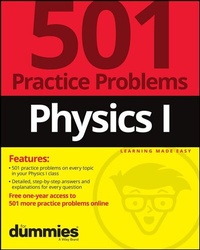
Physics I: 501 Practice Problems For Dummies (+ Free Online Practice)
Description

Overcome your study inertia and polish your knowledge of physics
Physics I: 501 Practice Problems For Dummies gives you 501 opportunities to practice solving problems from all the major topics covered you Physics I class-in the book and online! Get extra help with tricky subjects, solidify what you've already learned, and get in-depth walk-throughs for every problem with this useful book. These practice problems and detailed answer explanations will help you succeed in this tough-but-required class, no matter what your skill level. Thanks to Dummies, you have a resource to help you put key concepts into practice.
- Work through practice problems on all Physics I topics covered in school classes
- Step through detailed solutions to build your understanding
- Access practice questions online to study anywhere, any time
- Improve your grade and up your study game with practice, practice, practice
The material presented in Physics I: 501 Practice Problems For Dummies is an excellent resource for students, as well as parents and tutors looking to help supplement Physics I instruction.
Physics I: 501 Practice Problems For Dummies (9781119883715) was previously published as Physics I Practice Problems For Dummies (9781118853153). While this version features a new Dummies cover and design, the content is the same as the prior release and should not be considered a new or updated product.
More details
Other editions
Additional editions
Content
- Intro
- Title Page
- Copyright Page
- Table of Contents
- Introduction
- What You'll Find
- How This Workbook Is Organized
- Part 1: The Questions
- Part 2: The Answers
- Beyond the Book
- Where to Go for Additional Help
- Part 1 The Questions
- Chapter 1 Reviewing Math Fundamentals and Physics Measurements
- The Problems You'll Work On
- What to Watch Out For
- Equipping Yourself with Basic Algebra
- Tackling a Little Trigonometry
- Converting between Units
- Practicing Scientific Notation
- Understanding Unit Prefixes
- Spotting the Number of Significant Digits
- Rounding to the Correct Number of Digits
- Chapter 2 Moving along with Kinematics
- The Problems You'll Work On
- What to Watch Out For
- Determining Displacement Using Positions in One Dimension
- Getting Displacement in Two Dimensions with Axes
- Traveling with Average Speed and at Instantaneous Speed
- Distinguishing between Average Speed and Average Velocity
- Speeding Up and Down with Acceleration
- Finding Displacement with Acceleration and Time
- Finding Displacement with Acceleration and Velocities
- Finding Acceleration with Displacement and Time
- Finding Acceleration with Velocities and Displacement
- Finding Velocities with Acceleration and Displacement
- Chapter 3 Moving in a Two-Dimensional World
- The Problems You'll Work On
- What to Watch Out For
- Getting to Know Vectors
- Adding and Subtracting Vectors
- Adding Vectors and Subtracting Vectors on the Grid
- Breaking Vectors into Components
- Reassembling a Vector from Its Components
- Describing Displacement, Velocity, and Acceleration in Two Dimensions
- Moving under the Influence of Gravity: Projectile Launched Horizontally
- Moving under the Influence of Gravity: Projectile Launched at an Angle
- Chapter 4 Pushing and Pulling: The Forces around You
- The Problems You'll Work On
- What to Watch Out For
- Resisting Motion with Newton's First Law
- Forcing a Massive Object to Accelerate
- Drawing Free-Body Diagrams
- Adding Forces Together to Obtain the Net Force
- Moving a Distance with the Net Force
- Finding the Needed Force to Speed Up
- Pairing Up Equal and Opposite Forces
- Overcoming Friction by Pulling Hard
- Pulling in a Different Direction with Pulleys
- Balancing the Forces to Find Equilibrium
- Chapter 5 Slipping and Sliding: Motion and Forces
- The Problems You'll Work On
- What to Watch Out For
- Finding the Gravity along a Slope
- Moving Fast with Gravity down a Slippery Slope
- Getting Unstuck with the Coefficient of Friction
- Starting Motion with Static Friction
- Keeping on Moving with Kinetic Friction
- Pushing and Pulling on a Non-Slippery Slope
- Covering the Distance on a Non-Slippery Slope
- Shooting Objects Straight Up to the Maximum Height
- Taking the Time to Go Up and Down
- Shooting at an Angle: Separating the Motion in Components
- Reaching Far with a Projectile
- Chapter 6 Describing Rotational Motion
- The Problems You'll Work On
- What to Watch Out For
- Keeping a Constant Speed around a Circle
- Measuring Angles in Radians
- Traveling in a Circle with Angular Velocity
- Speeding Up and Down around a Circle with Angular Acceleration
- Accelerating toward the Center with Centripetal Acceleration
- Providing the Centripetal Force Based on Mass, Velocity, and Radius
- Chapter 7 Rotating Around in Different Loops
- The Problems You'll Work On
- What to Watch Out For
- Turning on a Flat Road with a Little Help from Friction
- Making a Banked Turn in Debt to Normal Force
- Applying the Law of Universal Gravitation to the Stars
- Accelerating with Gravity Near a Planet's Surface
- Finding the Speed of the Satellites in Circular Orbits
- Taking the Time to Travel around Celestial Bodies
- Moving Fast to Avoid Falling Off in a Vertical Loop
- Chapter 8 Going with the Flow: Fluids
- The Problems You'll Work On
- What to Watch Out For
- Getting Denser with More Mass Packed Together
- Comparing Densities Using Specific Gravity
- Applying Pressure with a Force
- Working under Pressure: Calculating the Pressure at a Depth
- Passing on Pressure with Pascal's Principle
- Floating with Archimedes' Principle
- Distinguishing Different Types of Flow
- Flowing Faster with a Smaller Pipe
- Relating Pressure and Speed with Bernoulli's Equation
- Putting It All Together with Pipes
- Chapter 9 Getting Some Work Done
- The Problems You'll Work On
- What to Watch Out For
- Applying Force in the Direction of Movement
- Applying Force at an Angle
- Applying Force in the Opposite Direction of Motion
- Finding the Kinetic Energy of a Moving Object
- Turning Work into Kinetic Energy
- Banking on Potential Energy by Working against Gravity
- Cashing Out Potential Energy to Kinetic Energy
- Maintaining the Total Mechanical Energy
- Gaining Power by Doing More Work Faster
- Powering Up with Speed
- Chapter 10 Picking Up Some Momentum with Impulse
- The Problems You'll Work On
- What to Watch Out For
- Applying Force for a Period of Time: Impulse
- Gathering Momentum in All Directions
- Supplying Impulse to Change Momentum
- Finding Force from Impulse and Momentum
- Conserving Momentum during Collisions
- Sticking Together: Finding the Velocity in Inelastic Collisions
- Finding the Initial Velocity of Collisions
- Colliding Elastically along a Line
- Colliding Pool Balls: Elastic Collisions in Two Dimensions
- Chapter 11 Rolling Around with Rotational Kinetics and Dynamics
- The Problems You'll Work On
- What to Watch Out For
- Linking Linear and Tangential Motion with Radius
- Finding Centripetal Acceleration
- Figuring Out Angular Velocity and Acceleration
- Twisting Around with Torque
- Lifting Some Weights: An Exercise in Rotational Equilibrium
- Hanging Signs up and Keeping the Torques Balanced
- Leaning against the Wall with Help from Friction
- Converting Tangential Acceleration to Angular Acceleration in Newton's Second Law
- Looking into Mass Distribution to Find Moments of Inertia
- Relating Torque, Angular Acceleration, and Moments of Inertia
- Putting a Spin on Work
- Rolling with Rotational Kinetic Energy
- Finding Rotational Kinetic Energy on a Ramp
- Conserving Angular Momentum
- Chapter 12 Bouncing with a Spring: Simple Harmonic Motion
- The Problems You'll Work On
- What to Watch Out For
- Compressing and Stretching Springs: The Spring's Restoring Force
- Getting around the Equilibrium
- Riding the Sine Wave of Simple Harmonic Motion
- Finding Period and Frequency
- Linking Position, Velocity, and Acceleration
- Finding the Period of a Mass on a Spring
- Taking Energy into Account in Simple Harmonic Motion
- Swinging with Pendulums
- Chapter 13 Heating Up with Thermodynamics and Heat Transfer
- The Problems You'll Work On
- What to Watch Out For
- Measuring Temperature in Different Ways
- Getting to the Coldest Zone
- Expanding with the Heat: Getting Longer
- Expanding with the Heat: Taking Up More Space
- Changing the Temperature with Energy Flow
- Gaining or Losing Energy to Change into a New Phase
- Rising with the Hot Fluid in Convection
- Getting in Touch with Thermal Conduction
- Working with Thermal Conductivity
- Radiating with Black Bodies
- Chapter 14 Living in an Ideal World with the Ideal Gas Law
- The Problems You'll Work On
- What to Watch Out For
- Finding Number of Molecules in Moles with Avogadro's Number
- Working with Boyle's Law When Temperature Is Constant
- Working with Charles's Law When Pressure Is Constant
- Relating Pressure, Volume, and Temperature with the Ideal Gas Law
- Calculating the Kinetic Energy of the Ideal Gas Molecules
- Chapter 15 Experiencing the Laws of Thermodynamics
- The Problems You'll Work On
- What to Watch Out For
- Conserving Energy Using the First Law: Heat and Work
- Staying at Constant Pressure in Isobaric Processes
- Staying at Constant Temperature in Isothermal Processes
- Staying at Constant Volume in Isochoric Processes
- Staying at Constant Heat in Adiabatic Processes
- Putting Heat to Work with Heat Engines
- Evaluating Efficiency of Heat Engines
- Going against the Flow with Heat Pumps
- Part 2 The Answers
- Chapter 16 Answers
- Index
- EULA
