

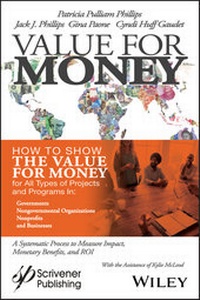
Value for Money
Description

More details
Other editions
Additional editions
Persons
Patricia Pulliam Phillips, PhD is an internationally recognized author, consultant, and president and CEO of ROI Institute, Inc. Phillips provides consulting services to organizations worldwide. She has been an author or editor of more than a hundred books and numerous journal articles, and her work has been featured on MSNBC and EuroNews.
Jack J. Phillips, PhD is chairman of ROI Institute and a world-renowned expert on measurement and evaluation. Phillips, a former bank president, is also the author or editor of more than a hundred books and has provided consulting services in 70 countries. His work has been featured in the Wall Street Journal, Bloomberg Businessweek, Fortune, and on CNN.
Gina Paone joined the International Monetary Fund in February 2011 after nearly eleven years with the United Nations World Food Programme based in Rome, Italy and 10 years in the private sector in a marketing capacity based in Toronto, Canada. She is currently the Division Chief, Talent Acquisition and Operations.
Cyndi Huff Gaudet, PhD, is director of the School of Interdisciplinary Studies and Professional Development at The University of Southern Mississippi's Gulf Park campus, a scholar-practitioner managing projects integrating the ROI Methodology, and a recognized national expert helping organizations implement a systematic approach for developing human capital
Content
Praise for Value for Money v
Foreword xxv
Preface xxvii
Value is Changing... xxvii
Need for a New Approach xxviii
The ROI Methodology: The Enhanced Logic Model xxix
We Can't Measure Our Way to Success xxx
Flow of the Book xxxi
Acknowledgements xxxv
Authors xxxviii
1 The Value Evolution 1
The Value Shift 4
Why Now? 8
Challenges Along the Way 16
Final Thoughts 19
2 Six Ways to Show Value for Money 21
Six Ways to Show Value for Money 25
Barriers to Showing Value for Money 32
Final Thoughts 38
3 Needed: An Enhanced Logic Model 39
A Review of Models 42
Concerns about Current Models 47
How Does Your Current Model Stack Up? 60
Requirements for the Value for Money: A Measurement Process 64
ROI Methodology 65
Terminology: Projects, Solutions, Participants 66
Final Thoughts 67
4 Introducing the ROI Methodology 69
Types of Data 70
The Initial Analysis 75
Using Design Thinking to Deliver and Measure Results 77
The ROI Process Model 78
Operating Standards and Philosophy 87
Implementing and Sustaining the Process 87
Benefits of this Approach 88
Final Thoughts 91
5 Start with Why: Align Programs with the Business 93
Impact Measures are Critical 96
The Challenge 97
The Alignment Model 98
Payoff Needs 99
Business Needs 109
Final Thoughts 118
6 Make it Feasible: Select the Right Solution 119
Performance Needs 122
The Performance Dialogue 122
Use Analysis Techniques 125
Learning Needs 131
Preference Needs 134
Matching Solutions to Needs 135
The Matrix Diagram 136
Selecting Solutions for Maximum Payoff 138
Final Thoughts 140
7 Expect Success: Design for Results 141
The Power of Expectations 144
Defining the Success of Programs 147
Designing for Results at Each Level 149
Developing Objectives at Multiple Levels 152
The Power of Objectives 160
Defining Roles and Responsibilities 162
Planning the Evaluation 166
Final Thoughts 172
8 Make it Matter: Design for Input, Reaction, and Learning 173
Communicating with Results in Mind 174
Changing the Role of Participants 177
Creating Expectations 178
Think ROI 181
Design Input for Results 183
Design Reaction for Results 187
Design Learning for Results 193
Data Collection for Input, Reaction, and Learning 194
Timing of Data Collection 197
Final Thoughts 199
9 Make it Stick: Design for Application and Impact 201
Data Collection for Application and Impact 204
Monitoring Business Performance Data 219
Selecting the Appropriate Method for Each Level 222
Timing of Data Collection 224
Built-In Application Tools 226
Involving the Participants' Manager or Significant Other 230
Final Thoughts 235
10 Make it Credible: Isolate the Effects of the Program 237
The Importance of Pinpointing the Contribution 240
Preliminary Issues 242
Quantitative and Research Isolation Methods 244
Qualitative Isolation Methods 254
Select the Method 263
Final Thoughts 264
11 Make it Credible: Convert Data to Monetary Value 265
The Importance of Monetary Value 267
Key Steps in Converting Data to Money 270
Standard Monetary Values 272
When Standard Values are Not Available 281
Selecting the Technique 290
Final Thoughts 295
12 Make it Credible: Identify the Intangibles 297
Why Intangibles are Important 299
Measuring and Analyzing Intangibles 304
Final Thoughts 313
13 Make it Credible: Capture Costs of the Program and Calculate ROI 315
The Importance of Costs and ROI 319
Fundamental Cost Issues 320
Specific Costs to Include 325
Cost Tabulation in Action 328
The ROI Calculation 333
Other ROI Measures 342
Final Thoughts 343
14 Tell the Story: Communicate Results to Key Stakeholders 345
The Importance of Communicating Results 352
Principles of Communicating Results 355
The Process for Communicating Results 357
Step 1: Analyze Reason for Communication 359
Step 2: Plan for Communication 359
Step 3: Select Audience 360
Step 4: Develop Reports 363
Step 5: Select Media 363
Step 6: Present Information 370
Step 7: Analyze Reaction 378
Final Thoughts 379
15 Optimize Results: Use Black Box Thinking to Increase Funding 381
Process Improvement is the Key: Black Box Thinking 383
Making Adjustments in Programs 387
The Timing of Changes 390
Increasing ROI 393
Influencing Allocation 396
Final Thoughts 400
16 Forecast the ROI 401
The Importance of Forecasting ROI 407
The Trade-Offs of Forecasting 411
Pre-Program ROI Forecasting 413
Forecasting with a Pilot Program 422
ROI Forecasting with Reaction Data 423
Forecasting Guidelines 427
Final Thoughts 429
17 Make it Work: Sustaining the Change to a Results-Based Process 431
Overcoming Resistance 433
Assess the Climate 434
Develop Roles and Responsibilities 434
Establish Goals and Plans 436
Revise Guidelines and Procedures 438
Prepare the Team 440
Initiate ROI Studies 441
Prepare the Management Team 442
Remove Obstacles 443
Monitor Progress 445
Final Thoughts 446
References 447
Appendix A 459
Appendix B 467
Appendix C 471
Index 473
Preface
Value is Changing .
Bill and Melinda Gates, cofounders of the world's largest foundation, dedicated their 2017 annual letter to Warren Buffett. He donated the largest amount of money in the history of the Gates Foundation. In a cordial way, Buffett had asked the Gateses to describe the results of this contribution-essentially, he was asking for the value for money.
In their annual letter, the Gateses began with Buffett's correspondence to them. They then showed the return on his investment. Essentially, the annual letter was Warren Buffett's ROI for the roughly $30 billion investment in the Gates Foundation. The letter focused on the impacts of their various grants and initiatives. For one initiative, they actually showed the financial return on investment. This single act of responsibility and accountability portrays what is happening across the public and social sectors. Foundations, nonprofits, governments, nongovernmental organizations, religious institutions, universities, associations, and others are being held to higher levels of accountability than ever before.
Chaplains in hospital settings are being asked to show the value they deliver to healthcare organizations, otherwise, they face a reduction in numbers. The United Methodist Church is stepping up to this challenge by preparing chaplains to show the value of what they do in terms that funders can understand. This often means value for money and, in some cases, the financial ROI.
The president of the University of Malaysia Putra is asking the head of the library to show the ROI for all of the database subscriptions. Subscriptions represent an almost $20 million investment each year. "After all, isn't all of this information on the Internet?" asked the president. This prompted the head of the library to show the ROI of having the database from the perspective of the students and faculty.
The largest foundation in Saudi Arabia, and one of the largest in the Middle East, is planning a conference for nonprofits. The theme of the conference is "Measuring the ROI for Non-Profits." Part of the plans for this conference is to not only teach and show examples of how and why to measure ROI, but to also offer ROI Certification for nonprofit leaders so they can build internal capability to show value for money for the contributions they receive.
Various government agencies are facing tremendous accountability issues. The IT function within the Social Security Administration in the United States has been asked to show the ROI for major IT projects. Otherwise, its $1.3 billion investment would be in jeopardy. One intelligence agency is being asked to show the impact and ROI of a master's degree program offered to high-potential employees on agency time, paid by the agency.
Alberta Health Services, the largest provincial health system in Canada, has challenged its Healthy Living group to show the impact and ROI of their various programs. Demonstrating such results comes with the prospect of allocating more funds into the preventive-type programs that they advocate and organize.
These, and hundreds of other examples, show what is happening in the public sector. Accountability is required in areas unaccustomed to demonstrating value beyond the activities they offer. This is caused, in part, by four major trends:
- Budgets are constrained, reduced, and tightly monitored, more so than any time in the past.
- There is more competition for funding within an organization than ever before, and the competition frequently makes a compelling case for portions of budgets other than their own.
- Organizations are moving from activities to results and on to fact-based outcomes, and sometimes to the financial ROI.
- Donors and funders are requesting more accountability for their contributions. For government, it's the taxpayers. For foundations, charities, and nonprofits, it's the donors. And for businesses, it's shareholders and top executives.
These trends are a reality for many organizations and will likely continue. In fact, we anticipate that they will become even more pronounced.
Need for a New Approach
Moving toward fact-based outcomes is a challenge to all organizations as they attempt to show the value for the money that they receive. This book shows six ways to show value for money; some of the ways are closely related or interconnected. Of the six ways, the most credible is the ROI calculation. This is accomplished by following steps in cost-benefit analysis, an economic theory grounded in public finance. Development of the ROI metric follows standards and assumptions that meet financial officer approval.
ROI is not always necessary for public sector programs. Although, in theory, it can be accomplished, only a small number of projects deserve this level of analysis. This book describes how to take the analysis all the way through to the ROI calculation. A few shortcuts are possible, which creates a basis for some of the other ways to show the value. While the ultimate demonstration of value for money is ROI, it is reserved for specific types of projects.
The ROI Methodology: The Enhanced Logic Model
The classic logic model has served organizations quite well for many years, particularly those in the public sector. This book presents an enhanced version of the logic model, responding to needs not addressed with, and concerns about, the classic logic model. Although this classic model has been successful, times have changed, and the accountability needs have shifted. The model presented here, the ROI Methodology, addresses these needs and the needs for measurement and evaluation across the spectrum of organizations. Chapter 3 in this book is devoted to why a new evaluation system is needed.
The ROI Methodology has been evolving for some time. Initially, it was developed in the business sector to help executives see value for money in terms they could understand, appreciate, and support. Along the way, it attracted the attention of governments-with 26 federal governments adopting and using this methodology. Many nongovernmental organizations (NGOs) have adopted it, such as the United Nations, which started using this method with a UN General Assembly resolution in 2008. Nonprofits are using it, including charities, foundations, associations, and religious organizations. Approximately 300 healthcare organizations are now using the process, sparked in part by the book Measuring ROI in Healthcare (McGraw-Hill, 2013). About 150 universities are using it to show the value of their internal processes as well as external outreach programs and services. Grant writers are now suggesting that if you can wrap ROI around your proposal and deliver impact and ROI data to the organization providing the grant money, you double your chances of receiving the grant. John White, one of the premier grant writers in the United States, agrees [1]. The ROI Methodology has been very successful and has become the most used evaluation system in the world.
This book responds to a need for a system that tackles these widespread applications head-on, with the emphasis on the public arena while not losing sight of the business applications. This book attempts to do what no other book has attempted: present a methodology that crosses boundaries of different functional areas and professional fields, types of organizations, cultures, and countries to have one system that can be used in those environments. The ROI Methodology is a proven process in those areas already, and this book brings that experience and focus to readers.
This will be a book that can help those who are measuring the success of any type of project, program, initiative, system, procedure, event, or process in these types of organizations:
- Publicly traded businesses
- Privately held businesses
- Governments (federal, state, and local level)
- Nongovernment organizations
- Nonprofits
- Universities
- Community colleges and technical institutes
- K-12 school systems
- Foundations
- Charities
- Trusts
- Networks and alliances
- Associations
- Religious organizations
The ROI Methodology is a flexible, versatile process that can withstand the scrutiny of critics, while providing CEO and CFO friendly data through a process that is user-friendly.
Whether it is a development program in East Africa, an economic development activity for Oman, a cultural event in Brussels, a military operation in South Africa, a UN peacekeeping mission in Lebanon, a women's initiative in Brazil, a medical procedure in Canada, or a faith-based initiative in the United States, this process will be useful for delivering and demonstrating value for money.
We Can't Measure Our Way to Success
Many of us in the measurement and evaluation profession have suggested, encouraged, and supported more measurement and evaluation. We, the authors of this book, have tackled this in different ways and through different media channels. Our premise has been that when evaluators measure at the business level, they also make adjustments and improve programs. However, four challenges have prevented the needed change: 1) fear of the outcomes, which prevents program owners from making needed adjustments; 2) the task of measurement appears impossible, as it will be difficult to collect needed data; 3) exposing concern of a flawed system that no one wants to correct; and 4) resources needed to measure, underscoring a lack of funds to support the...
