

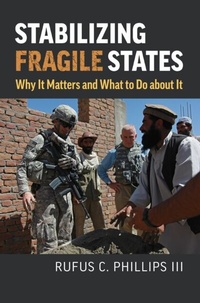
Stabilizing Fragile States
Why It Matters and What to Do about It
1st Edition
Published on 9. July 2022
348 pages
978-0-7006-3305-0 (ISBN)
Description

Stabilizing Fragile States: Why It Matters and What to Do About It is a masterclass on intervening to help fragile states stabilize in the face of internal challenges that threaten national security and how the United States can do better at less cost with improved chances of success. Written from the point of view of an on-the-ground practitioner after exceptional government and voluntary service abroad, Rufus C. Phillips III uses his experience to explain why US efforts to help fragile countries stabilize is important to national security.
Helping stabilize fragile states has been too much of a poorly informed, impersonal, technocratic, and conflicted process that has been dominated by reactions to events and missing a more human approach tailored to various countries' circumstances. In his book, Phillips explains why we have not been more successful and what it would take to make our stabilization efforts effective, sustainable, and less expensive.
Recent US involvements have ranged in intensity and size from Colombia, which did not put US boots on the ground, to massive interventions in Iraq and Afghanistan, which did. The lack of success in Afghanistan and Iraq has tended to dominate the national conversation about dealing with fragile states. Stabilizing Fragile States provides a thorough analysis of what has gone wrong and what has gone right in US involvement.
• Stabilizing fragile states is more of an unconventional political and psychological endeavor requiring an operational mindset rather than conventional war or normal diplomacy.
• Defines the focus of counterinsurgency not as killing insurgents but as a positive effort to win local people's support by involving them in their own self-defense and political, social, and economic development.
• Americans must understand the religious, historical, political, and social context of the host country and be consistent, patient, and persistent in what they do.
• Security-force training in host countries must include respect for civilians and the definition by their leadership of a national cause that the trainees believe is worth risking their lives to defend.
• Recommends creating a dedicated cadre of expeditionary diplomacy and development professionals in Department of State/USAID and a special training school as an addition to the Global Fragility Act.
Helping stabilize fragile states has been too much of a poorly informed, impersonal, technocratic, and conflicted process that has been dominated by reactions to events and missing a more human approach tailored to various countries' circumstances. In his book, Phillips explains why we have not been more successful and what it would take to make our stabilization efforts effective, sustainable, and less expensive.
Recent US involvements have ranged in intensity and size from Colombia, which did not put US boots on the ground, to massive interventions in Iraq and Afghanistan, which did. The lack of success in Afghanistan and Iraq has tended to dominate the national conversation about dealing with fragile states. Stabilizing Fragile States provides a thorough analysis of what has gone wrong and what has gone right in US involvement.
• Stabilizing fragile states is more of an unconventional political and psychological endeavor requiring an operational mindset rather than conventional war or normal diplomacy.
• Defines the focus of counterinsurgency not as killing insurgents but as a positive effort to win local people's support by involving them in their own self-defense and political, social, and economic development.
• Americans must understand the religious, historical, political, and social context of the host country and be consistent, patient, and persistent in what they do.
• Security-force training in host countries must include respect for civilians and the definition by their leadership of a national cause that the trainees believe is worth risking their lives to defend.
• Recommends creating a dedicated cadre of expeditionary diplomacy and development professionals in Department of State/USAID and a special training school as an addition to the Global Fragility Act.
All prices
More details
Other editions
Additional editions
Book
06/2022
University Press of Kansas
€79.42
Shipment within 15-20 days
Person
Rufus C. Phillips III is a retired political action and counterinsurgency expert with significant foreign experience. His previous work includes Why Vietnam Matters: An Eyewitness Account of Lessons Not Learned.
Content
Foreword by H. R. McMaster
Series Editor's Foreword
Preface
List of Abbreviations for Key Terms and Organizations
Introduction
Part I. Understanding the Challenge
1. Background
2. Significant Factors
3. Public Support
4. Essential Ideas and Terms
Part II. Interventions
5. Cold War Cases
6. Iraq
7. Afghanistant
8. Colombia
Part III. How to Do Better
Existing Capabilities and Organizational Change
10. Organizing for Better Assistance
11. Mission and Roles
12. Recruitment, Education, and Training
13. Field Organization, Operations, and Financing
14. Stabilization Strategy and Implementation in a Hypothetical State
15. The Future
Appendix: Proposed Education and Training Program
Acknowledgments
Notes
Bibliography
Index

