

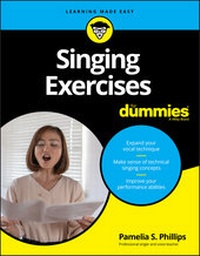
Singing Exercises For Dummies
Description

Some people are born with naturally beautiful voices, but even the best can get better by applying training that can make a performance truly soar. Singing Exercises For Dummies shows you how to do just that. Following the drills and exercises found both in the book and online examples, you'll be able to refine your technique; develop consistency, power, and endurance; and increase your vocal range so you can achieve a voice that stands out from (and always wows) the crowd!
Professional singing coach and respected performer Pamelia S. Phillips is your friendly tutor and guide, starting you out with warm-ups and instructions on correct posture before leading you melodically through the intricacies of scales, chords, rhythm, pitch, tone, and much, much more.
* Advance your technique and control
* Work out your range
* Harmonize with others
* Practice like a pro
Whether you're studying under a tutor or are working to your own plan, Singing Exercises For Dummies will have you quickly scaling up the ladder to vocal perfection--and even more!
P.S. If you think this book seems familiar, you''re probably right. The Dummies team updated the cover and design to give the book a fresh feel, but the content is the same as the previous release of Singing Exercises For Dummies (9781118281086). The book you see here should'n't be considered a new or updated product. But if you''re in the mood to learn something new, check out some of our other books. We''re always writing about new topics!
More details
Other editions
Additional editions
Person
Content
Introduction
Singing is an amazing sport that can provide you with hours of entertainment. But developing your singing skills takes time and practice. This book is here to help you expand your singing technique with exercises specifically designed to address the most common aspects of singing. These exercises provide a great practice routine for you to use every day or when you need to brush up on a skill. Whether you want to sing just for fun or you have dreams of breaking out as a singing sensation, Singing Exercises For Dummies is for you.
About This Book
Whether you sing pop music or you're auditioning for the local chorus, Singing Exercises For Dummies has what you need to refine your singing technique. The exercises in these pages, which range from easy to pretty hard, cover the most common topics in singing and are designed for any type of singer singing any style of music. They're also the same type of exercises that you may expect to sing during a voice lesson or in a singing class. If you can't afford to pay for lessons on a regular basis, this book can help you continue to refine your technique on your own at home.
In addition to exercises, Chapters 5 through 14 also feature practice pieces - short songs I've written to help you practice applying a specific singing technique. They all have accompanying audio tracks and a singer who demonstrates the correct sounds for you so you know the sound that goes with the text that you read in the chapter. You will find these tracks on the book's website at www.dummies.com/go/singingexercisesfd. The combination of exercises and practice pieces provides a variety of ways to practice your technique.
The audio tracks are demonstrations of the music figures you see in the chapters. Some of the tracks have only the piano playing the figure for you so that you can make the sounds on your own; the text in the chapter lets you know which tracks you won't hear a singer on.
I've organized the material so that you don't have to read the book from cover to cover. Instead, you can review the table of contents to find the technique you want or need to work on most and head straight to that section. For example, if you have trouble transitioning between different vocal registers, you can proceed directly to Chapter 11 for help. Or you can work through all the practice exercises for a complete vocal workout that builds on itself.
Conventions Used in This Book
I use common singing terms throughout this book, but I define them for you in case you haven't seen them before. You can also expect to see the following conventions:
- Key signatures: Each figure includes a key signature so you know exactly where to sing that particular pattern. Don't worry if you don't know key signatures; for those patterns with audio tracks, you can still follow along with the piano and/or singer.
- Pattern repetitions: Most figures in the book show all the repetitions of the patterns, but some larger figures show only the ascending or descending versions of the patterns. Rest assured that you can hear all the repetitions on the audio tracks.
- Phonetic spellings for vowels: The English alphabet has five vowels - A, E, I, O, and U - but each of those vowels may make more than one sound based on how they're combined with other vowels or consonants in a word. I use the phonetic spellings of the various vowel sounds to help you understand exactly which vowel sound you're supposed to make. (Note: The sound the letter a makes in the word cat is different from the a in the word father. When you see this a, know that the vowel sound you're going for is like the a in cat.)
- Practice exercises and other figures: Some of the figures in this book help you practice a particular exercise, and some of them provide basic singing information or practice for you. A black box with a track number tells you which exercises have an accompanying audio track. If you don't see a black track box, you know that example is a figure that's explained in the chapter but doesn't have audio. Note: A lot of the time, music is written in treble clef for guys even though they sing the notes an octave lower. Guys, when you see the music written in treble clef, just know that you sing it down an octave unless instructed otherwise. In some exercises in the book, I ask you to sing the music as written - not down an octave.
- Singers on the tracks: Many of the exercises have accompanying audio tracks where a singer demonstrates the sounds of the patterns for you. I include both male and female singers, as well as different voice types. The text accompanying each exercise tells you whether you hear a singer or you get to practice the figure on your own.
- Song lists: At the end of most of the chapters in this book, I include a list of songs that you can use to help you practice the different techniques covered in the rest of the chapter. If a song's text is gender specific or if it's for a role that's gender specific, I mention that gender. Otherwise, I list either. You can work on any song you like, but you may want to note the gender-specific information if you want to perform the song. To help you learn a song, I recommend you get the sheet music first so you can practice singing along with the notation without hearing a recording. You can find sheet music at your local music store or online.
What You're Not to Read
Throughout the text, I include helpful tips for performing each exercise, but if you're in a hurry and you just want to get to singing, feel free to perform the exercises along with the audio tracks. You can always go back to the tips later.
Foolish Assumptions
I made the following assumptions about you when writing this book:
- You really like singing and want some help with developing your technique.
- You have some prior knowledge about singing - whether from singing in a choir, taking lessons, or reading my book Singing For Dummies (Wiley) - and you want to take your skills to the next level.
- You sing all kinds of music and don't limit yourself to just one style (such as classical, country, pop, or gospel).
- You'll use the audio tracks for a long time, which is why the exercises range from really easy to pretty hard. That way, they can keep you challenged now and later.
How This Book Is Organized
This book is organized into five parts, each of which contains specific topics about singing. Each chapter in the part contains details about how to develop that part of your singing technique with exercises that correspond to the explanation.
Part 1: Preparing Your Body for Practicing
Practicing singing is like practicing any other sport because you need to warm up your body and voice. After all, your singing voice will last longer during your practice session and won't tire out as easily if you take the time to warm up beforehand. Chapter 1 is all about knowing what to do when you warm up.
Chapter 2 helps you explore breathing so you can develop the physical coordination you need to manage any phrase in your song. It lists all the places that move when you breathe and explains how to control all those shifting muscles. The rest of the part is about vowels and consonants. Chapter 3 guides you on shaping vowels, and Chapter 4 helps you practice the proper articulation for consonants.
Part 2: Making Your Music Magical with Variety
Musical variety is what makes a song memorable. This part helps you discover several musical elements that can make your song sound great every time you sing it. Chapter 5 tells you all about the most common intervals you find in songs. Knowing how to recognize intervals and sing them allows you to get your new song ready fast.
Chapter 6 helps you explore the most common rhythms seen in songs. The notation on the pages of classical music is exactly what you're supposed to sing. The rhythms in contemporary radio songs are often just suggestions because contemporary singers don't always sing what's on the page. However, if you don't know what's written on the page, you won't know how to change the rhythm to make it sound the way you want it to sound.
Chapter 7 describes the elements you can use to make your songs unique. In it, you explore dynamics and discover what you need to do physically to sing softly or loudly. You also find out about the symbols that you see above the notes that tell you how to sing the notes - short or long, detached or connected - or even when to stop singing. This chapter also helps you work on improvisational techniques.
Part 3: Working Out Your Range
The chapters in this part work out the various areas of your singing voice from top to bottom. Chapter 8 explores your chest voice - the lowest part of your singing voice. Chapter 9 moves way up the scale and explores your head voice - the high part of your singing voice. Chapter 10 moves to the middle area of your voice to help you work on your mix. (Mix is a word that you hear a lot...
