

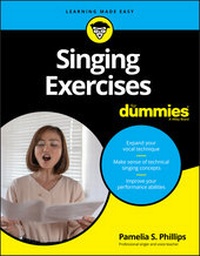
Singing Exercises For Dummies
1st Edition
Published on 23. June 2020
240 pages
978-1-119-70103-3 (ISBN)
Description

Build your voice up--and bring the house down!
Some people are born with naturally beautiful voices, but even the best can get better by applying training that can make a performance truly soar. Singing Exercises For Dummies shows you how to do just that. Following the drills and exercises found both in the book and online examples, you'll be able to refine your technique; develop consistency, power, and endurance; and increase your vocal range so you can achieve a voice that stands out from (and always wows) the crowd!
Professional singing coach and respected performer Pamelia S. Phillips is your friendly tutor and guide, starting you out with warm-ups and instructions on correct posture before leading you melodically through the intricacies of scales, chords, rhythm, pitch, tone, and much, much more.
* Advance your technique and control
* Work out your range
* Harmonize with others
* Practice like a pro
Whether you're studying under a tutor or are working to your own plan, Singing Exercises For Dummies will have you quickly scaling up the ladder to vocal perfection--and even more!
P.S. If you think this book seems familiar, you''re probably right. The Dummies team updated the cover and design to give the book a fresh feel, but the content is the same as the previous release of Singing Exercises For Dummies (9781118281086). The book you see here should'n't be considered a new or updated product. But if you''re in the mood to learn something new, check out some of our other books. We''re always writing about new topics!
Some people are born with naturally beautiful voices, but even the best can get better by applying training that can make a performance truly soar. Singing Exercises For Dummies shows you how to do just that. Following the drills and exercises found both in the book and online examples, you'll be able to refine your technique; develop consistency, power, and endurance; and increase your vocal range so you can achieve a voice that stands out from (and always wows) the crowd!
Professional singing coach and respected performer Pamelia S. Phillips is your friendly tutor and guide, starting you out with warm-ups and instructions on correct posture before leading you melodically through the intricacies of scales, chords, rhythm, pitch, tone, and much, much more.
* Advance your technique and control
* Work out your range
* Harmonize with others
* Practice like a pro
Whether you're studying under a tutor or are working to your own plan, Singing Exercises For Dummies will have you quickly scaling up the ladder to vocal perfection--and even more!
P.S. If you think this book seems familiar, you''re probably right. The Dummies team updated the cover and design to give the book a fresh feel, but the content is the same as the previous release of Singing Exercises For Dummies (9781118281086). The book you see here should'n't be considered a new or updated product. But if you''re in the mood to learn something new, check out some of our other books. We''re always writing about new topics!
More details
Other editions
Additional editions
Pamelia S. Phillips
Singing Exercises For Dummies
Book
09/2020
1st Edition
Wiley
€25.00
Shipment within 15-20 days
Person
Pamelia S. Phillips is a professional singer with over 35 years of teaching experience. She has designed curriculum for high school students, college BFA programs, and professional training programs, helping thousands of singers refine their singing technique.
Content
- Intro
- Title Page
- Copyright Page
- Table of Contents
- Introduction
- About This Book
- Conventions Used in This Book
- What You're Not to Read
- Foolish Assumptions
- How This Book Is Organized
- Part 1: Preparing Your Body for Practicing
- Part 2: Making Your Music Magical with Variety
- Part 3: Working Out Your Range
- Part 4: Advancing Your Singing Technique
- Part 5: The Part of Tens
- Icons Used in This Book
- Where to Go from Here
- Part 1: Preparing Your Body for Practicing
- Chapter 1: Warming Up for Singing
- Preparing Your Instrument: Stretching Out from Head to Toe
- Opening and Positioning the Lower Body
- Connecting your feet to the floor
- Balancing on the ankles and knees
- Distributing weight in the legs and hips
- Positioning the Upper Body for Easy Movement
- Lengthening your spine
- Releasing the shoulders
- Balancing the head and neck
- Managing the arms and hands
- Putting It All Together with a Vocal Warm-Up
- Chapter 2: Practicing Breathing Exercises
- Moving the Breathing Muscles for Singing
- Opening the ribs
- Releasing the abs
- Moving the sides
- Releasing into the hips
- Take It In: Shaping Inhalation
- Controlling the movement of your ribs
- Adding suspension to develop coordination
- Opening the torso for quick inhalation
- Let It Out: Controlling Exhalation
- Developing muscle coordination
- Isolating muscles for extra-long phrases
- Singing Practice Exercises with Long and Short Phrases
- Practicing short phrases
- Practicing longer phrases
- Testing your breath control
- Songs for Extending Breath Control
- Chapter 3: Shaping the Tongue and Lips for Vowels
- Coordinating the Tongue and Lips for Back Vowels
- Shifting the arch around for ooh and ah
- Altering your lip shape for oh and ah
- Tackling the tricky vowels aw and OOh
- Singing through the five back vowels
- Positioning the Tongue for Front Vowels
- Dropping the arch between ee and ih
- Moving between ee and ay
- Distinguishing between ee and eh
- Comparing eh and a
- Singing through the five front vowels
- Alternating between Front and Back Vowels
- Presenting the Middle Vowel, Uh
- Singing Combination Vowels
- Songs for Singing Vowels Precisely
- Chapter 4: Articulating Consonants Accurately
- Touching on the Tip Consonants
- Exploring the voiced consonants L, N, and D
- Distinguishing between voiced D and unvoiced T
- Sounding out the voiced R
- Singing unvoiced S and voiced Z
- Moving the tip of the tongue to the teeth for TH
- Singing through the consonants L, N, D, T, S, Z, and TH
- Arching Back for Soft Palate Consonants
- Practicing voiced G, unvoiced K, and voiced NG
- Singing through the consonants K, G, and NG
- Working on Lip Consonants
- Practicing voiced consonants W and M
- Alternating between voiced B and unvoiced P
- Moving only the bottom lip for F and V
- Singing through W, M, P, B, F, and V
- Consonant Combos: Moving the Lips and Tongue
- Puckering for voiced J and unvoiced CH
- Moving air through SH and ZH
- Singing through the consonants J, CH, SH, and ZH
- Songs for Singing Various Consonants
- Part 2: Making Your Music Magical with Variety
- Chapter 5: Singing Precise Intervals for Musical Accuracy
- Recognizing the Most Common Intervals
- Major intervals
- Minor intervals
- Perfect intervals
- Hearing the Small Intervals
- Minor and major seconds: m2 and M2
- Minor and major thirds: m3 and M3
- Seconds and thirds in action
- Finding Perfect Intervals
- Identifying perfect intervals: P4 and P5
- Working in unison: P8
- Singing perfect intervals
- Comparing the Larger Intervals
- Minor and major sixths: m6 and M6
- Minor and major sevenths: m7 and M7
- Singing sixths and sevenths
- Discovering Chromatics
- Raising the pitch with sharps
- Lowering the pitch with flats
- Canceling an accidental
- Working on Scales
- Building scales with triads
- Singing major scales
- Singing minor scales
- Practice Piece: "Singing All the Intervals"
- Songs for Practicing Large Intervals
- Chapter 6: You've Got Rhythm: Conquering Rhythmic Notation and Tempo
- Rhythm Basics: Notes and Rests
- The whole note
- The half note
- The quarter note
- The eighth note
- The sixteenth note
- The corresponding rests
- Practice piece: "The Rhythm Song"
- Exploring Advanced Rhythms
- Joining notes together with triplets
- Adding more notes with dotted rhythms
- Emphasizing the weaker beats with syncopation
- Practice piece: "Checking Out Rhythm"
- Managing Rhythm at Any Tempo
- Songs for Working on Rhythm
- Chapter 7: Adding Diversity with Dynamics, Articulation Marks, and More
- Singing Dynamically
- Reading the markings
- Making a smooth crescendo
- Gradually singing softer with a decrescendo
- Mastering dynamic contrast
- Articulating What's Written
- Connecting notes
- Making a note short and sweet
- Knowing when to let go
- Practice Piece: "I Sing Out!"
- Improvising to Give Songs Your Own Unique Stamp
- Adding more words
- Changing the rhythm
- Altering the melody
- Varying the tone
- Songs for Improving Your Musical Diversity
- Part 3: Working Out Your Range
- Chapter 8: Checking Out Chest Voice
- Getting Familiar with Chest Voice
- Exploring the sounds of chest voice
- Varying the heaviness in your chest voice
- Strengthening your chest voice
- Modifying vowels in chest voice
- Practice Piece: "Finding My Chest Voice"
- Songs That Work Out Your Chest Voice
- Chapter 9: Soaring into Head Voice and Falsetto
- Figuring Out Falsetto
- Working out your falsetto
- Taking falsetto down
- Exploring various vowels in falsetto
- Songs for singing in falsetto
- Discovering Your Head Voice
- Getting a feel for head voice
- Exploring high resonance in head voice
- Singing through consonants in head voice
- Positioning Your Larynx for Fuller Head Voice Sounds
- Stabilizing the larynx
- Monitoring your larynx while singing
- Managing many high phrases
- Developing Your Head Voice Range
- Creating spinning tone
- Sustaining notes in your head voice
- Songs for broadening your head voice range
- Practice Piece: "A Bejeweled Love Song"
- Chapter 10: Mixing Up Your Sound with Middle Voice
- Discovering Your Middle Voice
- Distinguishing male and female middle voice
- Getting to know your middle voice
- Strengthening your middle voice
- Finding clear vowels in middle voice
- Songs that work out the middle voice
- Combining Registers with Mix
- Knowing when to use a mix
- Rolling into a mix
- Changing around the mix
- Songs that require a mix
- Exploring Your Mix with a Few Practice Pieces
- For the guys
- For the gals
- Chapter 11: Coordinating Register Transitions
- Moving Smoothly between Registers
- Dropping into chest voice
- Changing back and forth from chest voice to middle voice
- Climbing from middle voice to head voice
- Leaping to and from Falsetto
- Singing from falsetto into chest voice
- Changing from chest voice to falsetto
- Rolling back and forth from chest voice to falsetto
- Refining Your Smooth Transitions
- Shifting from middle voice to chest voice
- Shifting from middle voice to head voice
- Practice Piece: "Marching Forth"
- Songs That Require Register Transitions
- Part 4: Advancing Your Singing Technique
- Chapter 12: Developing Your Vocal Tone
- Touching on Tone Basics
- Practicing the onset of tone
- Opening the space to change the tone
- Releasing tension to enhance tone
- Coordinating breath to improve tone
- Eliminating intonation issues
- Creating Echoing Tone with Resonance
- Finding your resonance
- Using vowels to explore resonance
- Varying where tone resonates in your body
- Choosing the right resonance for a song
- Varying Tone with Vibrato
- Discovering vibrato
- Changing between vibrato and straight tone
- Practice Piece: "Changing Tone"
- Songs for Developing Your Tone
- Chapter 13: Expanding Your Vocal Agility
- Exploring the Art of the Quick Breath
- Catching your breath quickly in fast songs
- Taking a quick breath
- Howdy, Neighbor! Working on Stepwise Motion
- Giving up control to get a feeling for agility
- Stepping up the pace
- Turning around on the tonic
- Running to the top of the scale
- Mastering Thirds
- Singing every other step of the scale
- Gaining momentum
- Taking Musical Leaps with Larger Intervals
- Starting on the top
- Jumping up (or down) an octave
- Practice Piece: "A Joyful Noise"
- Songs for Flaunting Your Agility
- Chapter 14: Belting It Out with Exercises from Beginner to Advanced
- Getting Started with Belting Basics
- Feeling belt transitions in the voice
- Making a plan to develop your belt
- Resonating All the Way to the Back Row
- Chatting It Up
- Buzzing your words on various pitches
- Speaking chatty sounds on specific pitches
- Working on your speaking range
- Using different phrases to expand your speaking range
- Developing Stamina for Belting
- Comparing Belt and Mix
- Changing from mix to belt on one note
- Songs that move from mix to belt
- Belting Your Face Off
- Applying your belt sounds to a tune
- Increasing your belt range
- Developing vocal stamina
- Testing Out Your Belt Sounds with Practice Pieces
- "Don't You Tell Me No Lie"
- "It's Time"
- Cooling Down Your Voice after Belting
- Songs for Beginner Belters Looking to Try Out Their Technique
- Songs for Advanced Belters Looking for a Challenge
- Part 5: The Part of Tens
- Chapter 15: Ten Tips for Practicing Like a Pro
- Set Aside Time to Focus on Singing
- Plan What to Practice
- Use the Exercises in This Book
- Record Your Practice Sessions
- Track Your Progress
- Cool Down after Practicing
- Know When to Rest
- Get to Know Your Song and Your Story
- Prepare for the Performance
- Find Help from a Voice Teacher
- Chapter 16: Ten Questions Singers Ask Frequently
- What Style of Music Is Right for My Voice?
- When Is a Song out of My Range?
- Am I Tone Deaf or Just Singing Out of Tune?
- How Do I Blend with Other Singers?
- How Do I Blend My Voice with Instruments?
- What's the Best Way to Develop Vocal Endurance?
- How Can I Maintain Proper Singing Posture While Playing an Instrument?
- When (And What) Should I Eat before a Performance?
- How Do I Get Over Stage Fright?
- What Do I Have to Do to Keep My Voice Healthy?
- Appendix: About The Website
- Listening to the Audio Tracks
- Customer Care
- EULA
