

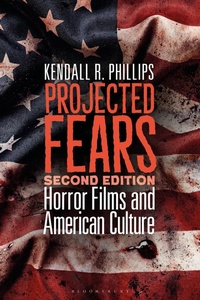
Projected Fears
Horror Films and American Culture
2nd Edition
Published on 16. October 2025
336 pages
979-8-7651-2222-8 (ISBN)
Description

A revised and expanded edition of this popular book that traces the cultural history of the American horror film by focusing on individual films that helped to define or redefine the genre from Dracula (1931) to Get Out (2017).
This book examines thirteen films that redefined the notion of cinematic horror and influenced the films that followed: Dracula (1931), The Thing (1951), Psycho (1960), Night of the Living Dead (1968), The Exorcist (1973), The Texas Chainsaw Massacre (1974), Halloween (1978), The Silence of the Lambs (1991), Scream (1996), The Sixth Sense (1999), The Blair Witch Project (1999), Saw (2004), and Get Out (2017). Carefully situating each film in relation to the history of the genre and the cultural contexts in which it emerged, the book explains why certain horror films create a connection with a wide audience.
Since the publication of the first edition in 2005, the horror genre has become even more culturally prominent and commercially successful. The genre has also shown rapid development, and several prominent trends have emerged in the 21st century. This edition includes two additional chapters that focus on Saw (2004) and Get Out (2017), as James Wan's Saw helped to launch a highly successful franchise as well as the subgenre of "torture porn," while Jordan Peele's Get Out inaugurated a broader cultural conversation about the power of horror narratives to interrogate systems of ideology and oppression.
This book examines thirteen films that redefined the notion of cinematic horror and influenced the films that followed: Dracula (1931), The Thing (1951), Psycho (1960), Night of the Living Dead (1968), The Exorcist (1973), The Texas Chainsaw Massacre (1974), Halloween (1978), The Silence of the Lambs (1991), Scream (1996), The Sixth Sense (1999), The Blair Witch Project (1999), Saw (2004), and Get Out (2017). Carefully situating each film in relation to the history of the genre and the cultural contexts in which it emerged, the book explains why certain horror films create a connection with a wide audience.
Since the publication of the first edition in 2005, the horror genre has become even more culturally prominent and commercially successful. The genre has also shown rapid development, and several prominent trends have emerged in the 21st century. This edition includes two additional chapters that focus on Saw (2004) and Get Out (2017), as James Wan's Saw helped to launch a highly successful franchise as well as the subgenre of "torture porn," while Jordan Peele's Get Out inaugurated a broader cultural conversation about the power of horror narratives to interrogate systems of ideology and oppression.
More details
Edition
2nd edition
Language
English
Place of publication
New York
United States
Publishing group
Bloomsbury Publishing Plc
Target group
College/higher education
Illustrations
26 bw illus
ISBN-13
979-8-7651-2222-8 (9798765122228)
Copyright in bibliographic data and cover images is held by Nielsen Book Services Limited or by the publishers or by their respective licensors: all rights reserved.
Schweitzer Classification
Other editions
Additional editions
Book
11/2025
2nd Edition
Bloomsbury Academic USA
€27.50
Article not available at the moment
Person
Kendall R. Phillips is Professor of Communication and Rhetorical Studies at Syracuse University, USA, where he teaches courses on rhetoric, popular culture, and public memory.
Content
List of Images
Acknowledgements
Introduction to 2nd Edition
Introduction to 1st Edition
1. Dracula (1931)
2. The Thing From Another World (1951)
3. Psycho (1960)
4. Night of the Living Dead (1968)
5. The Exorcist (1973) and The Texas Chain Saw Massacre (1974)
6. Halloween (1978)
7. The Silence of the Lambs (1991)
8. Scream (1996)
9. The Sixth Sense (1999) and The Blair Witch Project (1999)
10. Saw (2004)
11. Get Out (2017)
Conclusion
Appendix: Conclusion to the 1st Edition
Selected Bibliography
Index
Acknowledgements
Introduction to 2nd Edition
Introduction to 1st Edition
1. Dracula (1931)
2. The Thing From Another World (1951)
3. Psycho (1960)
4. Night of the Living Dead (1968)
5. The Exorcist (1973) and The Texas Chain Saw Massacre (1974)
6. Halloween (1978)
7. The Silence of the Lambs (1991)
8. Scream (1996)
9. The Sixth Sense (1999) and The Blair Witch Project (1999)
10. Saw (2004)
11. Get Out (2017)
Conclusion
Appendix: Conclusion to the 1st Edition
Selected Bibliography
Index
