

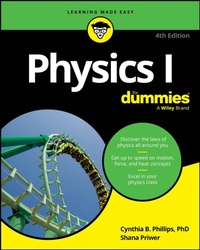
Physics I For Dummies
4th Edition
Published on 15. December 2025
403 pages
978-1-394-36716-0 (ISBN)
Description

Discover the power of physics! Physics I For Dummies, 4th Edition explains the basic principles of physics simply and clearly. This useful guide includes easy-to-follow explanations of motion, energy, the states of matter, thermodynamics, electromagnetism, relativity, and beyond. It breaks down complex concepts into manageable chunks and uses relatable examples to you readers understand how physics applies to everyday situations. You'll get a handle on physics in no time! Inside: Work through everything in an intro physics class, explained in plain English Understand physics formulas and how to use them Learn the basics of motion, force, work, heat, and more--and pass your test! Make learning easier with examples that connect physics to the world Perfect for anyone looking for a course supplement or for those simply curious about physics and the way it intersects with our everyday life, Physics I For Dummies takes the work out of learning physics.
More details
Other editions
Additional editions
Cynthia Phillips | Shana Priwer
Physics I For Dummies
Book
01/2026
4th Edition
Wiley
€26.50
Shipment within 15-20 days
Content
- Intro
- Title Page
- Copyright Page
- Table of Contents
- Introduction
- About This Book
- Foolish Assumptions
- Icons Used in This Book
- Beyond the Book
- Where to Go from Here
- Part 1 Putting Physics into Motion
- Chapter 1 Using Physics to Understand Your World
- What Physics Is All About
- Observing the world
- Making predictions
- Reaping the rewards
- Observing Objects in Motion
- Measuring speed, direction, velocity, and acceleration
- Round and round: Rotational motion
- Springs and pendulums: Simple harmonic motion
- When Push Comes to Shove: Forces
- Absorbing the energy around you
- Getting weighed down with pressures in fluids
- Feeling the Heat with Thermodynamics
- Chapter 2 Reviewing the Basics: Math and Measurement
- Measuring the World around You and Making Predictions
- Using systems of measurement
- From meters to inches and back again: Converting between units
- Using conversion factors
- Conversion factors at work
- Eliminating Some Zeros: Using Scientific Notation
- Checking the Accuracy and Precision of Measurements
- Knowing which digits are significant
- Finding the number of significant digits
- Rounding answers to the correct number of digits
- Estimating accuracy
- Arming Yourself with Basic Algebra
- Tackling a Little Trig
- Interpreting Equations as Real-World Ideas
- Chapter 3 Exploring the Need for Speed
- Going the Distance with Displacement
- Understanding displacement and position
- Examining axes
- Finding the distance
- Determining direction
- Speed Specifics: What Is Speed, Anyway?
- Reading the speedometer: Instantaneous speed
- Staying steady: Uniform speed
- Shifting speeds: Nonuniform motion
- Busting out the stopwatch: Average speed
- Contrasting average and instantaneous speed
- Distinguishing average speed and average velocity
- Speeding Up (or Down): Acceleration
- Defining acceleration
- Determining the units of acceleration
- Looking at positive and negative acceleration
- Changing speed
- Accounting for direction
- Speed can go up or down
- Examining average and instantaneous acceleration
- Taking off: Putting the acceleration formula into practice
- Understanding uniform and nonuniform acceleration
- Relating Acceleration, Time, and Displacement
- Not-so-distant relations: Deriving the formula
- Calculating acceleration and distance
- Finding acceleration
- Figuring out time and distance
- Finding distance with initial velocity
- Linking Velocity, Acceleration, and Displacement
- Finding acceleration
- Solving for displacement
- Arriving at final velocity
- Chapter 4 Following Directions: Motion in Two Dimensions
- Visualizing Vectors
- Asking for directions: Vector basics
- Looking at vector addition from start to finish
- Going head-to-head with vector subtraction
- Putting Vectors on the Grid
- Adding vectors by adding coordinates
- Changing the length: Multiplying a vector by a number
- A Little Trig: Breaking Up Vectors into Components
- Finding vector components
- Reassembling a vector from its components
- Finding the magnitude
- Finding and checking the angle
- Displacing and Accelerating in Two Dimensions
- Displacement: Going the distance in two dimensions
- Adding vector coordinates to find displacement
- Cutting the corners with a right triangle
- Velocity: Speeding in a new direction
- Acceleration: Getting a new angle on changes in velocity
- Accelerating Downward: Motion under the Influence of Gravity
- Looking at the golf-ball-off-the-cliff exercise
- Tackling a how-far-can-you-kick- the-ball exercise
- Part 2 May the Forces of Physics Be with You
- Chapter 5 When Push Comes to Shove: Force
- Newton's First Law: Resisting with Inertia
- Resisting change: Inertia and mass
- Measuring mass
- Newton's Second Law: Relating Force, Mass, and Acceleration
- Relating the formula to the real world
- Naming units of force
- Vector addition: Gathering net forces
- Calculating displacement given a time and acceleration
- STEP 1: FINDING NET FORCE
- STEP 2: FINDING ACCELERATION
- STEP 3: FINDING DISPLACEMENT
- Calculating net force given a time and velocity
- Newton's Third Law: Looking at Equal and Opposite Forces
- Seeing Newton's third law in action
- Pulling hard enough to overcome friction
- Pulleys: Supporting double the force
- Analyzing angles and force in Newton's third law
- Finding equilibrium
- Chapter 6 Getting Down with Gravity, Inclined Planes, and Friction
- Acceleration Due to Gravity: One of Life's Little Constants
- Finding a New Angle on Gravity with Inclined Planes
- Finding the force of gravity along a ramp
- Figuring out the angle
- Finding the component of the weight along a ramp
- Figuring the speed along a ramp
- Getting Sticky with Friction
- Calculating friction and the normal force
- Conquering the coefficient of friction
- On the move: Understanding static and kinetic friction
- Starting motion with static friction
- Sustaining motion with kinetic friction
- A not-so-slippery slope: Handling uphill and downhill friction
- Figuring out the weight components parallel and perpendicular to the ramp
- Determining the force of friction
- Object on the loose: Calculating how far an object will slide
- Figuring the acceleration and final velocity at the end of the ramp
- Figuring the distance traveled
- Let's Get Fired Up! Sending Objects Airborne
- Shooting an object straight up
- Going up: Maximum height
- Floating on air: Hang time
- Coming down: Factoring the total time
- Projectile motion: Firing an object at an angle
- Breaking down a cannonball's motion into its components
- Discovering the cannon's maximum range
- Chapter 7 Circling Around Rotational Motion and Orbits
- Centripetal Acceleration: Changing Direction to Move in a Circle
- Keeping a constant speed with uniform circular motion
- Describing the period
- Accelerating toward the center
- Finding the magnitude of the centripetal acceleration
- Seeking the Center: Centripetal Force
- Looking at the force you need
- Breaking down centripetal force
- Negotiating flat curves and banked turns
- Relying on friction to turn on a flat road
- Depending on the normal force to make a banked turn
- Getting Angular with Displacement, Velocity, and Acceleration
- Measuring angles in radians
- Relating linear and angular motion
- Letting Gravity Supply Centripetal Force
- Using Newton's law of universal gravitation
- Deriving the force of gravity on the Earth's surface
- Using the law of gravitation to examine circular orbits
- Calculating a satellite's speed
- Calculating the period of a satellite
- Looping the Loop: Vertical Circular Motion
- Chapter 8 Go with the Flow: Looking at Pressure in Fluids
- Mass Density: Getting Some Inside Information
- Calculating density
- Comparing densities with specific gravity
- Applying Pressure
- Looking at units of pressure
- Connecting pressure to changes in depth
- Diving down
- Varying blood pressure
- Pumping water upward
- Amplifying pressure with Pascal's principle
- Buoyancy: Floating Your Boat with Archimedes's Principle
- Fluid Dynamics: Going with Fluids in Motion
- Characterizing the type of flow
- Evenness: Steady or unsteady flow
- Squeezability: Compressible or incompressible flow
- Thickness: Viscous or nonviscous flow
- Spinning: Rotational or irrotational flow
- Picturing flow with streamlines
- Getting Up to Speed on Flow and Pressure
- The equation of continuity: Relating pipe size and flow rates
- Conserving mass with the equation of continuity
- Incompressible liquids: Changing the pipe size to change the flow rate
- Bernoulli's equation: Relating speed and pressure
- Pipes and pressure: Putting it all together
- Part 3 Manifesting the Energy to Work
- Chapter 9 Getting Some Work Out of Physics
- Looking for Work
- Working on measurement systems
- Positive work: Applying force in the direction of movement
- Negative work: Applying force opposite the direction of motion
- Using a tow rope: Applying force at an angle
- Pulling harder to do the same amount of work
- Cutting down on your work by reducing friction
- Making a Move: Kinetic Energy
- The work-energy theorem: Turning work into kinetic energy
- Using the kinetic energy equation
- Calculating changes in kinetic energy by using net force
- Energy in the Bank: Potential Energy
- Gaining potential energy by working against gravity
- Converting potential energy into kinetic energy
- Choose Your Path: Conservative versus Nonconservative Forces
- Keeping the Energy Up: The Conservation of Mechanical Energy
- Shifting between kinetic and potential energy
- The mechanical-energy balance: Finding velocity and height
- Determining final velocity with mechanical energy
- Determining final height with mechanical energy
- Powering Up: The Rate of Doing Work
- Using common units of power
- Powering through the calculations
- Chapter 10 Putting Objects in Motion: Momentum and Impulse
- Looking at the Impact of Impulse
- Gathering Momentum
- The Impulse-Momentum Theorem: Relating Impulse and Momentum
- Shooting pool: Finding force from impulse and momentum
- Singing in the rain: An impulsive activity
- When Good Objects Go Wild: Conserving Momentum
- Deriving the conservation formula
- Finding velocity with the conservation of momentum
- Finding firing velocity with the conservation of momentum
- When Worlds (or Cars) Collide: Elastic and Inelastic Collisions
- Determining whether a collision is elastic
- Colliding elastically along a line
- Bumping into a heavier mass
- Bumping into a lighter mass
- Colliding elastically in two dimensions
- Chapter 11 Winding Up with Angular Kinetics
- Going from Linear to Rotational Motion
- Understanding Tangential Motion
- Finding tangential velocity
- Finding tangential acceleration
- Finding centripetal acceleration
- Applying Vectors to Rotation
- Calculating angular velocity
- Solving angular acceleration
- Changing the speed and reversing direction
- Tilting the axle
- Doing the Twist: Torque
- Mapping out the torque equation
- Understanding lever arms
- Generating torque
- Recognizing that torque is a vector
- Spinning at Constant Velocity: Rotational Equilibrium
- Determining how much weight Hercules can lift
- Hanging a flag: A rotational equilibrium problem
- Ladder safety: Introducing friction into rotational equilibrium
- Chapter 12 Round and Round with Rotational Dynamics
- Rolling Up Newton's Second Law into Angular Motion
- Switching force to torque
- Converting tangential acceleration to angular acceleration
- Factoring in the moment of inertia
- Moments of Inertia: Looking into Mass Distribution
- Merry-go-rounds and torque: A spinning-disk inertia example
- Angular acceleration and torque: A pulley inertia example
- Wrapping Your Head around Rotational Work and Kinetic Energy
- Putting a new spin on work
- Moving along with rotational kinetic energy
- Rolling down a hill: Kinetic energy on a ramp
- Can't Stop This: Angular Momentum
- Conserving angular momentum
- Case study: Satellite orbits
- Chapter 13 Springs 'n' Things: Simple Harmonic Motion
- Bouncing Back with Hooke's Law
- Stretching and compressing springs
- Pushing or pulling back: The spring's restoring force
- Getting Around to Simple Harmonic Motion
- Around equilibrium: Examining horizontal and vertical springs
- Catching the wave: A sine of simple harmonic motion
- Understanding sine waves with a reference circle
- Getting periodic
- Remembering not to speed away without the velocity
- Including the acceleration
- Finding the angular frequency of a mass on a spring
- Factoring Energy into Simple Harmonic Motion
- Swinging with Pendulums
- Part 4 Laying Down the Laws of Thermodynamics
- Chapter 14 Turning Up the Heat with Thermodynamics
- Measuring Temperature
- Fahrenheit and Celsius: Working in degrees
- Zeroing in on the Kelvin scale
- Analyzing absolute zero
- Making kelvin conversions
- The Heat Is On: Thermal Expansion
- Linear expansion: Getting longer
- Relating temperature changes to changes in length
- Workin' on the railroad: A linear expansion example
- Volume expansion: Taking up more space
- Tanker trucks: Looking at expanding liquids
- Radiators: Seeing expanding liquids and containers
- Heat: Going with the Flow (of Thermal Energy)
- Getting specific with temperature changes
- Just a new phase: Adding heat without changing temperature
- Breaking the ice with phase-change graphs
- Understanding latent heat
- Chapter 15 Here, Take My Coat: How Heat Is Transferred
- Convection: Letting the Heat Flow
- Hot fluid rises: Putting fluid in motion with natural convection
- Controlling the flow with forced convection
- Too Hot to Handle: Getting in Touch with Conduction
- Finding the conduction equation
- Working with thermal conductivity
- Camping with the Johnsons: A conduction example
- Considering conductors and insulators
- Radiation: Riding the (Electromagnetic) Wave
- Mutual radiation: Giving and receiving heat
- Blackbodies: Absorbing and reflecting radiation
- The Stefan-Boltzmann constant
- The Stefan-Boltzmann law of radiation
- Chapter 16 Best of the Best: The Ideal Gas Law
- Digging into Molecules and Moles with Avogadro's Number
- Relating Pressure, Volume, and Temperature with the Ideal Gas Law
- Forging the ideal gas law
- Working with standard temperature and pressure
- A breathing problem: Checking your oxygen
- Boyle's and Charles's laws: Alternative expressions of the ideal gas law
- Tracking Ideal Gas Molecules with the Kinetic Energy Formula
- Predicting air molecule speed
- Calculating kinetic energy in an ideal gas
- Chapter 17 Heat and Work: The Laws of Thermodynamics
- Getting Temperature with Thermal Equilibrium: The Zeroth Law
- Conserving Energy: The First Law of Thermodynamics
- Calculating with conservation of energy
- Practicing the sign conventions
- Trying a first-law-of-thermodynamics sample problem
- Staying constant: Isobaric, isochoric, isothermal, and adiabatic processes
- At constant pressure: Isobaric
- At constant volume: Isochoric
- At constant temperature: Isothermal
- At constant heat: Adiabatic
- Flowing from Hot to Cold: The Second Law of Thermodynamics
- Heat engines: Putting heat to work
- Evaluating heat's work: Heat engine efficiency
- Finding heat from a car engine
- Finding heat from your race car
- Limiting efficiency: Carnot says you can't have it all
- Finding efficiency in Carnot's engine
- Using the equation for a Carnot engine
- Going against the flow with heat pumps
- Heating with less work
- Checking a heat pump's performance
- Going Cold: The Third (and Absolute Last) Law of Thermodynamics
- Part 5 The Part of Tens
- Chapter 18 Ten Ways Physics Runs Your Day
- Waking Up
- Turning On the Lights
- Checking Your Morning Email
- Brewing the Coffee
- Getting to Work
- Sitting Down in the Office
- Climbing the Stairs
- Idling the Day Away
- Heading Home
- Calling It a Day
- Chapter 19 Ten Physics Heroes
- Galileo Galilei
- Sir Isaac Newton
- Charles-Augustin de Coulomb
- William Thomson (Lord Kelvin)
- Marie Salomea Sklodowska Curie
- Albert Einstein
- Emmy Noether
- Maria Goeppert Mayer
- Chien-Shiung Wu
- Jocelyn Bell Burnell
- Glossary
- Index
- EULA
