

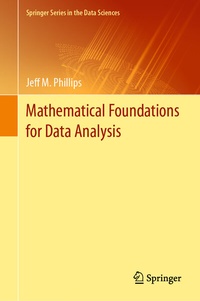
Mathematical Foundations for Data Analysis
Description

This textbook, suitable for an early undergraduate up to a graduate course, provides an overview of many basic principles and techniques needed for modern data analysis. In particular, this book was designed and written as preparation for students planning to take rigorous Machine Learning and Data Mining courses. It introduces key conceptual tools necessary for data analysis, including concentration of measure and PAC bounds, cross validation, gradient descent, and principal component analysis. It also surveys basic techniques in supervised (regression and classification) and unsupervised learning (dimensionality reduction and clustering) through an accessible, simplified presentation. Students are recommended to have some background in calculus, probability, and linear algebra. Some familiarity with programming and algorithms is useful to understand advanced topics on computational techniques.
Reviews / Votes
"This is certainly a timely book with large potential impact and appeal. . the book is therewith accessible to a broad scientific audience including undergraduate students. . Mathematical Foundations for Data Analysis provides a comprehensive exploration of the mathematics relevant to modern data science topics, with a target audience that is looking for an intuitive and accessible presentation rather than a deep dive into mathematical intricacies." (Aretha L. Teckentrup, SIAM Review, Vol. 65 (1), March, 2023)"The book is fairly compact, but a lot of information is presented in those pages. . the book is pretty much self-contained, but prior knowledge of linear algebra and python programming would benefit anyone. The clear writing is backed in many instances by helpful illustrations. Color is used judiciously throughout the text to help differentiate between objects and highlight items of interest. . Phillips' book is much more concise, but still discusses many different mathematical aspects of data science." (David R. Gurney, MAA Reviews, September 5, 2021)
More details
Other editions
Additional editions
Person
Jeff M. Phillips is an Associate Professor in the School of Computing within the University of Utah. He directs the Utah Center for Data Science as well as the Data Science curriculum within the School of Computing. His research is on algorithms for big data analytics, a domain with spans machine learning, computational geometry, data mining, algorithms, and databases, and his work regularly appears in top venues in each of these fields. He focuses on a geometric interpretation of problems, striving for simple, geometric, and intuitive techniques with provable guarantees and solve important challenges in data science. His research is supported by numerous NSF awards including an NSF Career Award.
