

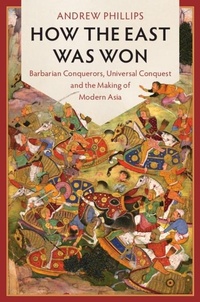
How the East Was Won
Barbarian Conquerors, Universal Conquest and the Making of Modern Asia
Published on 29. September 2021
978-1-009-06437-8 (ISBN)
Description

How did upstart outsiders forge vast new empires in early modern Asia, laying the foundations for today's modern mega-states of India and China? In How the East Was Won, Andrew Phillips reveals the crucial parallels uniting the Mughal Empire, the Qing Dynasty and the British Raj. Vastly outnumbered and stigmatised as parvenus, the Mughals and Manchus pioneered similar strategies of cultural statecraft, first to build the multicultural coalitions necessary for conquest, and then to bind the indigenous collaborators needed to subsequently uphold imperial rule. The English East India Company later adapted the same 'define and conquer' and 'define and rule' strategies to carve out the West's biggest colonial empire in Asia. Refuting existing accounts of the 'rise of the West', this book foregrounds the profoundly imitative rather than innovative character of Western colonialism to advance a new explanation of how universal empires arise and endure.
Reviews / Votes
'Andrew Phillips has done it again - this book will completely change how you think about empires, as well the competition between the East and the West.' Ayse Zarakol, Reader in International Relations, University of Cambridge 'How the East was Won brilliantly shows how peripheral groups overcame more powerful polities to create universal empires. Andrew Phillips demonstrates how these groups created such empires not by assimilating subject peoples but by a strategic process of cultural differentiation. They established diversity regimes that maintained the unique identity of the dominant elite, while simultaneously yoking culturally diverse indigenous elites to the conquest elite. In comparing the British Raj to Manchu and Mughal rule, he challenges the preconception that Western colonial empires differed fundamentally from the Asian empires. Instead of displacing indigenous practices, the British layered on to existing practices. Rather than see the current international order, as propelled by "the Rise of the West," we might thus conclude that order has been infused with the hybridization of West and East from its infancy.' Hendrik Spruyt, Norman Dwight Harris Professor of International Relations, Northwestern University, Illinois 'A sweeping and beautifully-written explanation of how the Mughals, Manchus and British created vast and powerful empires and left lasting legacies for world order. This book is a definitive contribution to the creation of modernity and the study of global historical International relations.' Amitav Acharya, American University, Washington DC, and co-author (with Barry Buzan) of The Making of Global International Relations (Cambridge University Press, 2019) 'In this magnificent book Andrew Phillips takes us on a fascinating and deeply insightful journey beyond IR's Eurocentric frontier to challenge many of the continuing theoretical/conceptual assumptions of the discipline. He reveals the near-ubiquity of hierarchical Asian empires in the early modern period and how these shared many similarities in their origins and modalities of rule with the British empire as well as how international politics was forged through the interweaving of Western and Asian agency.' John M. Hobson,, Professor of Politics and International Relations, University of Sheffield, UK 'Phillips' masterful book on the Mughal Empire (c.1526-1858), the Qing Empire (c.1644-1912), and the British Raj (c.1765-1947) ambitiously challenges the received wisdom about early modern Asia. The author highlights that the West was initially backward so that Western colonialism could succeed only because it was built on Asian precedents of imperial emergence, expansion and consolidation. The winning formula was a 'define-and-conquer' and 'define-and-rule' strategy that curated identities to facilitate cultural appropriation and local collaboration. The resulting mega-states of 'India' and 'China' are modern inventions rather than the manifest destiny of supposedly unified and ancient civilizations. This book is a must read for students of international relations, comparative history, East Asia, India and China.' Victoria Tin-bor Hui, Associate Professor, Department of Political Science, University of Notre Dame 'A provocative read ... Highly recommended.' Q. E. Wang, Choice Connect 'How the East Was Won presents a novel theory on the origins and governance of empires, focusing on the nexus between cultural variety and international order. ... Through the use of three significant imperial international regimes in Asian history, this study advances our understanding of the mechanisms of hierarchy in global politics.' Zheng Chen, China International Strategy ReviewMore details
Series
Language
English
Place of publication
Cambridge
United Kingdom
Target group
Professional and scholarly
Illustrations
Worked examples or Exercises
File size
7,00 MB
ISBN-13
978-1-009-06437-8 (9781009064378)
Copyright in bibliographic data and cover images is held by Nielsen Book Services Limited or by the publishers or by their respective licensors: all rights reserved.
Schweitzer Classification
Other editions
Additional editions
Andrew Phillips
How the East Was Won
Barbarian Conquerors, Universal Conquest and the Making of Modern Asia
Book
10/2021
Cambridge University Press
€136.60
Shipment within 15-20 days
Andrew Phillips
How the East Was Won
Barbarian Conquerors, Universal Conquest and the Making of Modern Asia
Book
10/2021
Cambridge University Press
€49.60
Shipment within 15-20 days
Person
Content
Introduction; 1. From the rise of the west to how the east was won; 2. The Eurasian transformation; 3. The rise of Asia's terrestrial empires; 4. European infiltration and Asian consolidation in maritime Asia; 5. The great Asian divergence - Mughal decline and Manchu consolidation in the eighteenth century; 6. The East India Company and the rise of British India, 1740-1820; 7. Crises of empire and the reconstitution of international orders in south and East Asia, 1820-1880.
