

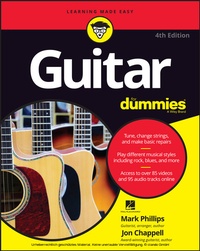
Guitar For Dummies
Description

The guitar is one of the most versatile instruments in the world, which is why it's so appealing to musicians. Guitar For Dummies, 4th Edition gives you everything a beginning or intermediate acoustic or electric guitarist needs: from buying a guitar to tuning it, playing it, and caring for it. Fully revised and updated, with online video and audio clips that help you learn and play along, you'll explore everything from simple chords and melodies to more challenging exercises that are designed to satisfy players of all levels. Additionally, new players can dive into the basics of guitar and accessory selection. Whether you prefer the cool sounds of the acoustic or the edgier tones of the electric, your guitar will get a lot of use as you play your way through the lessons presented in this integral book. But your journey doesn't stop at the last page! With an updated multimedia component, you have access to more than 80 online videos and 35 audio tracks that help build your talent.
* Play along with online videos and audio tracks to develop and reinforce your new skills
* Tune your guitar, change strings, and make simple repairs to keep your instrument in working order
* Choose the right guitar and equipment for your needs
* Explore numerous musical styles, including rock, blues, jazz, and country
Guitar For Dummies, 4th Edition guides you in the development of your strumming talent--and who knows where that can take you!
More details
Other editions
Additional editions
Persons
Jon Chappell is a multistyle guitarist, arranger, and former editor-in-chief of Guitar magazine.
Content
Part 1: Getting Started with Guitar 7
CHAPTER 1: Guitar Basics: The Parts of a Guitar and How It Makes Music 9
CHAPTER 2: How to Tune Your Guitar 17
CHAPTER 3: Preparing to Play: Holding the Guitar and Reading Guitar Notation 25
Part 2: Ready to Play: The Basics 37
CHAPTER 4: The Best Way to Begin: Strumming Chords 39
CHAPTER 5: Playing Melodies -- without Reading Music! 59
CHAPTER 6: Adding Some Spice with 7th Chords 69
Part 3: Beyond the Basics: Starting to Sound Cool 85
CHAPTER 7: Making Things Smooth by Playing in Position 87
CHAPTER 8: Doubling Up with Double-Stops 97
CHAPTER 9: Stretching Out: Barre Chords 105
CHAPTER 10: Special Articulation: Making the Guitar Talk 129
Part 4: A Pile of Styles 157
CHAPTER 11: Ready to Rock: Rock Guitar Basics 159
CHAPTER 12: Bluer Than Blue: Blues Guitar Basics 187
CHAPTER 13: Around the Campfire: Folk Guitar Basics 211
CHAPTER 14: Maestro, If You Please: Classical Guitar Basics 237
CHAPTER 15: Sunglasses and Berets: Jazz Guitar Basics 255
Part 5: A Guitar of Your Own 269
CHAPTER 16: Shopping for a Guitar 271
CHAPTER 17: Eyeing Guitar Amps, Effects, Cases, and Accessories 287
CHAPTER 18: Changing Your Strings 303
CHAPTER 19: Guitar Wellness: Basic Maintenance 317
Part 6: The Part of Tens 333
CHAPTER 20: Ten (Or So) Guitarists You Should Know 335
CHAPTER 21: Ten Great Songs for Beginning Guitarists 339
Part 7: Appendixes 343
APPENDIX A: How to Read Music 345
APPENDIX B: 96 Common Chords 355
APPENDIX C: How to Use the Website 359
Index 373
Introduction
So you wanna play guitar, huh? And why wouldn't you?
You may as well face it: In the music world, guitars set the standard for cool (and we're not just being biased here). Since the 1950s, many of the greatest stars in rock 'n' roll, blues, and country have played the guitar. Think of Chuck Berry doing his one-legged hop (the "duck walk") across the stage while belting out "Johnny B. Goode"; Jimi Hendrix wailing on his upside-down, right-handed (and sometimes flaming) Stratocaster; Bonnie Raitt slinkily playing her slide guitar; Garth Brooks with his acoustic guitar and Western shirts; B.B. King's authoritative bending and expressive vibrato on his guitar "Lucille"; or Jim Hall's mellow jazz guitar stylings. (Even Elvis Presley, whose guitar prowess may not have exceeded five chords, still used the guitar effectively onstage as a prop.) The list goes on.
Playing electric guitar can put you out in front of a band, where you're free to roam, sing, and connect with your adoring fans. Playing acoustic guitar can make you the star of the vacation campfire sing-along. And playing any kind of guitar can bring out the music in your soul and become a cherished lifetime hobby.
About This Book
Guitar For Dummies, 4th Edition, delivers everything the beginning to intermediate guitarist needs: From buying a guitar to tuning the guitar to playing the guitar to caring for the guitar - this book has it all!
Believe it or not, many would-be guitarists never really get into playing because they have the wrong guitar. Or maybe the strings are too difficult to press down (causing a great deal of pain). Guitar For Dummies, 4th Edition, unlike some other books we could mention, doesn't assume that you already have the right guitar - or even any guitar at all, for that matter. In this book, you find everything you need to know (from a buyer's guide to buying strategies, to guitars and accessories for particular styles) to match yourself with the guitar and equipment that fit your needs and budget.
Most guitar books want you to practice the guitar in the same way that you practice the piano. First, you learn where the notes fall on the staff; then you learn about the length of time that you're supposed to hold the notes; then you move on to practicing scales; and the big payoff is to practice song after unrecognizable song that you probably don't care about playing anyway. If you're looking for this kind of ho-hum guitar book, you've definitely come to the wrong place. But don't worry, you'll find no shortage of that kind of book.
The truth is that many great guitarists don't know how to read music, and many who can read music learned to do so after they learned to play the guitar. Repeat after us: You don't need to read music to play the guitar. Chant this mantra until you believe it, because this principle is central to the design of Guitar For Dummies, 4th Edition.
One of the coolest things about the guitar is that, even though you can devote your lifetime to perfecting your skills, you can start faking it rather quickly. We assume that, instead of concentrating on what the 3/4 time signature means, you want to play music - real music (or at least recognizable music). We want you to play music, too, because that's what keeps you motivated and practicing.
So how does Guitar For Dummies, 4th Edition, deliver? Glad you asked. The following list tells you how this book starts you playing and developing real guitar skills quickly:
- Look at the photos. Fingerings you need to know appear in photos in the book. Just form your hands the way we show you in the photos. Simple.
- Read guitar tablature. Guitar tablature is a guitar-specific shorthand for reading music that actually shows you what strings to strike and what frets to hold down on the guitar to create the sound that's called for. Tab (as it's known to its friends and admirers) goes a long way toward enabling you to play music without reading music. Don't try this stuff on the piano!
- View videos and listen to audio tracks. More than 80 short videos enable you to see how key selected techniques are executed. You can also listen to all the songs and exercises in the book performed on nearly 100 audio tracks. Doing so is important for a couple of reasons: You can figure out the rhythm of the song as well as how long to hold notes by listening instead of reading. We could tell you all sorts of really cool things about the audio tracks, such as how they have the featured guitar on one channel and the accompaniment on the other (so you can switch back and forth by using the balance control on your stereo), but, aw shucks, we don't want to brag on ourselves too much.
- Look at the music staff as you improve. To those who would charge that Guitar For Dummies, 4th Edition, rejects the idea of reading music, we respond: "Not so, Fret Breath!" The music for all the exercises and songs appears above the tab. So you get the best of both worlds: You can associate the music notation with the sound you're making after you already know how to make the sound. Pretty cool, huh?
A serious guitar is a serious investment, and, as with any other serious investment, you need to maintain it. Guitar For Dummies, 4th Edition, provides the information you need to correctly store, maintain, and care for your six-string, including how to change strings and what little extras to keep stashed away in your guitar case.
Foolish Assumptions
We really don't make many assumptions about you. We don't assume that you already own a guitar. We don't assume that you have a particular preference for acoustic or electric guitars or that you favor a particular style. Gee, this is a pretty equal-opportunity book!
Okay, we do assume some things. We assume that you want to play a guitar, not a banjo, Dobro, or mandolin, and we concentrate on the six-string variety. We assume you're relatively new to the guitar world. And we assume that you want to start playing the guitar quickly, without a lot of messing around with reading notes, clefs, and time signatures. You can find all that music-reading stuff in the book, but that's not our main focus. Our main focus is helping you make cool, sweet music on your six-string.
Icons Used in This Book
In the margins of this book, you find several helpful little icons that can make your journey a little easier:
Expert advice that can hasten your journey to guitar excellence.
Skip to a real song for some instant guitar gratification. Go to www.dummies.com/go/guitar for videos and audio clips.
Something to write down on a cocktail napkin and store in your guitar case.
Watch out, or you could cause damage to your guitar or someone's ears.
The whys and wherefores behind what you play. The theoretical and, perhaps at times, obscure stuff that you can skip at the time, if you so desire, but that you may return to at a later time for a deeper understanding of these concepts and techniques.
Beyond the Book
Guitar For Dummies, 4th Edition, provides text, photos, and diagrams to help you get your head around - and your hands on - the guitar. But membership in the Guitar For Dummies club also gets you something else of great value: access to the online assets that help you stay connected even when your eyes aren't focused somewhere between the book's covers.
To begin with, we have an electronic version of a Cheat Sheet that gives you quick, at-a-glance guidance to several aspects of the guitar that help your playing. The eCheat Sheet is divided into four sections, dealing with such diverse topics as notation explanations, common chords for various music styles, and recommended tools and accessories to have on hand for your guitar playing sessions. To view this book's Cheat Sheet, simply go to www.dummies.com and search for "Guitar For Dummies Cheat Sheet" in the Search box.
You can find several free pieces of information online at www.dummies.com/extras/guitar.
You also can find online video and audio files at www.dummies.com/go/guitar that demonstrate exactly what the exercises and songs sound like and how they should be played. As a bonus, we include two printable documents (in the form of PDFs): a page of blank chord diagrams that you can fill in with the chord forms of your choice and a page of blank music paper, containing a treble clef staff and a tab staff. We encourage you to print these documents and fill them with song excerpts or exercises that you're focusing on. Be sure to check out Appendix C for a full explanation of and guide to the online files.
Where to Go from Here
Guitar For Dummies, 4th Edition, has been carefully crafted so you can find what you want or need to know about the guitar and no more. Because each chapter is self-contained, you can skip information that you've already mastered and not feel lost. Yet, at the same time, you can also follow along from front to back and practice the guitar in a way...
