

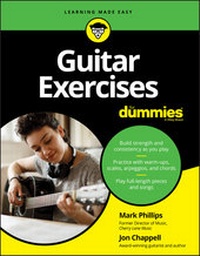
Guitar Exercises For Dummies
Description

If you already play some guitar but need some practice, you're in the right place. Guitar Exercises For Dummies is a friendly guide that provides just enough need-to-know information about practicing scales, chords, and arpeggios in the context of specific skills and techniques to help you maximize its 400+ exercises and improve your guitar playing. (If you need instruction on topics like buying or tuning a guitar and playing basic chords, check out Guitar For Dummies.)
This practical book starts off with warm-up exercises (on and off-instrument) and then logically transitions to scales, scale sequences, arpeggios, arpeggio sequences, and chords, with a focus on building strength and consistency as well as refining technique. Each section helps you to practice correct hand and body posture and experience variations, such as fingering options and hand positions, and then ends with a brief musical piece for you to try. You can also practice incorporating other facets of musical performance in your exercises, such as:
* Tempo
* Time signature
* Phrasing
* Dynamics
The book wraps up with tips to help you maximize your practice time (like setting goals for each session), ways to improve your musicianship (such as studying other performers' body language), and an appendix that explains the accompanying website (where you can find audio tracks and additional information). Grab your guitar, grab a copy of Guitar Exercises For Dummies, and start perfecting your finger picking today.
P.S. If you think this book seems familiar, you're probably right. The Dummies team updated the cover and design to give the book a fresh feel, but the content is the same as the previous release of Guitar Exercises For Dummies (9780470387665). The book you see here shouldn't be considered a new or updated product. But if you're in the mood to learn something new, check out some of our other books. We're always writing about new topics!
More details
Other editions
Additional editions
Persons
Jon Chappell is a multi-style guitarist, arranger, author, and journalist, and former editor of Guitar magazine.
Content
- Intro
- Title Page
- Copyright Page
- Table of Contents
- Introduction
- About This Book
- Conventions We Use in This Book
- What You're Not to Read
- Foolish Assumptions
- How This Book Is Organized
- Part 1: Preparing to Practice
- Part 2: Scales and Scale Sequences
- Part 3: Arpeggios and Arpeggio Sequences
- Part 4: Chords and Additional Exercises
- Part 5: The Part of Tens
- Icons Used in This Book
- Where to Go from Here
- Part 1: Preparing to Practice
- Chapter 1: Reviewing Guitar Fundamentals
- Perfecting Your Practice Posture
- Brushing Up On Guitar Notation
- Decoding tablature
- Comprehending chord diagrams
- Interpreting neck diagrams
- Recognizing rhythm slashes
- Chapter 2: Warming Up for Your Practice Sessions
- Preparing Your Body and Mind to Play
- Limbering up your fingers
- Reflecting on your breathing, relaxation, and focus
- Waking Up Your Fingers with Some Practice Exercises
- Single-note exercises
- Chord exercises
- Part 2: Scales and Scale Sequences
- Chapter 3: Putting the Major Scales to Use in Your Playing
- Practicing Five Major Scale Patterns
- Major scale pattern #1
- Major scale pattern #2
- Major scale pattern #3
- Major scale pattern #4
- Major scale pattern #5
- Applying Your Scale Work to Actual Pieces of Music
- "The First Noël"
- Bach's "Minuet in G"
- Chapter 4: Adding Major Scale Sequences to Your Repertoire
- Practicing Major Scale Sequences
- Major scale sequences using pattern #1
- Major scale sequences using pattern #2
- Major scale sequences using pattern #3
- Major scale sequences using pattern #4
- Major scale sequences using pattern #5
- Putting Your Sequence Skills to Work with a Few Songs
- "Oh, Them Golden Slippers"
- "We Wish You a Merry Christmas"
- Chapter 5: Tackling the Three Minor Scales
- Familiarizing Yourself with Natural Minor Scales
- Natural minor scale pattern #1
- Natural minor scale pattern #2
- Natural minor scale pattern #3
- Natural minor scale pattern #4
- Natural minor scale pattern #5
- Raising the Bar with Melodic Minor Scales
- Melodic minor scale pattern #1
- Melodic minor scale pattern #2
- Melodic minor scale pattern #3
- Melodic minor scale pattern #4
- Melodic minor scale pattern #5
- Harmonizing with Harmonic Minor Scales
- Harmonic minor scale pattern #1
- Harmonic minor scale pattern #2
- Harmonic minor scale pattern #3
- Harmonic minor scale pattern #4
- Harmonic minor scale pattern #5
- Playing Pieces Using the Three Minor Scales
- "God Rest Ye Merry, Gentlemen"
- Handel's "Allegro"
- "The Three Ravens"
- Chapter 6: Examining Minor Scale Sequences
- It's Only Natural: Practicing Natural Minor Scale Sequences
- Natural minor scale sequences using pattern #1
- Natural minor scale sequences using pattern #2
- Natural minor scale sequences using pattern #3
- Natural minor scale sequences using pattern #4
- Natural minor scale sequences using pattern #5
- Up and Down the Scale: Practicing Melodic Minor Scale Sequences
- Melodic minor scale sequences using pattern #1
- Melodic minor scale sequences using pattern #2
- Melodic minor scale sequences using pattern #3
- Melodic minor scale sequences using pattern #4
- Melodic minor scale sequences using pattern #5
- Discovering a More Intense Sound with Harmonic Minor Scale Sequences
- Harmonic minor scale sequences using pattern #1
- Harmonic minor scale sequences using pattern #2
- Harmonic minor scale sequences using pattern #3
- Harmonic minor scale sequences using pattern #4
- Harmonic minor scale sequences using pattern #5
- Practicing Some Pieces Using Minor Scale Sequences
- "To Work upon the Railroad"
- Bach's "Bourrée in E Minor"
- "The Full Little Jug"
- Part 3: Arpeggios and Arpeggio Sequences
- Chapter 7: Breaking Out with Major Arpeggios
- Preparing Yourself for Major Chords by Practicing Major Arpeggios
- Major arpeggio pattern #1
- Major arpeggio pattern #2
- Major arpeggio pattern #3
- Major arpeggio pattern #4
- Major arpeggio pattern #5
- Applying Your Skills: Performing Pieces Using Major Arpeggios
- "To the Colors"
- "Retreat"
- Chapter 8: Discovering How to Play Major Arpeggio Sequences
- Picking Up On Major Arpeggio Sequences
- Major arpeggio sequences using pattern #1
- Major arpeggio sequences using pattern #2
- Major arpeggio sequences using pattern #3
- Major arpeggio sequences using pattern #4
- Major arpeggio sequences using pattern #5
- Playing Pieces That Feature Major Arpeggio Sequences
- "Blues Riff in B"
- "Doo-Wop Groove in A"
- Chapter 9: Getting to Know Minor Arpeggios
- Working On Minor Arpeggios
- Minor arpeggio pattern #1
- Minor arpeggio pattern #2
- Minor arpeggio pattern #3
- Minor arpeggio pattern #4
- Minor arpeggio pattern #5
- Playing Pieces with Minor Arpeggios
- "Wolfgang's Whistle"
- "Amadeus's Air"
- Chapter 10: Looking at Minor Arpeggio Sequences
- Adding Minor Arpeggio Sequences to Your Practice Sessions
- Minor arpeggio sequences using pattern #1
- Minor arpeggio sequences using pattern #2
- Minor arpeggio sequences using pattern #3
- Minor arpeggio sequences using pattern #4
- Minor arpeggio sequences using pattern #5
- Tackling a Few Pieces Composed of Minor Arpeggio Sequences
- "Mozart's Motif"
- Schumann's "The Wild Horseman"
- Chapter 11: Enhancing Your Playing with Seventh Chord Arpeggios
- Practicing Dominant Seventh Chord Arpeggios
- Dominant seventh chord arpeggio pattern #1
- Dominant seventh chord arpeggio pattern #2
- Dominant seventh chord arpeggio pattern #3
- Dominant seventh chord arpeggio pattern #4
- Dominant seventh chord arpeggio pattern #5
- Putting Your Fingers to Work with Minor Seventh Chord Arpeggios
- Minor seventh chord arpeggio pattern #1
- Minor seventh chord arpeggio pattern #2
- Minor seventh chord arpeggio pattern #3
- Minor seventh chord arpeggio pattern #4
- Minor seventh chord arpeggio pattern #5
- Running Through the Major Seventh Chord Arpeggios
- Major seventh chord arpeggio pattern #1
- Major seventh chord arpeggio pattern #2
- Major seventh chord arpeggio pattern #3
- Major seventh chord arpeggio pattern #4
- Major seventh chord arpeggio pattern #5
- Applying Seventh Chord Arpeggios to Some Famous Pieces
- Schubert's "Ave Maria"
- Fauré's "Pavane". .
- Chapter 12: Trying Your Hand at Seventh Chord Arpeggio Sequences
- Taking On Dominant Seventh Chord Arpeggio Sequences
- Dominant seventh chord arpeggio sequence using pattern #1
- Dominant seventh chord arpeggio sequence using pattern #2
- Dominant seventh chord arpeggio sequence using pattern #3
- Dominant seventh chord arpeggio sequence using pattern #4
- Dominant seventh chord arpeggio sequence using pattern #5
- Adding Minor Seventh Chord Arpeggio Sequences to Your Collection
- Minor seventh chord arpeggio sequence using pattern #1
- Minor seventh chord arpeggio sequence using pattern #2
- Minor seventh chord arpeggio sequence using pattern #3
- Minor seventh chord arpeggio sequence using pattern #4
- Minor seventh chord arpeggio sequence using pattern #5
- Practicing Major Seventh Chord Arpeggio Sequences
- Major seventh chord arpeggio sequence using pattern #1
- Major seventh chord arpeggio sequence using pattern #2
- Major seventh chord arpeggio sequence using pattern #3
- Major seventh chord arpeggio sequence using pattern #4
- Major seventh chord arpeggio sequence using pattern #5
- Playing Pieces with Seventh Chord Arpeggio Sequences
- Liszt's "Liebestraum"
- Bach and Gounod's "Ave Maria"
- Part 4: Chords and Additional Exercises
- Chapter 13: Building Finger Independence with Chord Exercises
- Practicing Inversion Patterns
- Patterns using outside chords
- Patterns using inside chords
- Playing Chord Progressions
- Progressions using outside chords
- Progressions using inside chords
- Practicing Pieces That Use Chord Progressions
- Putting outside chords to use with "Danny Boy"
- Playing inside chords in "Look for the Silver Lining"
- Chapter 14: Developing Strength and Speed by Playing Single-Note Exercises
- Moving Across the Neck
- Stepping up and down on one string
- Skipping around on one string
- Jumping around on different strings
- Moving Along the Neck
- Climbing up and down the strings
- Ascending and descending with diagonals
- Part 5: The Part of Tens
- Chapter 15: Ten Tips for Maximizing Your Practice Time
- Establish Your Practice Place
- Define Your Practice Time (and Stick to It)
- Establish Objectives for Your Practice Sessions
- Keep Your Accessories Handy
- Get Your Head in the Game
- Warm Up Your Hands and Fingers
- Start Slow and Work Your Way Up
- Isolate Difficult Passages
- Play Different Guitars
- Join the Club
- Chapter 16: Ten Ways to Improve Your Musicianship
- Get with the Rhythm
- Familiarize Yourself with Pitch
- Discover Harmony
- Perform Live for a Crowd
- Compose Your Own Melody and Improvise a Bit
- Train Your Ear to Hear
- Polish Your Playing with Expression
- Listen to Lots of Music
- Watch a Performer's Body Language
- Test Yourself by Teaching Someone Else
- Appendix A: How to Use the Website
- EULA
Introduction
Playing guitar is an activity that has so many terrific qualities. It's artistic, expressive, inspiring, therapeutic, and even cathartic. Nothing beats the blues like playing the blues. Guitar playing is an effective and natural means for relieving stress. But it's like sports, games, and any other physical endeavors requiring strength, speed, stamina, and coordination: The more you practice, the better you become at it. And the better you are at guitar playing, the more successful your music making efforts will be.
One of the best ways to become more accomplished in the purely physical aspects of playing guitar is to exercise your fingers - the main agents of guitar playing - to get them conditioned. And that's what Guitar Exercises For Dummies focuses on. By picking up this book, you've agreed to send your digits off to spring training. After going through the pages of Guitar Exercises For Dummies, your fingers will come out faster, nimbler, stronger, and more confident, and they'll be better team players as well. And because music involves the mind as well as the body, we give you tips and advice that will get you thinking. As Yogi Berra said, "Ninety percent of the game is half mental," so we work on strengthening your gray matter, too.
In this book, we give you exercises that make sense in a musical context; that way, you learn useful things like scales, arpeggios, and chords - all of which are incorporated into the songs and pieces you play. Your brain is the coach, and the following pages are your playbook. After putting your fingers through the workout regimen of Guitar Exercises For Dummies, they will be lean, mean playing machines.
About This Book
Because there are real physical aspects to playing guitar, we recognize that what's true for guitar playing is also true for swimming, running, golf, or Guitar Hero: You don't get better unless you practice. And practice, in terms of the physical conditioning we talk about here, is known as exercise. Exercise is an efficient way for your body to practice moving specific parts in the way a given activity requires. Football players lift weights to become stronger and more powerful against opponents on the gridiron. Guitar players practice scales to become more facile at playing melodies on the fretboard.
This book is a reference you can jump into and out of at will. In other words, you don't have to read from cover to cover. Just head to the table of contents to find what you need to practice at any given moment. But it's worth noting that we present scales, arpeggios, and chords in a logical, organized way that allows you to train your fingers and learn the musical vocabulary that comes up time and again in real-life musical situations. We explain the exercise presentation most thoroughly in Chapters 3 and 4 to get you up and playing, and then in later chapters we provide more great practice opportunities but with less commentary (we can almost hear you sighing with relief). Also notice that Chapters 3 through 12 are grouped in pairs, where the first, odd-numbered chapter in the pair introduces a new concept (such as a scale or arpeggio pattern) and the second chapter has you applying that concept in a series of exercises. Both chapters in each pair include helpful exercises, but to get the most out of these chapters and be sure you can easily follow along, you may find that it's best to tackle these pairs starting with the odd-numbered chapter, where we take a little more time to explain things.
We think it's also cool that all the exercises in this book are presented in movable form, which means you can move them anywhere on the neck without changing the fingering, because the pattern or form uses no open strings. A movable scale, arpeggio, or chord can be transposed to any key by simply shifting your hand up or down the neck to a different starting note and playing the same pattern. So though we present these exercises in specific keys, you can move them to any fret on the neck. We remind you of the exercises' movability throughout the book, but we mention it here as well because it's an important concept in understanding how this book is organized.
Finally, most chapters end with composed pieces of music that give you a chance to play what you learn in the context of making "real music." You find these full-length practice pieces, as well as many other examples you can play along with, on the website that accompanies this book.
Conventions We Use in This Book
Because we assume that you already play the guitar a little and are familiar with practice drills and exercises, we adopt certain conventions in this book and adhere to certain accepted terms and practices for guitar playing. For example, when we say up we typically mean higher in pitch, whether it's referring to a string (the high E string) or to a position. So "going up the neck" means heading in the direction of the bridge, not the nut. Down means lower in pitch or lower on the neck (toward the nut and headstock).
Notice, too, that throughout this book, we call the hand that you fret notes with the left hand, even though some left-handed people will turn the guitar over, string it in reverse, and fret with their right hand. But rather than say "fretting hand" and "picking hand," we use "left hand" and "right hand," respectively. We beg the forgiveness of southpaws everywhere.
We employ a bit of logic in the ordering of the figures presented. For example, you may notice that we introduce the major scale before the minor one. And for the three types of minor scales presented, we start with the natural minor scale. We do this because scales have a conventional order of presentation, not because, say, the major scale is necessarily easier to play than the minor scale. Also note that we always present the various patterns for both scales and arpeggios based on their starting notes - moving from low to high within a given position.
In the music figures, we introduce each new scale with a neck diagram showing you where to put your fingers on the frets and strings. The left-hand finger indications appear inside the circles (1 = index, 2 = middle, 3 = ring, and 4 = little), and the tonic, or name tone, of the scale appears as a white number in a black circle. The corresponding music notation is presented without bar lines. We do this to show you that it's not meant to be played in a particular meter but instead is a figure you can use to see and hear the scale without worrying about the rhythmic context. The tab staff that's presented below the figures shows the corresponding string and tab numbers, and below that are the letter names of the pitches, with the tonics circled.
Additionally, we always provide the starting left-hand finger, which appears just to the left of the first note in the standard music staff. If we offer other left-hand fingers within the figure, it's to signal that you're playing an out-of-position note, or to remind you which finger takes you back into position after having just played an out-of-position note. (By the way, an out-of-position note is one that doesn't fall within the four-fret span defined by the position and that requires a stretch by the 1st or 4th finger to play it.) Keep in mind that these fingerings serve as gentle reminders only. If you can play out-of-position notes using fingerings that are more comfortable or more logical, please feel free to do so. Just be sure to get back on track with the correct fingering as quickly as possible so that the following notes will be played in the proper position.
We don't provide notation for the right hand because you can play these exercises either with your individual right-hand fingers or with a flatpick. If you play with your fingers, practice the scales and arpeggios by alternating your index and middle or the middle and ring fingers. If using a pick is more your style, play the scales using alternate picking - playing downstrokes and upstrokes in an alternating motion, starting with a downstroke on the first note. Sometimes we tell you when a certain scale or arpeggio may favor one approach over the other, but you can play any exercise in this book using either right-hand technique. Many well-rounded guitarists play both fingerstyle and with a pick, and you're encouraged to do the same with these exercises.
You'll notice black track boxes above the music figures in this book. These boxes tell you the track number that the recorded version appears on. In these boxes, we sometimes include the starting time within the track. In many instances, multiple figures are included in a single track, so the timing helps to separate them. A time of 0:00 means the figure is the first one on the track.
And don't forget about the usual For Dummies convention that has us italicizing any important new words that you may need for the topic at hand. These italicized words are always followed by a clear, easy-to-read definition.
What You're Not to Read
One of the things we like about Guitar Exercises For Dummies (if we do say so ourselves) is that the music figures - which include the chord diagrams, neck diagrams, songs, and exercises - are all self-contained. That is, you can open the book to any piece of music or exercise and know what to play without reading...
