

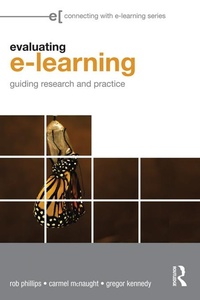
Evaluating e-Learning
Guiding Research and Practice
1st Edition
Published on 22. March 2012
240 pages
978-1-136-69951-1 (ISBN)
Description

How can novice e-learning researchers and postgraduate learners develop rigorous plans to study the effectiveness of technology-enhanced learning environments? How can practitioners gather and portray evidence of the impact of e-learning? How can the average educator who teaches online, without experience in evaluating emerging technologies, build on what is successful and modify what is not?
By unpacking the e-learning lifecycle and focusing on learning, not technology, Evaluating e-Learning attempts to resolve some of the complexity inherent in evaluating the effectiveness of e-learning. The book presents practical advice in the form of an evaluation framework and a scaffolded approach to an e-learning research study, using divide-and-conquer techniques to reduce complexity in both design and delivery. It adapts and builds on familiar research methodology to offer a robust and accessible approach that can ensure effective evaluation of a wide range of innovative initiatives, including those covered in other books in the Connecting with e-Learning series.
Readers will find this jargon-free guide is a must-have resource that provides the proper tools for evaluating e-learning practices with ease.
By unpacking the e-learning lifecycle and focusing on learning, not technology, Evaluating e-Learning attempts to resolve some of the complexity inherent in evaluating the effectiveness of e-learning. The book presents practical advice in the form of an evaluation framework and a scaffolded approach to an e-learning research study, using divide-and-conquer techniques to reduce complexity in both design and delivery. It adapts and builds on familiar research methodology to offer a robust and accessible approach that can ensure effective evaluation of a wide range of innovative initiatives, including those covered in other books in the Connecting with e-Learning series.
Readers will find this jargon-free guide is a must-have resource that provides the proper tools for evaluating e-learning practices with ease.
Reviews / Votes
"Education scholars Phillips, Carmel McNaught , and Gregor Kennedy offer a step-by-step guide to designing and conducting a study evaluating electronic learning, particularly addressing acknowledged weaknesses in the quality of research so far. They intend the book to be used by practitioners and researchers in formal and informal settings."--Reference and Research Book News Julie-Ann Sime Lancaster University (Areas of speciality: E-learning, evaluation, research methods)I would recommend this book to my distance learning, doctoral students in e-Research and Technology Enhanced Learning, as it provides a good source of evaluation methods, models and frameworks as well as presenting international examples of practice.
This book is particularly appealing because it is not based on a single approach to evaluation of e-learning but gives an overview of a range of methods appropriate for a variety of situations from an educator wanting to improve practice in small ways to evaluation of development projects. It adopts a pragmatic approach and is illustrated by case studies including mixed methods approaches that adopt 3 different perspectives on evaluation. This multi-perspective approach is particularly distinctive and appealing.
Alejandro Armellini, University of Leicester (Areas of specialty:Peadagogy in online learning environments, learning technologies)
It certain would sell copies overseas, especially given the origins of the authors and likely endorsements.
I would steer clear of topics on which hundreds of books have already been written (eg the typical research methods stuff, such as instruments, validity, triangulation, paradigms...) instead, I'd focus on the specifics of evaluating e-learning - what makes e-learning evaluation different from other forms of educational research?
More details
Series
Language
English
Place of publication
London
United Kingdom
Publishing group
Taylor & Francis Ltd
Target group
Professional and scholarly
Product notice
Reflowable
Illustrations
8 s/w Zeichnungen, 32 s/w Tabellen
32 Tables, black and white; 8 Line drawings, black and white
File size
3,53 MB
ISBN-13
978-1-136-69951-1 (9781136699511)
Copyright in bibliographic data and cover images is held by Nielsen Book Services Limited or by the publishers or by their respective licensors: all rights reserved.
Schweitzer Classification
Other editions
Additional editions
Book
07/2011
1st Edition
Routledge
€74.10
Shipment within 15-20 days
Book
07/2011
1st Edition
Routledge
€231.70
Shipment within 15-20 days
Persons
Rob Phillips is Associate Professor in the Educational Development Centre at Murdoch University, Australia.
Carmel McNaught is the Director and Chair Professor in the Centre for Learning Enhancement And Research (CLEAR) at The Chinese University of Hong Kong.
Gregor Kennedy is Director of e-Learning and Associate Professor of Educational Technology in the Centre for the Study of Higher Education at The University of Melbourne. His current work involves leading the university's strategy in technology-enhanced learning and teaching, supporting staff in the use of learning technologies, and undertaking research in the area of e-Learning. He has a background in psychology and has spent the past 15 years conducting and overseeing research and development in educational technology in higher education.
Carmel McNaught is the Director and Chair Professor in the Centre for Learning Enhancement And Research (CLEAR) at The Chinese University of Hong Kong.
Gregor Kennedy is Director of e-Learning and Associate Professor of Educational Technology in the Centre for the Study of Higher Education at The University of Melbourne. His current work involves leading the university's strategy in technology-enhanced learning and teaching, supporting staff in the use of learning technologies, and undertaking research in the area of e-Learning. He has a background in psychology and has spent the past 15 years conducting and overseeing research and development in educational technology in higher education.
Content
Preface
I. Setting the Scene
1. E-learning, learning and evaluation
2. Evaluation as part of a teacher's role
II. Theory
3. The Learning Environment, Learning Processes and Learning Outcomes (LEPO) Framework
4. What is meant by educational evaluation and research?
5. Research paradigms and methodologies
6. Evaluation-research approaches suitable for e-learning
7. The process of carrying out evaluation research
8. Evaluation research across the e-learning lifecycle
9. Conducting an Evaluation-research Study
10. Project-management Evaluation
11. Using evaluation-research results: An overview of impact issues beyond the confines of a single project
I. Setting the Scene
1. E-learning, learning and evaluation
2. Evaluation as part of a teacher's role
II. Theory
3. The Learning Environment, Learning Processes and Learning Outcomes (LEPO) Framework
4. What is meant by educational evaluation and research?
5. Research paradigms and methodologies
6. Evaluation-research approaches suitable for e-learning
7. The process of carrying out evaluation research
8. Evaluation research across the e-learning lifecycle
9. Conducting an Evaluation-research Study
10. Project-management Evaluation
11. Using evaluation-research results: An overview of impact issues beyond the confines of a single project
