

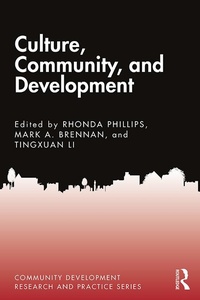
Culture, Community, and Development
1st Edition
Published on 3. February 2020
270 pages
978-0-429-95114-5 (ISBN)
Description

Culture is a living thing. In social settings, it is often used to represent entire ways of life, including rules, values, and expected behavior. Varying from nation to nation, neighborhood to neighborhood and beyond, even in the smallest localities, culture is a motivating factor in the creation of social identity and serves as a basis for creating cohesion and solidarity.
This book explores the intersection of culture and community as a basis for locally and regionally based development by focusing on three core bodies of literature: theory, research, and practice. The first section, theory, uncovers some of the relevant historical arguments, as well as more contemporary examinations. Continuing, the research section sheds light on some of the key concepts, variables, and relationships present in the limited study of culture in community development. Finally, the practice section brings together research and theory into applied examples from on the ground efforts.
During a time where the interest to retain the uniqueness of local life, traditions, and culture is significantly increasing in community-based development, the authors offer a global exploration of the impacts of culturally based development with comparative analysis in countries such as Korea, Ireland, and the United States. A must-read for community development planners, policymakers, students, and researchers.
This book explores the intersection of culture and community as a basis for locally and regionally based development by focusing on three core bodies of literature: theory, research, and practice. The first section, theory, uncovers some of the relevant historical arguments, as well as more contemporary examinations. Continuing, the research section sheds light on some of the key concepts, variables, and relationships present in the limited study of culture in community development. Finally, the practice section brings together research and theory into applied examples from on the ground efforts.
During a time where the interest to retain the uniqueness of local life, traditions, and culture is significantly increasing in community-based development, the authors offer a global exploration of the impacts of culturally based development with comparative analysis in countries such as Korea, Ireland, and the United States. A must-read for community development planners, policymakers, students, and researchers.
Reviews / Votes
"Culture, Community, and Development is an excellent resource for scholars of community development, creative placemaking, and cultural policy. The authors demystify and annotate the deep and fluid relationships among local arts, culture, and community well-being. The book provides a holistic view of current practices and research in this field."-Leonardo Vazquez, AICP/PP, Executive Director, The National Consortium for Creative Placemaking, USA"Over the past century, community development and public policy have almost entirely focused on our material lives-with resources flowing to jobs, housing, training, and infrastructure. But, humans also live in a symbolic world-as Clifford Geertz reminds us, 'we are suspended in webs of meaning we ourselves have spun.' Culture, Community, and Development is an indispensable volume for understanding the symbolic dimensions of community development. The editors have woven together theory, empirical research and policy into a compendium that gets at the heart of community change-the role of art, culture, heritage, and local knowledge for building connectivity, identity, cohesion, resilience and civic capacity."-Steven Tepper, Dean and Director, Foundation Professor, Herberger Institute for Design and the Arts, Arizona State University, USA
More details
Series
Edition
1. Auflage
Language
English
Place of publication
London
United Kingdom
Publishing group
Taylor & Francis Ltd
Target group
College/higher education
Professional and scholarly
Illustrations
24 Tables, black and white; 9 Line drawings, black and white; 5 Halftones, black and white; 14 Illustrations, black and white
ISBN-13
978-0-429-95114-5 (9780429951145)
Copyright in bibliographic data and cover images is held by Nielsen Book Services Limited or by the publishers or by their respective licensors: all rights reserved.
Schweitzer Classification
Other editions
Additional editions
Rhonda Phillips | Mark A. Brennan | Tingxuan Li
Culture, Community, and Development
Book
02/2020
1st Edition
Routledge
€63.50
Shipment within 10-20 days
Rhonda Phillips | Mark A. Brennan | Tingxuan Li
Culture, Community, and Development
Book
02/2020
1st Edition
Routledge
€206.60
Shipment within 10-20 days
Persons
Rhonda Phillips, Ph.D., FAICP is a community development and planning specialist. Her first book, Concept Marketing for Communities, profiled towns using innovative branding strategies for arts-based development. She's presented arts-based development workshops across the US and globally as a Fulbright Scholar and with a US AID project. Rhonda is Professor and Dean, Purdue University and author/editor of 26 books on community development and related topics. She is a member of the American Institute of Certified Planners College of Fellows.
Mark A. Brennan is Professor, Leadership and Community Development and UNESCO Chair in Community, Leadership, and Youth Development at the Pennsylvania State University. Dr. Brennan's teaching, research, writing, and program development concentrate on the role of civic engagement in the youth, community, and rural development process. He has over 25 years' experience designing, conducting, and analyzing social science research related to community and development.
Tingxuan Li is an Assistant Professor in the Graduate School of Education at Shanghai Jiao Tong University. Tina earned her Ph.D. in 2019 from the College of Education at Purdue University. At Purdue, she was a key personnel on multiple projects funded by the National Science Foundation as well as a member of Dr. Rhonda Phillips's research group. Tina was born and raised in Inner Mongolia Autonomous Region, China.
Mark A. Brennan is Professor, Leadership and Community Development and UNESCO Chair in Community, Leadership, and Youth Development at the Pennsylvania State University. Dr. Brennan's teaching, research, writing, and program development concentrate on the role of civic engagement in the youth, community, and rural development process. He has over 25 years' experience designing, conducting, and analyzing social science research related to community and development.
Tingxuan Li is an Assistant Professor in the Graduate School of Education at Shanghai Jiao Tong University. Tina earned her Ph.D. in 2019 from the College of Education at Purdue University. At Purdue, she was a key personnel on multiple projects funded by the National Science Foundation as well as a member of Dr. Rhonda Phillips's research group. Tina was born and raised in Inner Mongolia Autonomous Region, China.
Content
Introduction 1. Culture, Community and Development: A Critical Interrelationship Theory and Framework 2. A Proposal: Stand for Civic Engagement 3. Intercultural Learning among Community Development Students: Positive Attitudes, Ambivalent Experiences Research 4. Exploring the Dimensional Structure of the Arts in Communities 5. Traditions and Play as Ways to Develop Community: The Case of Korea's Belt-Wrestling Known as Ssireum 6. Irish Diaspora and Sporting Cultures of Conflict, Stability and Unity: Analysing the Power Politics of Community Development, Resistance and Disempowerment Through a Case Study Comparison of Benny Lynch and 'The Glasgow Effect' 7. Tradition, Cultures and Communities: Exploring the Potentials of Music and the Arts for Community Development in Appalachia Practice 8. Strange Bedfellows: Community Development, Democracy, and Magic 9. Working with Young People Through the Arts, Music and Technology: Emancipating New Youth Civic Engagement 10. More than Noise: Employing Hip-Hop Music to Inform Community Development Practice 11. Connecting Industry and the Arts for Community Development: The Art Hop of Burlington, Vermont Index
