

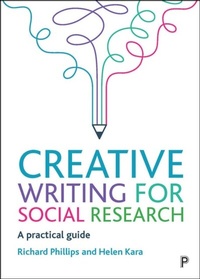
Creative Writing for Social Research
A Practical Guide
1st Edition
Published on 20. January 2021
224 pages
978-1-4473-5599-1 (ISBN)
Description

This groundbreaking book brings creative writing to social research. Its innovative format includes creatively written contributions by researchers from a range of disciplines, modelling the techniques outlined by the authors. The book is user-friendly and shows readers:
* how to write creatively as a social researcher;
* how creative writing can help researchers to work with participants and generate data;
* how researchers can use creative writing to analyse data and communicate findings.
Inviting beginners and more experienced researchers to explore new ways of writing, this book introduces readers to creatively written research in a variety of formats including plays and poems, videos and comics. It not only gives social researchers permission to write creatively but also shows them how to do so.
* how to write creatively as a social researcher;
* how creative writing can help researchers to work with participants and generate data;
* how researchers can use creative writing to analyse data and communicate findings.
Inviting beginners and more experienced researchers to explore new ways of writing, this book introduces readers to creatively written research in a variety of formats including plays and poems, videos and comics. It not only gives social researchers permission to write creatively but also shows them how to do so.
Reviews / Votes
"A fantastic book, a polyvocal story and a guide to creative practice with great examples and exercises. Once I started, I couldn't put it down! Essential reading for all social researchers and research methods students." Maggie O'Neill, University College Cork"My dog-eared and scribbled-upon copy of Creative Writing for Social Research: A Practical Guide sits within reach of my desk. I am beginning my creative writing adventure and fully anticipate its condition will worsen considerably as I progress through my research project." Aotearoa New Zealand Social Work
More details
Edition
First Edition
Language
English
Place of publication
Bristol
United Kingdom
Publishing group
Bristol University Press
Target group
Professional and scholarly
Illustrations
30 s/w Abbildungen
30 Illustrations, black and white
ISBN-13
978-1-4473-5599-1 (9781447355991)
DOI
https://doi.org/10.51952/9781447355991
Copyright in bibliographic data and cover images is held by Nielsen Book Services Limited or by the publishers or by their respective licensors: all rights reserved.
Schweitzer Classification
Other editions
Additional editions
E-Book
01/2021
1st Edition
Policy Press
€48.99
Available for download
Book
01/2021
1st Edition
Policy Press
€105.50
Shipment within 15-20 days
Book
01/2021
1st Edition
Policy Press
€46.70
Shipment within 15-20 days
Persons
Richard Phillips is Professor of Human Geography at the University of Sheffield. He is a specialist in creative and arts-led research methodologies, which he practises in his own work and encourages students to try in the field trips he leads in cities from Liverpool to New York. Richard's books include Georges Perec's Geographies (2019), Fieldwork for Human Geography (2012), Sex, Politics and Empire (1996), and Mapping Men and Empire: A Geography of Adventure (1997).
Helen Kara has been an independent researcher since 1999 and specialises in research methods and ethics. She is the author of Creative Research Methods: A Practical Guide (Policy Press, 2nd ed. 2020) and Research Ethics in the Real World: Euro-Western and Indigenous Perspectives (Policy Press, 2018). Helen is an Honorary Senior Research Fellow at the University of Manchester, and a Fellow of the Academy of Social Sciences.
Helen Kara has been an independent researcher since 1999 and specialises in research methods and ethics. She is the author of Creative Research Methods: A Practical Guide (Policy Press, 2nd ed. 2020) and Research Ethics in the Real World: Euro-Western and Indigenous Perspectives (Policy Press, 2018). Helen is an Honorary Senior Research Fellow at the University of Manchester, and a Fellow of the Academy of Social Sciences.
Content
INTRODUCTION
Definitions
~ Social research
~ Creativity and creative
~ Writing and creative writing
Synergies between creative writing and social research
What follows
DOING CREATIVE WRITING
Introduction
Doing it yourself: getting started
~ Reading for writing
~ Small steps and time frames
~ Warm-up exercises
Putting yourself in the picture
~ Writing in the first person
~ Diaries and journals
Observation and description
~ Autoethnography
~ Observational writing and the implied observer
~ Stories and storying
~ Collecting and transcribing stories
Writing about ideas: essays and lists
~ Essays
~ Lists and listing
Doing it yourself: following through
~ Drafting and editing
~ Seeking and receiving feedback
~ Writing together
DOING RSEARCH, GENERATING DATA, WORKING WITH PARTICIPANTS
Introduction
~ Rationale
~ Ethics
Getting started: participatory creative writing for social research
~ What is a participant?
~ How to invite or recruit participants
Workshops and groups
~ How to draw participants together into a cohesive group
~ Playful workshops
~ Getting started, warming up
~ How to write, review and revise together: workshopping
~ Scope
Working with individuals
~ Varying roles for participants and facilitators
Data and findings: process and product
~ Observing and documenting the creative writing process
~ Product: outputs and impacts
EXPLORING AND ARTICULATING FINDINGS
Introduction
Data analysis
~ Fiction in data analysis
~ Poetry in data analysis
~ Play and screenplay writing in data analysis
Dissemination
~ Visual methods of writing for dissemination
~ Performance for dissemination
~ Comedy in dissemination
Finding and telling stories; storying
SEARCHING AND QUEER(ING) WRITING
Introduction
Searching
Queer(ing) writing
Definitions
~ Social research
~ Creativity and creative
~ Writing and creative writing
Synergies between creative writing and social research
What follows
DOING CREATIVE WRITING
Introduction
Doing it yourself: getting started
~ Reading for writing
~ Small steps and time frames
~ Warm-up exercises
Putting yourself in the picture
~ Writing in the first person
~ Diaries and journals
Observation and description
~ Autoethnography
~ Observational writing and the implied observer
~ Stories and storying
~ Collecting and transcribing stories
Writing about ideas: essays and lists
~ Essays
~ Lists and listing
Doing it yourself: following through
~ Drafting and editing
~ Seeking and receiving feedback
~ Writing together
DOING RSEARCH, GENERATING DATA, WORKING WITH PARTICIPANTS
Introduction
~ Rationale
~ Ethics
Getting started: participatory creative writing for social research
~ What is a participant?
~ How to invite or recruit participants
Workshops and groups
~ How to draw participants together into a cohesive group
~ Playful workshops
~ Getting started, warming up
~ How to write, review and revise together: workshopping
~ Scope
Working with individuals
~ Varying roles for participants and facilitators
Data and findings: process and product
~ Observing and documenting the creative writing process
~ Product: outputs and impacts
EXPLORING AND ARTICULATING FINDINGS
Introduction
Data analysis
~ Fiction in data analysis
~ Poetry in data analysis
~ Play and screenplay writing in data analysis
Dissemination
~ Visual methods of writing for dissemination
~ Performance for dissemination
~ Comedy in dissemination
Finding and telling stories; storying
SEARCHING AND QUEER(ING) WRITING
Introduction
Searching
Queer(ing) writing
