

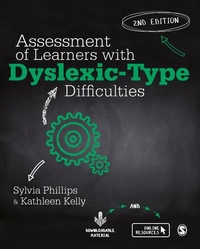
Assessment of Learners with Dyslexic-Type Difficulties
2nd Edition
Published on 24. May 2018
392 pages
978-1-5264-5141-5 (ISBN)
Description

Reinforcing best practice techniques, the second edition of this specialist guide for the assessment of learners with dyslexic-type difficulties includes:
- a new chapter on The Implications of Co-existing Specific Learning Difficulties
- updates to legislation including the SEND Code of Practice
- updates to specific diagnostic tests
- examples of interpreting test profiles
- photocopiable resources available to download from the website
This comprehensive guide enables teachers to understand a range of approaches to the assessment of children with dyslexic-type difficulties. It is an essential companion for those training to be specialist teachers of learners with dyslexia and a useful resource for all SENCOs, and teachers new or experienced.
- a new chapter on The Implications of Co-existing Specific Learning Difficulties
- updates to legislation including the SEND Code of Practice
- updates to specific diagnostic tests
- examples of interpreting test profiles
- photocopiable resources available to download from the website
This comprehensive guide enables teachers to understand a range of approaches to the assessment of children with dyslexic-type difficulties. It is an essential companion for those training to be specialist teachers of learners with dyslexia and a useful resource for all SENCOs, and teachers new or experienced.
Reviews / Votes
Phillips and Kelly have done it again with this superb second edition of their Assessing of Learners with Dyslexia-type difficulties. The first edition enjoyed tremendous success and I am sure this updated and comprehensive edition will be warmly welcomed by teachers, specialist teachers and other professionals involved in the area of assessment. A welcome addition in this edition is the chapter on SpLD - a key area due to the coexistence between the different conditions associated with dyslexia. This is a superb buy and I am sure it will prove to be indispensible as a reference and daily guide for teachers and specialist teachers. -- Gavin Reid * Independent Practitioner Pyschologist * What a wonderful and timely text! Each chapter of this book can be used to support and develop those who are learning the complex set of skills required to become outstanding practitioners in this field. No other text on the assessment of dyslexia achieves the delicate balance of how to use a variety of methods in the identification process. This new edition is even more relevant as it matches the most up-to-date forms of assessment with how these should be delivered within the current legal framework. This book should be a key text on the resource list of all programmes who are developing the dyslexia assessors of the future! -- Graeme Dobson The second edition of this invaluable book will no doubt become one of the key texts for our Masters in SpLD (dyslexia) at UCL, IOE. This book provides an accessible, yet comprehensive look at issues surrounding assessment of learners with dyslexia. Essential reading for specialist teachers, SENCos and all educational professionals. Kelly and Philips use an evidence based approach which is grounded in theory. -- Elisabeth HerbertMore details
Edition
Second Edition
Language
English
Place of publication
London
United Kingdom
Target group
Professional and scholarly
Product notice
Reflowable
ISBN-13
978-1-5264-5141-5 (9781526451415)
Copyright in bibliographic data and cover images is held by Nielsen Book Services Limited or by the publishers or by their respective licensors: all rights reserved.
Schweitzer Classification
Other editions
Additional editions
Sylvia Phillips | Kathleen Kelly
Assessment of Learners with Dyslexic-Type Difficulties
Book
06/2018
2nd Edition
SAGE Publications Ltd
€86.90
Shipment within 15-20 days
Sylvia Phillips | Kathleen Kelly
Assessment of Learners with Dyslexic-Type Difficulties
Book
06/2018
2nd Edition
SAGE Publications Ltd
€198.30
Shipment within 15-20 days
Persons
Sylvia Phillips, BA, DASE, MEd (SEN), AMBDA, Cert. TESL, began her career as a teacher of English in secondary schools where she first became interested in why some learners had severe literacy difficulties. She later joined Manchester Metropolitan University where she was a Principal Lecturer, Head of SEN, and then Head of Continuing Professional Development. At MMU she developed the first courses for specialist teachers of learners with dyslexia at both undergraduate and postgraduate levels. During that time she worked in primary, secondary and special schools both with teachers and directly with pupils. She taught on several SEND courses for teachers (particularly training SENDCos) and was the UK partner (with Italy, Belgium and Spain) developing and teaching courses on 'Inclusion and SEN' for European educationalists. She has served on the Accreditation Board of the British Dyslexia Association but left when she became a specialist member of the SEND Tribunal service. She has been involved in several dyslexia research projects developing teaching materials. In recent years she led the AMBDA courses for Wrexham Glyndwr University and was a part-time tutor to the AMBDA course at Stanmillis University College, Belfast. She is co-author of Phillips and Kelly (2018) Assessment of Learners with Dyslexic- Type Difficulties, 2nd edition.
Dr Kathleen Kelly PhD, MA (SEN), Dip TESL, AMBDA, is an independent consultant and trainer in the field of specific learning difficulties. For many years she was a Senior Lecturer at Manchester Metropolitan University in the Centre for Inclusion and Disability Studies where she was Programme Leader for the MA in Specific Learning Difficulties and the Post Graduate Certificate in Dyscalculia. For several years she has taught courses on specific learning difficulties as part of the initial teacher training programme in addition to postgraduate awards. She has presented papers in this area at a number of international conferences and was part of the MMU research team that evaluated the Department for Education funded project 'Teaching for neurodiversity' led and coordinated by the British Dyslexia Association (2017). She has considerable experience in delivering courses to meet the criteria set out by the British Dyslexia Association for Approved Teacher Status (ATS) and is an Associate Member of the British Dyslexia Association (AMBDA). She was a member of the SASC/BDA working party (2019) which was set up to develop a new definition of dyscalculia and to produce guidance on identification and assessment.
Kathleen has taught a wide range of learners with dyslexia, from children as young as 4 years to 16 years. She has worked in both mainstream and special schools, for language support and learning support services, as a SENCO in a primary school, and as Head of Sixth Form in a special school. She has many years of experience in supporting multilingual children with special educational needs (including specific learning difficulties). Multilingualism and dyslexia is a particular area of interest, and her doctorate was also in this area. She is co-author of Phillips and Kelly (2018) Assessment of Learners with Dyslexic-Type Difficulties, 2nd edition and author of Kelly (2020) Identifying, Assessing and Supporting Learners with Dyscalculia.
Dr Kathleen Kelly PhD, MA (SEN), Dip TESL, AMBDA, is an independent consultant and trainer in the field of specific learning difficulties. For many years she was a Senior Lecturer at Manchester Metropolitan University in the Centre for Inclusion and Disability Studies where she was Programme Leader for the MA in Specific Learning Difficulties and the Post Graduate Certificate in Dyscalculia. For several years she has taught courses on specific learning difficulties as part of the initial teacher training programme in addition to postgraduate awards. She has presented papers in this area at a number of international conferences and was part of the MMU research team that evaluated the Department for Education funded project 'Teaching for neurodiversity' led and coordinated by the British Dyslexia Association (2017). She has considerable experience in delivering courses to meet the criteria set out by the British Dyslexia Association for Approved Teacher Status (ATS) and is an Associate Member of the British Dyslexia Association (AMBDA). She was a member of the SASC/BDA working party (2019) which was set up to develop a new definition of dyscalculia and to produce guidance on identification and assessment.
Kathleen has taught a wide range of learners with dyslexia, from children as young as 4 years to 16 years. She has worked in both mainstream and special schools, for language support and learning support services, as a SENCO in a primary school, and as Head of Sixth Form in a special school. She has many years of experience in supporting multilingual children with special educational needs (including specific learning difficulties). Multilingualism and dyslexia is a particular area of interest, and her doctorate was also in this area. She is co-author of Phillips and Kelly (2018) Assessment of Learners with Dyslexic-Type Difficulties, 2nd edition and author of Kelly (2020) Identifying, Assessing and Supporting Learners with Dyscalculia.
Content
PART I: Dyslexic-Type Difficulties and Assessment: Setting the Context
Chapter 1: Dyslexic-Type Difficulties: Implications for Assessment
Chapter 2: The Implications of Co-existing Specific Learning Difficulties
Chapter 3: Purposes and Forms Of Assessment
Chapter 4: Legislation, Policy and Practice
Part II: Starting the Process
Chapter 5: Identification and Screening
Chapter 6: Gathering Information from Others
Part III: Informal Approaches to Assessment
Chapter 7: Informal Approaches: Assessing Diffuculties in Reading
Chapter 8: Informal Approaches: Assessing Spelling Difficulties
Chapter 9: Informal Approaches: Assessing Difficulties in Handwriting
Chapter 10: Assessing Alphabetic Knowledge
Chapter 11: Assessing Cognitive Processing Skills
Chapter 12: Assessing Difficulties in Mathematics
Part IV: Formal Assessment
Chapter 13: Principles and Concepts of Psychometrics
Chapter 14: Standardised Assessment of Reading
Chapter 15: Standardised Assessment of Spelling and Handwriting
Chapter 16: The Assessment of Underlying Ability
Chapter 17: Standardised Assessment of Cognitive Processing Skills
Chapter 18: Standardised Assessment of Mathematics and Dyscalculia
Part V: Managing the Assessment Process
Chapter 19: Conducting Assessment
Chapter 20: Writing an Assessment Report
Chapter 21: Assessment by Other Professionals
Chapter 1: Dyslexic-Type Difficulties: Implications for Assessment
Chapter 2: The Implications of Co-existing Specific Learning Difficulties
Chapter 3: Purposes and Forms Of Assessment
Chapter 4: Legislation, Policy and Practice
Part II: Starting the Process
Chapter 5: Identification and Screening
Chapter 6: Gathering Information from Others
Part III: Informal Approaches to Assessment
Chapter 7: Informal Approaches: Assessing Diffuculties in Reading
Chapter 8: Informal Approaches: Assessing Spelling Difficulties
Chapter 9: Informal Approaches: Assessing Difficulties in Handwriting
Chapter 10: Assessing Alphabetic Knowledge
Chapter 11: Assessing Cognitive Processing Skills
Chapter 12: Assessing Difficulties in Mathematics
Part IV: Formal Assessment
Chapter 13: Principles and Concepts of Psychometrics
Chapter 14: Standardised Assessment of Reading
Chapter 15: Standardised Assessment of Spelling and Handwriting
Chapter 16: The Assessment of Underlying Ability
Chapter 17: Standardised Assessment of Cognitive Processing Skills
Chapter 18: Standardised Assessment of Mathematics and Dyscalculia
Part V: Managing the Assessment Process
Chapter 19: Conducting Assessment
Chapter 20: Writing an Assessment Report
Chapter 21: Assessment by Other Professionals
