

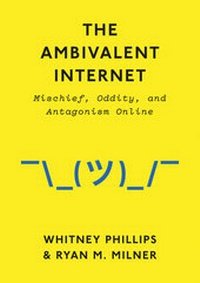
The Ambivalent Internet
Description

Reviews / Votes
"Memes, trolling and weird internet jokes are becoming part of the everyday language of contemporary societies, whether occupying centre stage in mainstream politics or scuttling around in the darkest corners of the web. In this book, two leading scholars of digital communication have joined forces, in turn bringing folklore together with rigorously forensic studies of internet culture to create a new theoretical vocabulary for understanding, researching and teaching the Internet?s multiple vernaculars." Jean Burgess, Queensland University of Technology "From pranks and tasteless jokes to political propaganda, it?s never been more important to face how online media give rise to and amplify the longstanding communal practices that lie between play and hate, fun and cruelty. Like its subject, this book is both entertaining and disturbing. It?s an honest, uneasy, and essential reckoning. You?ll laugh, feel bad you did, and understand." Nancy Baym, Principal Researcher at Microsoft ResearchMore details
Other editions
Additional editions
Persons
Content
1
Folkloric Expression
Long before either of us were internet scholars, long before either of us even knew what a scholar was, we were students of everyday folk expression. We wouldn't be the people we are today, and certainly not the scholars we are today, if folkloric expression hadn't so fundamentally shaped our humor, our values, and our basic understanding of the world. Similarly, online ambivalence would be a pale shadow of itself without folklore to blur so many normative boundaries.
This chapter will chronicle these blurred boundaries, emphasizing the overlap between then and now, formal and folk, and commercial and populist. It will focus most intently on then and now, connecting dirty limericks, high school hijinks, saucy photocopier art, Facebook antagonisms, laughter at tragedy, and a fun fellow named Uncle Dolan. As we'll see, every shared meme, every dark joke, every photoshopped image sexually corrupting a beloved children's icon, is a bridge between past and present, pre- and post-internet. Understanding the newest of the new necessitates tracing these connections; new dirt from old soil.
In addition to emphasizing continuity, the chapter will also emphasize divergence. This divergence can be attributed, first and foremost, to the affordances of digital mediation: modularity, modifiability, archivability, and accessibility in particular. These affordances accelerate familiar embodied ambivalence, immediately complicating ethical assessment and even basic classification of digitally mediated content. Irony can be especially difficult to parse from earnestness online, and problematic perspectives can be amplified just as easily as pro-social ones. These new contours coexist alongside all that has come before, a point of ambivalence that will underscore each of the subsequent chapters.
The essentials of folklore
Some of Milner's earliest exposure to ambivalent folkloric expression occurred during adolescence. When he came of age around 12, he was permitted to join the men on his mom's side of the family for their annual male bonding fishing trip. Although not much one for fishing (or rigid gender segregation), Milner nonetheless enjoyed his nights around the fire year after year in rural Missouri, trading jokes and stories as the Jack Daniels flowed and the conversations grew more ribald. Milner and his cousins were interrogated by various uncles and fathers about their moral purity; those same uncles and fathers then happily told story after story undercutting their own moral purity. Barbs were traded about love, politics, and "just what kind of bullshit" Milner's brother Eric had added to the night's playlist of background music. On these nights, Milner often found himself laughing along with the family, despite some of the troubling commentary being shared. And by the time Pappaw - mostly drunk and mostly toothless - began to recite from Uncle Dave's hallowed dirty limerick book, Milner was reciting right along: "There once was a fellow named Skinner, who took a young lady to dinner ."
Phillips' introduction to folkloric ambivalence corresponded with her burgeoning and now decades-long friendship with fellow weirdo Katie - or as 12-year-old Phillips called her for reasons neither can remember, "Bob" (Phillips, for similarly nebulous reasons, was "Artie"). The two would spend their all-day Saturday track meets giggling at stories from the Weekly World News, a campy tabloid featuring accounts of Bat Children, toilets haunted by plumbers' ghosts, and socialites impregnated by Bigfoot, among countless other gems of anti-journalism. They would also play pranks like tying a dollar bill to fishing wire, setting the bait, then tugging it away when someone would bend down for a pick-up (Phillips thinks this was something they learned from The Simpsons). And then there were their ongoing adventures with various adult enemies at meets and during practice, which they would chronicle in their self-published (that is to say, hand-drawn and shown to their mothers) newspaper, The Larry Times (don't ask); targets included a heartless fiend they dubbed "Achum," somebody's cranky mother who passed out jelly beans after practice and would squirrel away all the delicious reds for herself (Achum's name was derived from the sound the two assumed she made when she ate them).
To those who presume, as many people do, that folklore is comprised of "old stuff" like fairy tales, traditional dances, and spoken word performances, Milner's example might seem more obviously folkloric. It takes place around a campfire, involves alcohol and the spontaneous recitation of poetry, features an older generation bestowing dubious wisdom onto the younger generation, is vaguely ritualistic, and is gender-segregated (rude, Phillips snorts). Phillips' example, conversely, might not seem folkloric at all. It's restricted to inside jokes between two friends (and their bemused mothers), engages with mass media, and trades "traditional" locations like a campfire for youth track meets and practices. But both Phillips' and Milner's examples are folkloric, and understanding why is the first step in understanding the folkloric dimensions of ambivalent expression online.
The first point to mention is that there's no inherent rule that folk expression must consist of "old stuff." Rather than solely investigating the past, the discipline of folklore is concerned more broadly with the relationship between the folk - which prominent folklorist Alan Dundes famously described as "any group of people whatsoever who share at least one common factor" (1980, 6) - and their lore. Lore (also known as "folklore," like the discipline itself) is a fraught concept, but broadly defined consists of expressive creations (Radner 1993), expressive phenomena (Toelken 1996), and, perhaps most simply, the "stuff that people share" (Howard, quoted in Owens 2013) within a particular cultural circumstance. As Trevor J. Blank (2013) notes, this circumstance needn't necessarily span vast stretches of time, although of course it can. What matters most is that these expressions communicate "consistencies that allow a person or group to perceive expressions as traditional, locally derived, or community generated" (xiv). Both Milner's and Phillips' examples meet these criteria; each story revolves around a stable (if small) group with many factors in common, and each is steeped in consistent, locally derived traditions that in both cases have persisted for decades.
But tradition isn't folklore's only focus. Augmenting (and complicating) this focus, the discipline also foregrounds what Jan Harold Brunvand (2001) calls "multiple variation": the transformation of familiar expressions as they spread through new moments and audiences. Barre Toelken (1996) describes this process using the twin laws of conservatism and dynamism. As Toelken explains, conservative folkloric elements are stable; they are the aspects of a particular tradition that are passed down from generation to generation. Dynamic elements are those that evolve over time, and allow participants to personalize an event or behavior while still maintaining ties to tradition. Both Milner's and Phillips' experiences are underscored by these twin laws. In the case of Milner's family, fixed elements like excessive consumption of Jack Daniels, limerick readings, and the exchange of stories and life lessons were balanced by variations of the precise limericks, stories, and life lessons (read: unsolicited sex advice) that were shared and subsequently built upon during the next year's trip. For Phillips and Katie, their shared love of campy media and oddity generally, along with an eye for a particular kind of mischief, served as a consistent backdrop for the emergent jokes that evolved and became tangled into new expressions as the decades wore on.
The interplay between conservative precedent and dynamic transformation places folklore squarely within the realm of the vernacular. Folklorist Robert Glenn Howard (2008) foregrounds two common forms of vernacular expression, each consisting of dynamic innovations on conservative communicative standards: common vernacular and subaltern vernacular. As Howard explains, common vernacular is "held separate from the formal discursive products" (494) of existing institutions. It is, to use a very basic example, the difference between slang and words listed in a dictionary (or between "Achum" and whatever that poor woman's real name was). Subaltern vernacular, expression forwarded by individuals on the cultural margins, hinges as much on who is doing the communicating as it does on what, specifically, these individuals are expressing. Subaltern vernacular is doubly noninstitutional, in other words; the messages themselves run counter to formal or otherwise codified discourse, and so do the people transmitting the message. Reclamations of racist, sexist, or homophobic epithets by the groups these terms have been deployed against is an example of subaltern vernacular.
Both dimensions of vernacular expression are essential to the churning wheel of tradition and transformation that is folklore. And as they trace this churn, folklorists are ultimately tracing how...
