

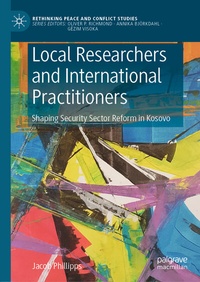
Local Researchers and International Practitioners
Description

This book is driven by the question: what role is played by the local security research community in Kosovo's internationally-led Security Sector Reform? Kosovo's SSR has been heavily driven by international knowledge rather than the context-sensitive evidence, with negative implications for the legitimacy and sustainability of SSR. Centred on an analysis of an extensive interview survey of international SSR practitioners and local researchers in Kosovo and local research papers, this book highlights how local research has engaged with, challenged and contributed to international SSR. Despite the general experience of local marginalisation, local researchers have an important role to play. Following engagement with local research, international SSR practitioners may consider local context in greater depth and think more critically about SSR implications. This highlights the potentially key role that local researchers can play to support effective post-conflict recovery.
Reviews / Votes
" This empirically rich book provides a fascinating insight into the relationship between the 'internationals' and the locals in Kosovo. While Security Sector Reform is the primary focus, this insightful book will be of great interest to all who wish to understand the broader dynamics of statebuilding in Kosovo, and specifically the way local experts have been marginalised, to the detriment of progress in Kosovo." ( Aidan Hehir , Reader in International Relations, University of Westminster, UK)" In this rigorously researched and lucid study, Phillipps convincingly demonstrates the harmful effects resulting from internationally-led security sector reform processes that fail to effectively draw on and integrate local knowledge and expertise. Top-down and templated, existing approaches have been characterised by missed opportunities and untapped potential. This important book explains how and why local research can play a valuable and constructive role in shaping more effective, sustainable and legitimate post-conflict statebuilding efforts." ( Thomas Waldman , Senior Lecturer in International Security Studies, Macquarie University, Australia)
More details
Other editions
Additional editions
Person
Jacob Phillipps holds a PhD in International Studies and Social Science from Coventry University, UK, where he was awarded a 3-year Special Exhibition Studentship. Prior to this, he completed an MA in Post-War Recovery Studies with the University of York Post-War Reconstruction and Development Unit. He has worked and conducted extensive research in Bosnia-Herzegovina and Kosovo. He has presented his work in the UK and internationally, including at the International Studies Association annual convention, and published his academic work in peer-reviewed journals. Jacob has an ongoing interest in post-conflict recovery, peacebuilding, and the work of civil society organisations.
