

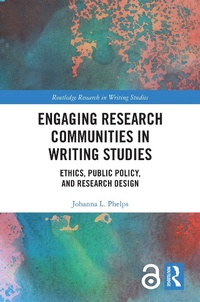
Engaging Research Communities in Writing Studies
Ethics, Public Policy, and Research Design
1st Edition
Published on 20. April 2021
216 pages
978-1-000-35767-7 (ISBN)
Description

This book invites readers to reconsider how writing studies researchers work with Institutional Review Boards (IRBs) on behalf of their communities and argues that engaging with IRBs during the research design process helps practitioners conduct research more quickly and effectively.
Using empirical data from both writing studies and extra-disciplinary contexts, Dr. Johanna Phelps presents findings from two discipline-wide studies, as well as metadata from two IRBs, to develop a principled engagement framework for writing studies researchers to interact with their communities. Phelps further examines the many facets of conducting research with human participants-from comprehending federal policy updates to pondering specific ethical issues to developing detailed research designs-and explores the confluence of ethics, policy, and methodology in a thoroughgoing philosophical investigation of writing studies as a public good.
This engaging and timely exploration of research design will be an important resource for scholars and students of writing studies; rhetoric and composition; technical and professional communication; cultural rhetoric; literacy studies; research design; research methodologies; research ethics; IRBs; justice; and critical theory.
Chapter 4 and Interchapter 4 of this book are freely available as a downloadable Open Access PDF at https://www.taylorfrancis.com/chapters/oa-mono/10.4324/9781003082002-9 under a Creative Commons Attribution-Non Commercial-No Derivatives 4.0 license.
Chapter 6 and Interchapter 6 of this book are freely available as a downloadable Open Access PDF at https://www.taylorfrancis.com/chapters/oa-mono/10.4324/9781003082002-13 under a Creative Commons Attribution-Non Commercial-No Derivatives 4.0 license.
Using empirical data from both writing studies and extra-disciplinary contexts, Dr. Johanna Phelps presents findings from two discipline-wide studies, as well as metadata from two IRBs, to develop a principled engagement framework for writing studies researchers to interact with their communities. Phelps further examines the many facets of conducting research with human participants-from comprehending federal policy updates to pondering specific ethical issues to developing detailed research designs-and explores the confluence of ethics, policy, and methodology in a thoroughgoing philosophical investigation of writing studies as a public good.
This engaging and timely exploration of research design will be an important resource for scholars and students of writing studies; rhetoric and composition; technical and professional communication; cultural rhetoric; literacy studies; research design; research methodologies; research ethics; IRBs; justice; and critical theory.
Chapter 4 and Interchapter 4 of this book are freely available as a downloadable Open Access PDF at https://www.taylorfrancis.com/chapters/oa-mono/10.4324/9781003082002-9 under a Creative Commons Attribution-Non Commercial-No Derivatives 4.0 license.
Chapter 6 and Interchapter 6 of this book are freely available as a downloadable Open Access PDF at https://www.taylorfrancis.com/chapters/oa-mono/10.4324/9781003082002-13 under a Creative Commons Attribution-Non Commercial-No Derivatives 4.0 license.
More details
Series
Edition
1. Auflage
Language
English
Place of publication
London
United Kingdom
Publishing group
Taylor & Francis Ltd
Target group
College/higher education
Illustrations
8 Tables, black and white; 7 Line drawings, black and white; 4 Halftones, black and white
ISBN-13
978-1-000-35767-7 (9781000357677)
Copyright in bibliographic data and cover images is held by Nielsen Book Services Limited or by the publishers or by their respective licensors: all rights reserved.
Schweitzer Classification
Other editions
Additional editions
Johanna Phelps
Engaging Research Communities in Writing Studies
Ethics, Public Policy, and Research Design
Book
09/2023
1st Edition
Routledge
€63.10
Shipment within 15-20 days
Johanna Phelps
Engaging Research Communities in Writing Studies
Ethics, Public Policy, and Research Design
Book
04/2021
1st Edition
Routledge
€206.20
Shipment within 15-20 days
Person
Johanna L. Phelps, PhD, MPA, is an Assistant Professor of English at Washington State University Vancouver. Her research on public policy's impact on writing studies has appeared in venues such as IEEE Transactions on Professional Communication and Present Tense. Her scholarship on paradigms, programmatic research, and community engagement has been published with Technical Communication Quarterly and Reflections.
Content
Introduction
First Interchapter: Defining and Historicizing Research with Human Participants
Chapter One: Situating Justice in the Research Enterprise
Second Interchapter: Surveys as a Data Collection Method in Writing Studies
Chapter Two: Metadata: What We Know About Research with Human Participants
Third Interchapter: "Medium" Data, Interviewing, and Corpus Analysis
Chapter Three: All "Spun Up": Findings from Familiar and Unfamiliar Methods
Fourth Interchapter: Collecting and Working with Census Data
Chapter Four: Don't be too WEIRD: Research for the Future of Writing Studies
Fifth Interchapter: Revisions to the Common Rule
Chapter Five: Ethical Praxis at Sites of Writing Studies Research
Sixth Interchapter: Questions to Consider when Designing Justice-Driven Research
Chapter Six: Centering Practical Ethics in Writing Studies Research
First Interchapter: Defining and Historicizing Research with Human Participants
Chapter One: Situating Justice in the Research Enterprise
Second Interchapter: Surveys as a Data Collection Method in Writing Studies
Chapter Two: Metadata: What We Know About Research with Human Participants
Third Interchapter: "Medium" Data, Interviewing, and Corpus Analysis
Chapter Three: All "Spun Up": Findings from Familiar and Unfamiliar Methods
Fourth Interchapter: Collecting and Working with Census Data
Chapter Four: Don't be too WEIRD: Research for the Future of Writing Studies
Fifth Interchapter: Revisions to the Common Rule
Chapter Five: Ethical Praxis at Sites of Writing Studies Research
Sixth Interchapter: Questions to Consider when Designing Justice-Driven Research
Chapter Six: Centering Practical Ethics in Writing Studies Research
