

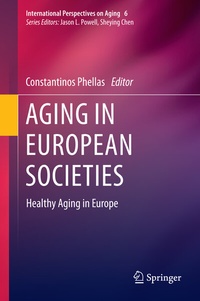
Aging in European Societies
Description

Between longer life expectancies and declining birth rates, Europe's elder population is growing into a sizable minority with considerable impact on nations, health systems, and economies-in other words, global implications as well as local and regional ones. Those investing in the health of older adults need a double perspective: the social and clinical complexity of aging and the larger forces shaping these experiences.
Aging in European Societies examines aging trends across the continent, analyzing individual and collective variables that affect the lives of older adults, and drawing salient comparisons with other parts of the world. An interdisciplinary panel of experts provides theory, research, and empirical findings (with examples from the UK, Cyprus, Sweden, and others) in key areas such as family and social supports, physical and cognitive changes, dependence and autonomy issues, and living arrangements. The book's wide-net approach offers insights into not only aging, but aging well. And of particular importance, it details approaches to defining and measuring the elusive but crucial concept, quality of life. Included in the coverage:
- The potential for technology to improve elders' quality of life.
- Dementia and quality of life issues.
- Changes in functional ability with aging and over time.
- Family networks and supports in older age.
- Factors influencing inequalities in quality of life.
- Late-life learning in the E.U.
Gerontologists, sociologists, health and cross-cultural psychologists, and public health policymakers will welcome Aging in European Societies as a springboard toward continued discussion, new directions for research, and improvements in policy and practice.
Reviews / Votes
From the reviews:
"I enjoyed and highly recommend this book. It provides an in-depth understanding of aging in Europe by combining scientific literature, data sources, analyses, and topics of discussion about aging in other contexts. Social policy makers and practitioners and scholars in gerontology, within the broad framework of social sciences, economics, psychology, and social work, as well as health and technological innovation designed for the elderly, will increase their knowledge through the practices and research results presented in this book." (Fermina Rojo-Pérez, Applied Research in Quality of Life, Vol. 8, 2013)More details
Other editions
Additional editions
Person
Content
Chapter 1 . Introduction.- Chapter 2. Challenging statutory pensions reforms in an aging Europe: Adequacy versus Sustainability.- Chapter 3 . Technology and Ageing: Potential for European Societies.- Chapter 4 . Dependency and individualism: The influence of modern ideologies on older people's food security.- Chapter 5 Cross-National Exploration of National Cultural Policy and Economic Characteristics.- Chapter 6. What about happiness in later life?.- Chapter 7. Dementia and Quality of Life Issues in Older People.- Chapter 8 . Changes in physical functional ability with ageing and over time.- Chapter 9. Family networks and supports in older age.- Chapter 10. Factors influencing inequalities in the quality of life.- Chapter 11. Older men in the community: A United Kingdom perspective.- Chapter 12. The Social Networks of Older Europeans.- Chapter 13. Financial Literacy in Retirement Planning Context: The Case of Czech Older Workers.- Chapter 14. Home nursing care of the elderly: The case of Cyprus.- Chapter 15. Quality of Life & Older People.- Chapter 16. Cohort change in living conditions and lifestyle among middle aged Swedes: The effects on mortality and late-life disability.- Chapter 17. Late-Life Learning in the European Union: Implications for Social and Public Policy.- Chapter 18. Transnationalism and the study of aging and old age.
