

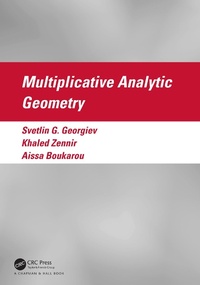
Multiplicative Analytic Geometry
1st Edition
Published on 24. November 2022
248 pages
978-1-000-72110-2 (ISBN)
Description

This book is devoted to multiplicative analytic geometry. The book reflects recent investigations into the topic. The reader can use the main formulae for investigations of multiplicative differential equations, multiplicative integral equations and multiplicative geometry.
The authors summarize the most recent contributions in this area. The goal of the authors is to bring the most recent research on the topic to capable senior undergraduate students, beginning graduate students of engineering and science and researchers in a form to advance further study. The book contains eight chapters. The chapters in the book are pedagogically organized. Each chapter concludes with a section with practical problems.
Two operations, differentiation and integration, are basic in calculus and analysis. In fact, they are the infinitesimal versions of the subtraction and addition operations on numbers, respectively. In the period from 1967 till 1970, Michael Grossman and Robert Katz gave definitions of a new kind of derivative and integral, moving the roles of subtraction and addition to division and multiplication, and thus established a new calculus, called multiplicative calculus. Multiplicative calculus can especially be useful as a mathematical tool for economics and finance.
Multiplicative Analytic Geometry builds upon multiplicative calculus and advances the theory to the topics of analytic and differential geometry.
The authors summarize the most recent contributions in this area. The goal of the authors is to bring the most recent research on the topic to capable senior undergraduate students, beginning graduate students of engineering and science and researchers in a form to advance further study. The book contains eight chapters. The chapters in the book are pedagogically organized. Each chapter concludes with a section with practical problems.
Two operations, differentiation and integration, are basic in calculus and analysis. In fact, they are the infinitesimal versions of the subtraction and addition operations on numbers, respectively. In the period from 1967 till 1970, Michael Grossman and Robert Katz gave definitions of a new kind of derivative and integral, moving the roles of subtraction and addition to division and multiplication, and thus established a new calculus, called multiplicative calculus. Multiplicative calculus can especially be useful as a mathematical tool for economics and finance.
Multiplicative Analytic Geometry builds upon multiplicative calculus and advances the theory to the topics of analytic and differential geometry.
More details
Edition
1. Auflage
Language
English
Place of publication
London
United Kingdom
Publishing group
Taylor & Francis Ltd
Target group
Professional and scholarly
Product notice
Reflowable
Illustrations
7 Line drawings, black and white; 3 Halftones, black and white; 10 Illustrations, black and white
ISBN-13
978-1-000-72110-2 (9781000721102)
Copyright in bibliographic data and cover images is held by Nielsen Book Services Limited or by the publishers or by their respective licensors: all rights reserved.
Schweitzer Classification
Other editions
Additional editions
Svetlin G. Georgiev | Khaled Zennir | Aissa Boukarou
Multiplicative Analytic Geometry
Book
11/2022
1st Edition
Chapman & Hall/CRC
€145.57
Shipment within 10-20 days
Person
Svetlin G. Georgiev (born 05 April 1974, Rouse, Bulgaria) is a mathematician who has worked in various areas of mathematics. He currently focuses on harmonic analysis, functional analysis, partial differential equations, ordinary differential equations, Clifford and quaternion analysis, integral equations and dynamic calculus on time scales.
Khaled Zennir was born in Skikda, Algeria, in 1982. He received his PhD in Mathematics in 2013 from Sidi Bel Abbes University, Algeria (Assist. Professor). He obtained his highest diploma in Algeria (Habilitation, Mathematics) from Constantine University, Algeria, in May 2015 (Assoc. Professor). He is now Associate Professor at Qassim University, KSA. His research interests lie in nonlinear hyperbolic partial differential equations: global existence, blow-up and long time behavior.
Aissa Boukarou received his PhD in Mathematics in 2021 from Ghardaia University, Algeria (Assist. Professor). His research interests lie in partial differential equations, harmonic analysis, stochastic PDE and numerical analysis.
Khaled Zennir was born in Skikda, Algeria, in 1982. He received his PhD in Mathematics in 2013 from Sidi Bel Abbes University, Algeria (Assist. Professor). He obtained his highest diploma in Algeria (Habilitation, Mathematics) from Constantine University, Algeria, in May 2015 (Assoc. Professor). He is now Associate Professor at Qassim University, KSA. His research interests lie in nonlinear hyperbolic partial differential equations: global existence, blow-up and long time behavior.
Aissa Boukarou received his PhD in Mathematics in 2021 from Ghardaia University, Algeria (Assist. Professor). His research interests lie in partial differential equations, harmonic analysis, stochastic PDE and numerical analysis.
Content
1. The Field R*. 2. Multiplicative Plane Euclidean Geometry. 3. Multiplicative Affine Transformations in the Multiplicative Euclidean Plane. 4. Finite Groups of Multiplicative Isometries of E?2. 5. Multiplicative Geometry on the Multiplicative Sphere. 6. The Projective Multiplicative Plane P?2. 7. The Multiplicative Distance Geometry on P?2. 8. The Hyperbolic Multiplicative Plane.
