

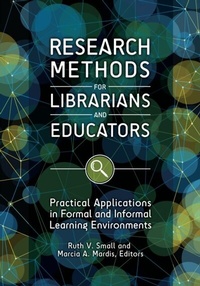
Research Methods for Librarians and Educators
Practical Applications in Formal and Informal Learning Environments
1st Edition
Published on 19. April 2018
328 pages
978-1-4408-4963-3 (ISBN)
Description

Using an innovative, real-world approach that makes the research problem and method relevant and valuable to the reader, this book provides a broad overview of research methods used in library and information studies and associated fields.
Research remains a core purpose of every library. This book provides a text for LIS students and a practical handbook to librarians and other educators who need to conduct research in their libraries. In Research Methods for Librarians and Educators, contributors reinforce the essential nature of research and provide readers with the confidence that they can conduct research to find solutions to various problems and improve their libraries and library programs.
The book details various research methodologies and uses a unique perspective on research that presents authentic scenarios to immediately make the research problem and method relevant and valuable to the reader. It covers topics ranging from various research methods, including Causal, Collaborative, Design-Based Research, Longitudinal, and Mixed Methods, as well as interview methods, learning assessment, literature review, and observation and survey methods.
Each chapter includes questions intended to spark discussion and deeper reflection that make the book more useful in learning settings. The summary charts throughout provide a handy and easy reference for readers who want a quick refresher on the research method without rereading the entire chapter.
Research remains a core purpose of every library. This book provides a text for LIS students and a practical handbook to librarians and other educators who need to conduct research in their libraries. In Research Methods for Librarians and Educators, contributors reinforce the essential nature of research and provide readers with the confidence that they can conduct research to find solutions to various problems and improve their libraries and library programs.
The book details various research methodologies and uses a unique perspective on research that presents authentic scenarios to immediately make the research problem and method relevant and valuable to the reader. It covers topics ranging from various research methods, including Causal, Collaborative, Design-Based Research, Longitudinal, and Mixed Methods, as well as interview methods, learning assessment, literature review, and observation and survey methods.
Each chapter includes questions intended to spark discussion and deeper reflection that make the book more useful in learning settings. The summary charts throughout provide a handy and easy reference for readers who want a quick refresher on the research method without rereading the entire chapter.
More details
Edition
1. Auflage
Language
English
Place of publication
New York
United States
Publishing group
Bloomsbury Publishing Plc
ISBN-13
978-1-4408-4963-3 (9781440849633)
Copyright in bibliographic data and cover images is held by Nielsen Book Services Limited or by the publishers or by their respective licensors: all rights reserved.
Schweitzer Classification
Other editions
Additional editions
Ruth V. Small Ph.D. | Marcia A. Mardis
Research Methods for Librarians and Educators
Practical Applications in Formal and Informal Learning Environments
Book
04/2018
Libraries Unlimited Inc
€72.70
Shipment within 10-20 days
Persons
Ruth V. Small is Laura J. and L. Douglas Meredith Professor of Information Studies at Syracuse University in Syracuse, NY.
Marcia A. Mardis is an associate professor and assistant dean at the College of Communication & Information at Florida State University (FSU).
Marcia A. Mardis is an associate professor and assistant dean at the College of Communication & Information at Florida State University (FSU).
Content
- Cover
- Half Title
- Title Page
- Copyright
- Dedication
- Contents
- Acknowledgments
- Chapter 1: Introduction to the Book
- Part I: Framing a Study
- Chapter 2: Conceptualizing a Study
- Chapter 3: Creating a Meaningful Literature Review
- Part II: Research Methods
- Chapter 4: Interview and Focus Group Research
- Chapter 5: Action Research
- Chapter 6: Historical Methodology
- Chapter 7: Formative Learning Assessment
- Chapter 8: Participant Observation
- Chapter 9: Assessing Learning with Rubrics
- Chapter 10: Formative Research
- Chapter 11: Correlational Research
- Chapter 12: Through the Lens of Evidence-Based Practice
- Chapter 13: Causal Research
- Chapter 14: Phenomenology
- Chapter 15: The Case Study
- Chapter 16: Critical Incident Technique
- Chapter 17: Design-Based Research
- Chapter 18: Longitudinal Research
- Chapter 19: Survey Research
- Chapter 20: The Delphi Method
- Chapter 21: Mixed Methods Research Design
- Chapter 22: Conclusion: Shared Research Strategies and Tools for Educators and Librarians
- Appendix A: Practice Scenarios
- Glossary
- Bibliography
- About the Editors and Contributors
- Index
