

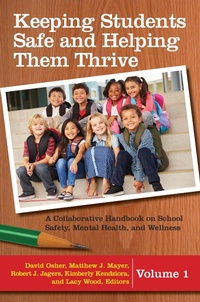
Keeping Students Safe and Helping Them Thrive
A Collaborative Handbook on School Safety, Mental Health, and Wellness [2 Volumes]
1st Edition
Published on 17. May 2019
1016 pages
979-8-216-10782-8 (ISBN)
Description

Details the safety, mental health, and wellness issues in schools today and focuses on the interactions and collaborations needed among students, teachers, families, community members, and other professionals to foster the safety, learning, and well-being of all students.
Safe schools and student well-being take a "village" of adults and students with varied interests, perspectives, and abilities collaborating to create caring, supportive, and academically productive schools. Schools are unofficial mental health care providers for children and youth who are placed at risk by social and economic circumstances and whose un- and under addressed needs can compromise teaching and learning. This handbook provides up-to-date information on how to promote safety, wellness, and mental health in a manner that can help draw the needed "village" together. It aligns research and practice to support effective collaboration-it provides information and tools for educators, administrators, policy makers, mental health and community organizations, families, parents, and students to join forces to promote and support school safety, student well-being, and student mental health.
Chapters address school context, the dynamic nature of school communities and child development, and the importance of diversity and equity. Chapters provide in-depth understanding of why and how to improve safety, well-being, and mental health in a culturally responsive manner. They provide strategies and tools for planning, monitoring, and implementing change, methods for collaborating, and policy and practice guidance. They provide examples of successful and promising cross-system and cross-stakeholder collaborations. This handbook will interest students, scholars, faculty, and researchers in education, counseling, and psychology; administrators in human services and youth development; policy makers; and student, family, and community representatives.
Safe schools and student well-being take a "village" of adults and students with varied interests, perspectives, and abilities collaborating to create caring, supportive, and academically productive schools. Schools are unofficial mental health care providers for children and youth who are placed at risk by social and economic circumstances and whose un- and under addressed needs can compromise teaching and learning. This handbook provides up-to-date information on how to promote safety, wellness, and mental health in a manner that can help draw the needed "village" together. It aligns research and practice to support effective collaboration-it provides information and tools for educators, administrators, policy makers, mental health and community organizations, families, parents, and students to join forces to promote and support school safety, student well-being, and student mental health.
Chapters address school context, the dynamic nature of school communities and child development, and the importance of diversity and equity. Chapters provide in-depth understanding of why and how to improve safety, well-being, and mental health in a culturally responsive manner. They provide strategies and tools for planning, monitoring, and implementing change, methods for collaborating, and policy and practice guidance. They provide examples of successful and promising cross-system and cross-stakeholder collaborations. This handbook will interest students, scholars, faculty, and researchers in education, counseling, and psychology; administrators in human services and youth development; policy makers; and student, family, and community representatives.
More details
Edition
1. Auflage
Language
English
Place of publication
New York
United States
Publishing group
Bloomsbury Publishing Plc
Target group
Interest Age: From 7 to 17 years
ISBN-13
979-8-216-10782-8 (9798216107828)
Copyright in bibliographic data and cover images is held by Nielsen Book Services Limited or by the publishers or by their respective licensors: all rights reserved.
Schweitzer Classification
Other editions
Additional editions
David Osher Ph.D. | Matthew J. Mayer | Robert J. Jagers
Keeping Students Safe and Helping Them Thrive
A Collaborative Handbook on School Safety, Mental Health, and Wellness [2 volumes]
Book
05/2019
Praeger Publishers Inc
€139.50
Article exhausted; check different version
Persons
David Osher, PhD, is vice president and institute fellow at American Institutes for Research and principal investigator of the National Center on Safe and Supportive Learning Environments.
Matthew J. Mayer, PhD, is associate professor of educational psychology in the Graduate School of Education at Rutgers University.
Robert J. Jagers, PhD, is vice president of research at the Collaborative for Academic, Social, and Emotional Learning.
Kimberly Kendziora, PhD, is a managing researcher at the American Institutes for Research.
Lacy Wood, PhD, is a principal consultant at the American Institutes for Research and has more than 18 years of experience working in the field of family engagement.
Matthew J. Mayer, PhD, is associate professor of educational psychology in the Graduate School of Education at Rutgers University.
Robert J. Jagers, PhD, is vice president of research at the Collaborative for Academic, Social, and Emotional Learning.
Kimberly Kendziora, PhD, is a managing researcher at the American Institutes for Research.
Lacy Wood, PhD, is a principal consultant at the American Institutes for Research and has more than 18 years of experience working in the field of family engagement.
Content
Part One Comprehensive Approaches to Promotion, Prevention, Intervention, and Support
Chapter 1 Approaches to Promotion and Prevention
Kimberly Kendziora and Trish Shaffer
Chapter 2 Early Intervention within the School Setting
Heather J. Clawson and Stephanie Wu
Chapter 3 Assuring Strengths- and Evidence-Based Approaches in Child, Adolescent, and School Mental Health
Mark D. Weist, Cheri J. Shapiro, Samantha N. Hartley, Abby A. Bode, Elaine Miller, Scott Huebner, John Terry, Kimberly Hills, and David Osher
Chapter 4 The Impact of Trauma and Adversities
Kathleen Guarino and Sarah Caverly
Chapter 5 Students with School Failure Trajectories
Terry Salinger and Matthew J. Mayer
Chapter 6 Supporting Students with Intensive Intervention Needs in Comprehensive, Integrated, Three-Tiered Models of Prevention: Considerations for the Field
Frank M. Gresham and Kathleen Lynne Lane
Part Two Creating Emotionally and Physically Safe Schools and Communities
Chapter 7 Emotional and Physical Safety
Shannon B. Wanless, Dewey G. Cornell, and Dwight Davis
Chapter 8 What Is School Safety? School Safety Trends, Data, and Key Issues
Matthew J. Mayer and Thomas W. Tramaglini
Chapter 9 Understanding the Critical Links between School Safety and Mental Health: Creating Pathways toward Wellness
Amy-Jane Griffiths, Elena Liles Diamond, Jennifer Greif Green, Eui Kyung Kim, James Alsip, Kevin P. Dwyer, Matthew J. Mayer, and Michael J. Furlong
Chapter 10 The Scientific Evidence Supporting an Eight-Point Public Health-Oriented Action Plan to Prevent Gun Violence
Daniel J. Flannery, George Bear, Rami Benbenishty, Ron Avi Astor, Catherine P. Bradshaw, George Sugai, Dewey G. Cornell, Denise C. Gottfredson, Maury Nation, Shane R. Jimerson, Amanda B. Nickerson, Matthew J. Mayer, Russell J. Skiba, Mark D. Weist, Dorothy L. Espelage, Michael J. Furlong, Nancy G. Guerra, Robert J. Jagers, Pedro A. Noguera, Daniel W. Webster, and David Osher
Chapter 11 Major Systems for Facilitating Safety and Pro-Social Behavior: Positive Schoolwide Behavior Supports and Interventions
Rhonda N. T. Nese, Sara C. McDaniel, Shanna E. Hirsch, Ambra L. Green, Jeffrey R. Sprague, Kent McIntosh, and Barbara McClung
Chapter 12 Supporting Students Involved in Bullying Behaviors: Moving Beyond a Disciplinary Framework
Deborah A. Temkin
Chapter 13 Reflections on Twenty Years of Restorative Justice in Schools
Brenda E. Morrison and Nancy Riestenberg
Chapter 14 Threat Assessment and School Crisis Preparedness
Amanda B. Nickerson and Dewey G. Cornell
Part Three Planning, Evaluation, and Policy Development
Chapter 15 Using Data to Improve Outcomes: Collaborative Planning, Progress Monitoring, and Continuous Improvement
Jason Katz, Abraham Wandersman, Patricia E. Campie, and Manolya Tanyu
Chapter 16 The Importance of Child-Guided and Youth-Directed Approaches: Engaging Youth Participatory Action Research Practices
Lawrence T. Winn and Katie E. Richards-Schuster
Chapter 17 Practical Guidance for Policy and Practice: Strategies and Tools for Assessing and Building Readiness and for Launching Local Efforts
Robert V. Mayo and Deborah A. Moroney
Chapter 18 Getting to Outcomes: Planning, Continuous Improvement, and Evaluation
Aaron R. Butler, Jessica Johnson, and Gene E. Hall
Chapter 19 Updating the National Agenda for Achieving Better Results for Children and Youth with Emotional and Behavioral Disorders
Nicholas A. Gage, Nicolette M. Grasley-Boy, Trina Osher, David Osher, and Mark D. Weist
About the Editors and Contributors
Index
Chapter 1 Approaches to Promotion and Prevention
Kimberly Kendziora and Trish Shaffer
Chapter 2 Early Intervention within the School Setting
Heather J. Clawson and Stephanie Wu
Chapter 3 Assuring Strengths- and Evidence-Based Approaches in Child, Adolescent, and School Mental Health
Mark D. Weist, Cheri J. Shapiro, Samantha N. Hartley, Abby A. Bode, Elaine Miller, Scott Huebner, John Terry, Kimberly Hills, and David Osher
Chapter 4 The Impact of Trauma and Adversities
Kathleen Guarino and Sarah Caverly
Chapter 5 Students with School Failure Trajectories
Terry Salinger and Matthew J. Mayer
Chapter 6 Supporting Students with Intensive Intervention Needs in Comprehensive, Integrated, Three-Tiered Models of Prevention: Considerations for the Field
Frank M. Gresham and Kathleen Lynne Lane
Part Two Creating Emotionally and Physically Safe Schools and Communities
Chapter 7 Emotional and Physical Safety
Shannon B. Wanless, Dewey G. Cornell, and Dwight Davis
Chapter 8 What Is School Safety? School Safety Trends, Data, and Key Issues
Matthew J. Mayer and Thomas W. Tramaglini
Chapter 9 Understanding the Critical Links between School Safety and Mental Health: Creating Pathways toward Wellness
Amy-Jane Griffiths, Elena Liles Diamond, Jennifer Greif Green, Eui Kyung Kim, James Alsip, Kevin P. Dwyer, Matthew J. Mayer, and Michael J. Furlong
Chapter 10 The Scientific Evidence Supporting an Eight-Point Public Health-Oriented Action Plan to Prevent Gun Violence
Daniel J. Flannery, George Bear, Rami Benbenishty, Ron Avi Astor, Catherine P. Bradshaw, George Sugai, Dewey G. Cornell, Denise C. Gottfredson, Maury Nation, Shane R. Jimerson, Amanda B. Nickerson, Matthew J. Mayer, Russell J. Skiba, Mark D. Weist, Dorothy L. Espelage, Michael J. Furlong, Nancy G. Guerra, Robert J. Jagers, Pedro A. Noguera, Daniel W. Webster, and David Osher
Chapter 11 Major Systems for Facilitating Safety and Pro-Social Behavior: Positive Schoolwide Behavior Supports and Interventions
Rhonda N. T. Nese, Sara C. McDaniel, Shanna E. Hirsch, Ambra L. Green, Jeffrey R. Sprague, Kent McIntosh, and Barbara McClung
Chapter 12 Supporting Students Involved in Bullying Behaviors: Moving Beyond a Disciplinary Framework
Deborah A. Temkin
Chapter 13 Reflections on Twenty Years of Restorative Justice in Schools
Brenda E. Morrison and Nancy Riestenberg
Chapter 14 Threat Assessment and School Crisis Preparedness
Amanda B. Nickerson and Dewey G. Cornell
Part Three Planning, Evaluation, and Policy Development
Chapter 15 Using Data to Improve Outcomes: Collaborative Planning, Progress Monitoring, and Continuous Improvement
Jason Katz, Abraham Wandersman, Patricia E. Campie, and Manolya Tanyu
Chapter 16 The Importance of Child-Guided and Youth-Directed Approaches: Engaging Youth Participatory Action Research Practices
Lawrence T. Winn and Katie E. Richards-Schuster
Chapter 17 Practical Guidance for Policy and Practice: Strategies and Tools for Assessing and Building Readiness and for Launching Local Efforts
Robert V. Mayo and Deborah A. Moroney
Chapter 18 Getting to Outcomes: Planning, Continuous Improvement, and Evaluation
Aaron R. Butler, Jessica Johnson, and Gene E. Hall
Chapter 19 Updating the National Agenda for Achieving Better Results for Children and Youth with Emotional and Behavioral Disorders
Nicholas A. Gage, Nicolette M. Grasley-Boy, Trina Osher, David Osher, and Mark D. Weist
About the Editors and Contributors
Index
