

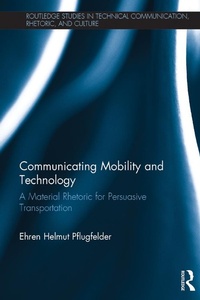
Communicating Mobility and Technology
A Material Rhetoric for Persuasive Transportation
Published on 7. July 2016
192 pages
978-1-317-16363-3 (ISBN)
Description

Winner of the 2018 CCCC Technical and Scientific Communication Award in the category of Best Book in Technical or Scientific Communication
Responding to the effects of human mobility and crises such as depleting oil supplies, Ehren Helmut Pflugfelder turns specifically to automobility, a term used to describe the kinds of mobility afforded by autonomous, automobile-based movement technologies and their ramifications. Thus far, few studies in technical communication have explored the development of mobility technologies, the immense power that highly structured, environmentally significant systems have in the world, or the human-machine interactions that take place in such activities. Applying kinaesthetic rhetoric, a rhetoric that is sensitive to and developed from the mobile, material context of these technologies, Pflugfelder looks at transportation projects such as electric taxi cabs from the turn of the century to modern day, open-source vehicle projects, and a large case study of an autonomous, electric pod car network that ultimately failed. Kinaesthetic rhetoric illuminates how mobility technologies have always been persuasive wherever and whenever linguistic symbol systems and material interactions enroll us, often unconsciously, into regimes of movement and ways of experiencing the world. As Pflugfelder shows, mobility technologies involve networks of sustained arguments that are as durable as the bonds between the actors in their networks.
Responding to the effects of human mobility and crises such as depleting oil supplies, Ehren Helmut Pflugfelder turns specifically to automobility, a term used to describe the kinds of mobility afforded by autonomous, automobile-based movement technologies and their ramifications. Thus far, few studies in technical communication have explored the development of mobility technologies, the immense power that highly structured, environmentally significant systems have in the world, or the human-machine interactions that take place in such activities. Applying kinaesthetic rhetoric, a rhetoric that is sensitive to and developed from the mobile, material context of these technologies, Pflugfelder looks at transportation projects such as electric taxi cabs from the turn of the century to modern day, open-source vehicle projects, and a large case study of an autonomous, electric pod car network that ultimately failed. Kinaesthetic rhetoric illuminates how mobility technologies have always been persuasive wherever and whenever linguistic symbol systems and material interactions enroll us, often unconsciously, into regimes of movement and ways of experiencing the world. As Pflugfelder shows, mobility technologies involve networks of sustained arguments that are as durable as the bonds between the actors in their networks.
Reviews / Votes
"Technical communicators, engineers, and designers in the automotive industry, as well as researchers with expertise and interest in actor-network theory (ANT), will find Communicating Mobility and Technology: A Material Rhetoric for Persuasive Transportation a valuable book. [It] offers a unique contribution to scholarly work on professional communication in the transportation industry." --Aiee Kendall Roundtree, IEEE Transactions on Professional Communication, 60(1), 2017More details
Series
Language
English
Place of publication
London
United Kingdom
Publishing group
Taylor & Francis Ltd
Target group
College/higher education
Illustrations
9 Line drawings, black and white; 10 Halftones, black and white; 19 Illustrations, black and white
File size
2,03 MB
ISBN-13
978-1-317-16363-3 (9781317163633)
Copyright in bibliographic data and cover images is held by Nielsen Book Services Limited or by the publishers or by their respective licensors: all rights reserved.
Schweitzer Classification
Other editions
Additional editions
Ehren Helmut Pflugfelder
Communicating Mobility and Technology
A Material Rhetoric for Persuasive Transportation
Book
06/2018
1st Edition
Routledge
€78.17
Shipment within 10-20 days
Ehren Helmut Pflugfelder
Communicating Mobility and Technology
A Material Rhetoric for Persuasive Transportation
Book
07/2016
1st Edition
Routledge
€217.50
Shipment within 10-20 days
Person
Ehren Helmut Pflugfelder is Assistant Professor of Professional, Technical, and Scientific Writing in the School of Writing, Literature, and Film at Oregon State University, USA.
Content
Preface
1. Persuasive Transportation
2. Rhetoric and Movement
3. Design
4. Interfaces
5. Logistics
6. Navigation
7. EPTV
Conclusion
1. Persuasive Transportation
2. Rhetoric and Movement
3. Design
4. Interfaces
5. Logistics
6. Navigation
7. EPTV
Conclusion
