

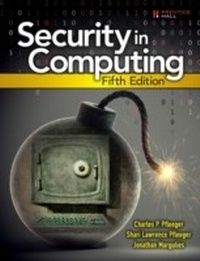
Security in Computing
5th Edition
Published on 14. January 2015
944 pages
978-0-13-408505-0 (ISBN)
Description

The New State of the Art in Information Security: Now Covers Cloud Computing, the Internet of Things, and Cyberwarfare
Students and IT and security professionals have long relied on Security in Computing as the definitive guide to computer security attacks and countermeasures. Now, the authors have thoroughly updated this classic to reflect today's newest technologies, attacks, standards, and trends.
Security in Computing, Fifth Edition, offers complete, timely coverage of all aspects of computer security, including users, software, devices, operating systems, networks, and data. Reflecting rapidly evolving attacks, countermeasures, and computing environments, this new edition introduces best practices for authenticating users, preventing malicious code execution, using encryption, protecting privacy, implementing firewalls, detecting intrusions, and more. More than two hundred end-of-chapter exercises help the student to solidify lessons learned in each chapter.
Combining breadth, depth, and exceptional clarity, this comprehensive guide builds carefully from simple to complex topics, so you always understand all you need to know before you move forward.
You'll start by mastering the field's basic terms, principles, and concepts. Next, you'll apply these basics in diverse situations and environments, learning to "think like an attacker" and identify exploitable weaknesses. Then you will switch to defense, selecting the best available solutions and countermeasures. Finally, you'll go beyond technology to understand crucial management issues in protecting infrastructure and data.
New coverage includes
A full chapter on securing cloud environments and managing their unique risks
Extensive new coverage of security issues associated with user-web interaction
New risks and techniques for safeguarding the Internet of Things
A new primer on threats to privacy and how to guard it
An assessment of computers and cyberwarfare-recent attacks and emerging risks
Security flaws and risks associated with electronic voting systems
Students and IT and security professionals have long relied on Security in Computing as the definitive guide to computer security attacks and countermeasures. Now, the authors have thoroughly updated this classic to reflect today's newest technologies, attacks, standards, and trends.
Security in Computing, Fifth Edition, offers complete, timely coverage of all aspects of computer security, including users, software, devices, operating systems, networks, and data. Reflecting rapidly evolving attacks, countermeasures, and computing environments, this new edition introduces best practices for authenticating users, preventing malicious code execution, using encryption, protecting privacy, implementing firewalls, detecting intrusions, and more. More than two hundred end-of-chapter exercises help the student to solidify lessons learned in each chapter.
Combining breadth, depth, and exceptional clarity, this comprehensive guide builds carefully from simple to complex topics, so you always understand all you need to know before you move forward.
You'll start by mastering the field's basic terms, principles, and concepts. Next, you'll apply these basics in diverse situations and environments, learning to "think like an attacker" and identify exploitable weaknesses. Then you will switch to defense, selecting the best available solutions and countermeasures. Finally, you'll go beyond technology to understand crucial management issues in protecting infrastructure and data.
New coverage includes
A full chapter on securing cloud environments and managing their unique risks
Extensive new coverage of security issues associated with user-web interaction
New risks and techniques for safeguarding the Internet of Things
A new primer on threats to privacy and how to guard it
An assessment of computers and cyberwarfare-recent attacks and emerging risks
Security flaws and risks associated with electronic voting systems
All prices
More details
Edition
5th edition
Language
English
Place of publication
Hoboken
United States
Publishing group
Pearson Education (US)
Target group
College/higher education
File size
15,50 MB
ISBN-13
978-0-13-408505-0 (9780134085050)
Copyright in bibliographic data and cover images is held by Nielsen Book Services Limited or by the publishers or by their respective licensors: all rights reserved.
Schweitzer Classification
Other editions
Additional editions
Charles Pfleeger | Shari Pfleeger | Jonathan Margulies
Security in Computing
Book
02/2015
5th Edition
Pearson
€117.91
Shipment within 15-20 days
Persons
Charles Pfleeger is an internationally known expert on computer and communications security. He was originally a professor at the University of Tennessee, leaving there to join computer security research and consulting companies Trusted Information Systems and Arca Systems (later Exodus Communications and Cable and Wireless). With Trusted Information Systems he was Director of European Operations and Senior Consultant. With Cable and Wireless he was Director of Research and a member of the staff of the Chief Security Officer. He was chair of the IEEE Computer Society Technical Committee on Security and Privacy.
Shari Lawrence Pfleeger is widely known as a software engineering and computer security researcher, most recently as a Senior Computer Scientist with the Rand Corporation and as Research Director of the Institute for Information Infrastructure Protection. She is currently Editor in Chief of IEEE Security & Privacy magazine.
Jonathan Margulies is the CTO of Qmulos, a cybersecurity consulting firm. After receiving his Masters Degree in Computer Science from Cornell University, Mr. Margulies spent nine years at Sandia National Labs, researching and developing solutions to protect national security and critical infrastructure systems from advanced persistent threats. He then went on to NIST's National Cybersecurity Center of Excellence, where he worked with a variety of critical infrastructure companies to create industry-standard security architectures. In his free time, Mr. Margulies edits the "Building Security In" section of IEEE Security & Privacy magazine.
Shari Lawrence Pfleeger is widely known as a software engineering and computer security researcher, most recently as a Senior Computer Scientist with the Rand Corporation and as Research Director of the Institute for Information Infrastructure Protection. She is currently Editor in Chief of IEEE Security & Privacy magazine.
Jonathan Margulies is the CTO of Qmulos, a cybersecurity consulting firm. After receiving his Masters Degree in Computer Science from Cornell University, Mr. Margulies spent nine years at Sandia National Labs, researching and developing solutions to protect national security and critical infrastructure systems from advanced persistent threats. He then went on to NIST's National Cybersecurity Center of Excellence, where he worked with a variety of critical infrastructure companies to create industry-standard security architectures. In his free time, Mr. Margulies edits the "Building Security In" section of IEEE Security & Privacy magazine.
Content
Chapter 1: Introduction
Chapter 2: Toolbox: Authentication, Access Control, and Cryptography
Chapter 3: Programs and Programming
Chapter 4: The Web-User Side
Chapter 5: Operating Systems
Chapter 6: Networks
Chapter 7: Databases
Chapter 8: Cloud Computing
Chapter 9: Privacy
Chapter 10: Management and Incidents
Chapter 11: Legal Issues and Ethics
Chapter 12: Details of Cryptography
Chapter 13: Emerging Topics
Bibliography
Index
Chapter 2: Toolbox: Authentication, Access Control, and Cryptography
Chapter 3: Programs and Programming
Chapter 4: The Web-User Side
Chapter 5: Operating Systems
Chapter 6: Networks
Chapter 7: Databases
Chapter 8: Cloud Computing
Chapter 9: Privacy
Chapter 10: Management and Incidents
Chapter 11: Legal Issues and Ethics
Chapter 12: Details of Cryptography
Chapter 13: Emerging Topics
Bibliography
Index
