

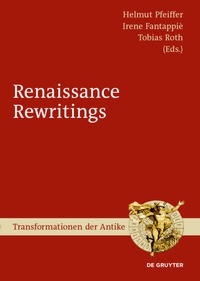
Renaissance Rewritings
Description

'Rewriting' is one of the most crucial but at the same time one of the most elusive concepts of literary scholarship. In order to contribute to a further reassessment of such a notion, this volume investigates a wide range of medieval and early modern literary transformations, especially focusing on texts (and contexts) of Italian and French Renaissance literature. The first section of the book, "Rewriting", gathers essays which examine medieval and early modern rewritings while also pointing out the theoretical implications raised by such texts. The second part, "Rewritings in Early Modern Literature", collects contributions which account for different practices of rewriting in the Italian and French Renaissance, for instance by analysing dynamics of repetition and duplication, verbatim reproduction and free reworking, textual production and authorial self-fashioning, alterity and identity, replication and multiplication. The volume strives at shedding light on the complexity of the relationship between early modern and ancient literature, perfectly summed up in the motto written by Pietro Aretino in a letter to his friend the painter Giulio Romano in 1542: "Essere modernamente antichi e anticamente moderni".
More details
Other editions
Additional editions
Persons
Irene Fantappiè ; Helmut Pfeiffer ; Tobias Roth , Humboldt-Universität zu Berlin, Germany.
Content
- Intro
- Contents
- Introduction
- 1. Rewriting
- Without Hierarchy: Diffraction, Performance, and Re-writing as Kippbild in Dante's Vita nova
- Anakyklosis. Transformation of Transformations
- Rewriting, Re-figuring. Pietro Aretino's Transformations of Classical Literature
- Liber mentalis: the Art of Memory and Rewriting
- 2. Rewritings in Early Modern Literature
- "nulla son io
- [.] due siam fatti d'uno" (Geta e Birria) - Subtracting by Duplicating, or The Transformations of Amphitryon in the Early Modern Period
- From Plague to Scabies. Rewriting Lucretius in Angelo Poliziano's Sylva in scabiem
- Hippocrates for Princes: Ippolito de' Medici's Retratti d'aphorismi
- The Inner-Poetic History of Latin Love Poetry in Tito Vespasiano Strozzi's Eroticon
- Shipwrecked Souls. Menippean Satire and Renaissance Textuality
- Ariosto's Rewriting of Ancient and Contemporary Models in Italian Verse Satire
- From Venice to Basel. Curione's Rewritings
- Pietro Aretino, St. John the Baptist and the Rewriting of the Psalms
- Rewriting the Bible in Pietro Aretino's Genesi (1538)
- Aretino's Rewritings of the Bible
- Index of names
