

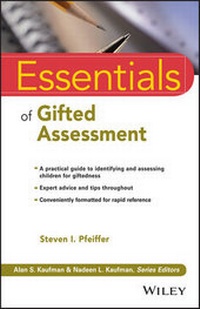
Essentials of Gifted Assessment
Published on 11. March 2015
192 pages
978-1-118-70564-3 (ISBN)
Description

An Up-to-Date Overview of the Theory and Practice UnderlyingGifted Assessment
Essentials of Gifted Assessment introduces readers to thetheory and practice underlying gifted assessment. Steven Pfeiffer,a leading expert in the field of gifted assessment, discusses whatit means to be gifted, why we should identify gifted students, andthe purposes of gifted assessment.
Well-organized and engaging, the book examines key principles ofgifted assessment and provides an up-to-date overview of giftedassessment measures. Topics include the use of local norms,measuring creativity and motivation, nonverbal measures, theimportance of recurring gifted assessment, multi-potentiality,gifted testing and minority group students, and evaluating thetwice-exceptional student. Early identification and interventiongreatly benefits gifted students, who may otherwise never realizetheir full potential. Throughout the book, Pfeiffer equips schoolpsychologists with the tools they need to:
* Identify and assess uniquely bright and talented students
* Integrate multiple assessment measures including intelligence,cognitive ability, and achievement tests
* Assess gifted students with coexisting disabilities anddisorders
* Promote the abilities of gifted students using evidence-basedstrategies
The book also includes extensive illustrative material, such ascallout boxes and case examples, that facilitate use as a quickreference, plus end-of-chapter "Test Yourself" questions that helpreinforce key concepts. Essentials of Gifted Assessmenthelps new and seasoned school psychologists and other professionalsacquire the skills and knowledge needed for ethical,evidence-based, and informed clinical practice with high-abilitystudents.
More details
Other editions
Additional editions
Steven I. Pfeiffer
Essentials of Gifted Assessment
Book
05/2015
Wiley
€52.50
Article not available at the moment
Person
STEVEN I. PFEIFFER, PHD, is a licensed psychologist and Professor and Director of Clinical Training in the combined School Psychology and Counseling Psychology program at Florida State University. An authority on the psychology of giftedness, he is the lead author of the Gifted Rating Scales, a widely used measure to help identify gifted students published by Pearson Assessment. Previously, Dr. Pfeiffer served as Executive Director of Duke University's acclaimed precollegiate gifted program.
Content
- Essentials of Gifted Assessment
- Contents
- Series Preface
- Acknowledgments
- One: Introduction to Gifted Assessment
- Who Are the Gifted?
- Brief History of Gifted Education
- Giftedness As a Social Construction
- Tripartite Model
- Should We Identify Gifted Students?
- Purposes of Gifted Assessment
- Two: Conceptions of Giftedness Guide Gifted Assessment
- Traditional Psychometric View
- Talent Development Models
- Differentiated Model of Giftedness and Talent
- Subotnik's Developmental Transitions in Giftedness and Talent
- Stanley's Talent Search Model
- Renzulli's Three-Ring Conception of Giftedness
- Expert Performance Perspective
- Multiple Intelligences Model
- Theory of Successful Intelligence: WICS
- Synthesis of Divergent Views of Giftedness
- Conclusion
- Three: Gifted Assessment: Guiding Principles and Fundamental Beliefs
- Fundamental Beliefs of Gifted Assessment
- Key Principles in Gifted Assessment
- How We Define Gifted Is Important
- Assessment Should Consider Types of Available Gifted Programs
- Psychometrics Count
- People, Not Test Scores, Should Make Diagnostic Decisions
- Multiple Measures Are an Advantage
- Local Norms and Recurring Assessment Are Advantages
- Beliefs and Principles Conclusion
- Decision-Making or Selection Models
- Four: Measuring Intellectual and Academic Ability
- Why and When to Use Tests of Cognitive and Academic Ability
- Where Does Abstract Reasoning Fit In?
- What Tests of Cognitive Ability Measure
- General and Specific Abilities
- Hierarchical Models: Cattell-Horn-Carroll
- Abstract Reasoning
- General Intelligence (g)
- Clinical Insights
- General Ability Index
- Clinical Considerations and Adaptations for High-Ability Students
- Tests with High Ceilings
- Testing the Limits
- Extended Norms
- Levels of Intellectual Giftedness
- Some Popular Iq Tests Used in Gifted Assessment
- Wechsler Intelligence Scale for Children-Fifth Edition
- Wechsler Preschool and Primary Scale of Intelligence-Fourth Edition
- Stanford-Binet Intelligence Scales, Fifth Edition
- Woodcock-Johnson IV Tests of Cognitive Abilities
- Differential Ability Scales, Second Edition
- Kaufman Assessment Battery for Children, Second Edition
- Cognitive Assessment System, Second Edition
- Reynolds Intellectual Assessment Scales
- A Few Illustrative Academic Measures
- Conclusion and Recommendations
- Five: Identifying and Assessing Creativity
- Defining Creativity
- Measuring Creativity
- Divergent Thinking: Torrance Tests of Creative Thinking
- Divergent Thinking: Profile of Creative Abilities
- Self-Report: Abedi Test of Creativity
- Teacher Checklist: Gifted Rating Scales-Creativity Scale
- Consensual Assessment Technique
- Creativity, Intelligence, and Talent Development
- Unanswered Questions
- Six: Alternative Gifted Assessment Methods
- Teacher and Parent Nominations
- Portfolio Assessment
- Nonverbal Measures
- Teacher Ratings
- The GRS As a Measure of Change
- Assessing Readiness for Grade Acceleration
- Types of Acceleration
- Iowa Acceleration Scale
- Seven: Frequently Asked Questions About Gifted Assessment
- Six Questions
- 1. Should Nonverbal Tests Be Used As Part of Gifted Assessment, and If So, When?
- 2. How Should We Approach the Assessment and Identification of Typically Underrepresented Gifted Populations?
- 3. What Constitutes a Complete Gifted Assessment Test Battery?
- 4. Should Social Competence, Passion for Learning, Motivation, and Emotional Intelligence Be Included in Gifted Assessment?
- 5. Should We Be Concerned About Multipotentiality When Testing High-Ability Students?
- 6. Are There Any Recommendations for Assessment of the Twice-Exceptional Learner?
- Concluding Comments
- References
- About the Author
- Index
- End User License Agreement
