

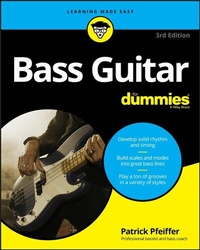
Bass Guitar For Dummies
3rd Edition
Published on 23. June 2020
416 pages
978-1-119-69559-2 (ISBN)
Description

Way more than just the bass-ics
Whatever you're playing--funk, soul, rock, blues, country--the bass is the heart of the band. Bassists provide a crucial part of driving force and funky framework that other members of any and work off. From John Paul Jones of Led Zeppelin, to "The Pixies'' Kim Deal, to James Brown's favored bassist, Jimmy Nolan, bass players have made big names for themselves and commanded respect throughout music history.
In Bass Guitar For Dummies, Patrick Pfeiffer--who coached U2's Adam Clayton, among others--is your friendly guide to laying down the low end. Starting from the beginning with what bass and accessories to buy, the book shows you everything from how to hold and position your instrument to how to read music and understand chords. You'll develop your skills step-by-step until you're confident playing your own solos and fills.
* Sharpen skills with instructional audio and video
* Discipline your play with exercises
* Understand chords, scales, and octaves
* Care for your instrument
Whether you're new to the bass or already well into the groove, Bass Guitar For Dummies gives you the thorough balance of theory and practice that distinguishes the titanic Hall of Famer from the just so-so.
P.S. If you think this book seems familiar, you're probably right. The Dummies team updated the cover and design to give the book a fresh feel, but the content is the same as the previous release of Bass Guitar For Dummies (9781118748800). The book you see here shouldn't be considered a new or updated product. But if you're in the mood to learn something new, check out some of our other books. We're always writing about new topics!
Whatever you're playing--funk, soul, rock, blues, country--the bass is the heart of the band. Bassists provide a crucial part of driving force and funky framework that other members of any and work off. From John Paul Jones of Led Zeppelin, to "The Pixies'' Kim Deal, to James Brown's favored bassist, Jimmy Nolan, bass players have made big names for themselves and commanded respect throughout music history.
In Bass Guitar For Dummies, Patrick Pfeiffer--who coached U2's Adam Clayton, among others--is your friendly guide to laying down the low end. Starting from the beginning with what bass and accessories to buy, the book shows you everything from how to hold and position your instrument to how to read music and understand chords. You'll develop your skills step-by-step until you're confident playing your own solos and fills.
* Sharpen skills with instructional audio and video
* Discipline your play with exercises
* Understand chords, scales, and octaves
* Care for your instrument
Whether you're new to the bass or already well into the groove, Bass Guitar For Dummies gives you the thorough balance of theory and practice that distinguishes the titanic Hall of Famer from the just so-so.
P.S. If you think this book seems familiar, you're probably right. The Dummies team updated the cover and design to give the book a fresh feel, but the content is the same as the previous release of Bass Guitar For Dummies (9781118748800). The book you see here shouldn't be considered a new or updated product. But if you're in the mood to learn something new, check out some of our other books. We're always writing about new topics!
More details
Other editions
Additional editions
Patrick Pfeiffer
Bass Guitar for Dummies 3rd Edition
Book
07/2020
Wiley
€27.50
Shipment within 15-20 days
Person
Patrick Pfeiffer is a professional bassist, bass educator, and composer. His former clients include Polygram, Red Ant Records, Arista Records, and other major labels as well as Adam Clayton of U2. He has recorded with George Clinton, Phoebe Snow, Jimmy Norman of the Coasters, Paul Griffin and Bernard Purdie of Steely Dan, and many other stars.
Content
- Intro
- Title Page
- Copyright Page
- Table of Contents
- Foreword
- Introduction
- About This Book
- Foolish Assumptions
- Icons Used in This Book
- Beyond the Book
- Where to Go from Here
- Part 1 Getting Started with the Bass Guitar
- Chapter 1 The Very Basics of Bass
- Discovering the Differences between the Bass and Its High-Strung Cousins
- Understanding the Bass Player's Function in a Band
- Forging the link between harmony and rhythm
- Moving the song along
- Keeping time
- Establishing rhythms
- Looking cool
- Dissecting the Anatomy of a Bass Guitar
- The neck
- The body
- The innards
- On a Need-to-Know "Basses": Gearing Up to Play Bass
- Coordinating your right and left hands
- Mastering major and minor chord structures
- Tuning your bass
- Combining scales and chords
- Playing Grooves, Solos, and Fills
- Creating grooves and riffs
- Treating yourself and your audience to solos and fills
- Experimenting with Different Musical Genres
- Stocking Up on Some Bass Gear
- Buying a bass
- Getting an amplifier
- Accessorizing your bass
- Giving Your Bass Some Good Ol' TLC
- Chapter 2 Gaining the Tools and Skills to Play
- Getting a Handle on Your Bass
- Holding Your Bass
- Strapping on your bass: Strings to the outside
- Voilà! Standing with your bass
- Sitting with your bass
- Placing Your Hands in the Proper Position
- Positioning your left hand
- Positioning your right hand
- Reading a Fingerboard Diagram
- The language of music: Scales and chords
- Viewing a diagram of the major and minor scales
- Playing open-string scales
- Finding the notes on the neck
- Identifying intervals: They're always in the same place
- Tuning Your Bass Guitar
- Reference pitch sources to use when playing alone
- Reference pitch sources to use when playing with others
- Tuning the bass guitar to itself
- Playing a Song on Your Bass Guitar
- Making some noise with the open strings
- Closing the strings
- Chapter 3 Warming Up: Getting Your Hands in Shape to Play
- Understanding the Sound Your Bass Makes
- Performing Right-Hand Warm-Ups
- Right-hand same-string strokes
- Controlling the strength in your striking hand: Right-hand accents
- Skating across the strings: Right-hand string crossing
- Coordinating Your Left Hand with Your Right Hand
- Doing finger permutations
- Muting the strings to avoid the infamous hum
- Putting it all together
- Part 2 The Bass-ics of Playing
- Chapter 4 Reading, 'Riting, and Rhythm
- Reading Notation: No Pain, Much Gain
- Chord notation: The chord chart
- Music notation: Indicating rhythm and notes
- Tablature notation: Showing strings, frets, and sequence
- The vocal chart: Using lyrics and chords for a singer or songwriter
- Finding Any Note in Any Octave
- Using the Metronome: You Know, That Tick-Tock Thing
- Setting the metronome
- Playing along
- Dividing Music into Phrases, Measures, and Beats
- The quarter note
- The eighth note
- The sixteenth note
- The half note
- The whole note
- The triplet
- The dot
- The tie
- The rest
- Discovering How to Read Music
- Rhythmic chunks
- Interval chunks
- What comes up must come down
- Playing Your First Song While Reading Music
- Chapter 5 Understanding Major and Minor Structures
- Building Major and Minor Scales
- Major scales
- Minor scales
- Building Chords: One Note at a Time, Please
- Triads: The three most important notes of a chord
- 7th chords: Filling out the triad
- Getting your kicks with boogie licks
- Inversions: Down Is Up, and Up Is Down
- Major chord inversions
- Minor chord inversions
- Spicing Up Your Sound: The Seven Main Modes (Scales)
- Using Chromatic Tones: All the Other Notes
- Chromatic tones within the box
- Chromatic tones outside the box
- Bringing a Groove to Life with Dead Notes (Weird but True)
- Playing dead - notes, that is
- Raking dead notes
- Sampling Accompaniments
- Using your accompaniments in a tune
- Keeping your groove gloriously ambiguous
- Part 3 Making the Moves, Creating the Grooves
- Chapter 6 Creating the Groove
- Anatomy of a Groove: Putting Together the Necessary Elements
- Getting your groove skeleton out of the closet
- Playing a song using only the groove skeleton
- Choosing the right notes for a groove
- Creating Your Own Groove
- Covering the "basses": Creating dominant, minor, and major grooves
- Waggin' the groove tail
- Movin' and groovin' from chord to chord
- Finding the perfect fit: The designer groove
- Grooving with a Drummer
- The bass drum
- The snare drum
- The hi-hat
- Jammin' with Other Musicians
- Preparing your ear
- Listening for "the note"
- Pivoting the note
- Getting Creative with Existing Grooves
- Altering a (famous) groove
- Simplifying a groove
- Chapter 7 Going Solo: Playing Solos and Fills
- Soloing: Your Moment to Shine
- Playing with the blues scale: A favorite solo spice
- Jamming with the minor pentatonic scale: No wrong notes
- Using the major pentatonic scale: Smooth as can be
- Moving from chord to chord
- Creating Fills without Any Help from Your Dentist
- A match made in heaven: Connecting your fill to the groove
- Timing a fill
- Part 4 Using the Correct Accompaniment for Each Genre
- Chapter 8 Rock On! Getting Down with the Rock Styles
- Rock 'n' Roll: It's The Attitude!
- Hard Rock: Going at It Fast and Furious
- Pop Rock: Supporting the Vocals
- Blues Rock: Doin' What "Duck" Does and Playing a Countermelody
- Country Rock: Where Vocals Are King, and You Take a Back Seat
- One Rock Fits All: Applying a Standard Rock Groove to Any Rock Song
- Chapter 9 Swing It! Playing Styles That Rely on the Triplet Feel
- Swing: Grooving Up-Tempo with Attitude
- Jazz: Going for a Walk
- Working the walk
- Applying a jazz blues walking pattern
- Blues Shuffle: Walking Like Donald Duck (Dunn, That Is)
- Funk Shuffle: Combining Funk, Blues, and Jazz
- Chapter 10 Making It Funky: Playing Hardcore Bass Grooves
- R & B: Movin' to Rhythm and Blues
- The Motown Sound: Grooving with the Music of the Funk Brothers
- Fusion: Blending Two Styles into One
- Funk: Light Fingers, Heavy Attitude
- Hip-Hop: Featuring Heavy Funk with Heavy Attitude
- Knowing What to Do When You Just Want to Funkifize a Tune
- Chapter 11 Sampling International Flavors: Bass Styles from Around the World
- Bossa Nova: Baskin' in a Brazilian Beat
- Samba: Speeding Up with Bossa's Fast Cousin
- Afro-Cuban: Ordering Up Some Salsa (Hold the Chips, Please)
- Reggae: Relaxing with Offbeat "Riddims"
- Calypso Party Sounds: Dancing through the Groove
- Combining Reggae and Rock: The Distinct Sound of Ska
- African Grooves: Experimenting with Exotic Downbeat Grooves
- Grooving on a steady beat, South African-style
- Checking out the bass groove styles from Cameroon
- Music without Borders: Grooving to the World Beat
- Chapter 12 Playing in Odd Meters: Not Strange, Just Not the Norm
- An Odd-Meter Oldie but Goodie: The Waltz
- Beyond the Waltz: Navigating Beats in Odd Meter
- 5/4 meter: Not an impossible mission
- Take a groove you know and make it grow
- 7/4 meter: Adding two more beats
- Complex Simplicity: Syncopation and Subdivision
- Syncopating in odd meter
- Adding an eighth
- Dealing with the rush
- Chapter 13 Groovin' in a Genre: It's All About Style!
- Playing Grooves in Each Genre: One Simple Song, Many Genres Strong
- Pop: Backing up the singer-songwriter
- Rocking by the quarter or eighth note
- R & B/Soul, with or without the dot
- Feeling da funk
- Layin' down some Latin grooves
- When you're feelin' blue, shuffle
- To Blend or Not to Blend: Knowing How to Fit In
- Just blending in: How to do it
- The bold and the beautiful: Creating a bold groove
- Blending and bolding by genre
- Signing off with a flourish
- Chapter 14 Eight Degrees of Separation: The Beatles' Solution
- Playing Your Rhythm Straight or Syncopated
- Pumping eighth notes
- Syncopating the bass beat
- Making Harmonic Choices
- Feeling fine (with roots and 5ths)
- Walking along Penny Lane
- Coming together to move with the groove
- Day-tripping in perfect agreement: Unison
- Playing something to counter the melody with
- Inverting while your bass gently weeps
- Part 5 Buying and Caring for Your Bass
- Chapter 15 Love of a Lifetime or One-Night Stand? Buying the Right Bass
- Assessing Your Needs Before You Buy
- Thinking long-term: Moving in together
- Thinking short-term: Help me make it through the night
- How many strings are too many?
- To fret or not to fret
- Needs Are One Thing . . . Budget Is Quite Another
- A Trip to the Bass-Mint: Where to Shop for Your Bass Guitar
- Hitting the music stores
- Consulting newspaper ads
- Visiting online shops and individual online ads
- When Money Is No Object: Getting a Custom-Made Bass
- Chapter 16 Getting the Right Gear for Your Bass Guitar
- Making Yourself Heard: A Primer on Amplifiers and Speakers
- Going with a combo or separate amp and speaker
- Opting for solid state or tubes
- Picking a speaker size
- Setting the tone
- Needs, Wants, and Nonessentials: Rounding Out Your Equipment
- Must-haves: Cases, gig bags, and more
- Definite maybes: Useful effects, gadgets, and practice items
- Extras: Effects pedals
- Chapter 17 Changing the Strings on Your Bass Guitar
- Knowing When It's Time to Say Goodbye
- Off with the Old: Removing Bass Strings
- On with the New: Restringing Your Bass
- Ensuring a Long Life for Your Strings
- Chapter 18 Keeping Your Bass in Shape: Maintenance and Light Repair
- Cleaning Your Bass, Part by Part
- The body and neck
- The hardware
- The pickups
- The fingerboard
- The strings
- Making Minor Repairs to Your Bass
- The taming of the screw(s)
- Taking care of the finish
- Leaving the electronics to the experts
- Adjusting the Bass Guitar
- Providing relief to the truss rod
- Raising and lowering the bridge
- Assembling a Cleaning and Repair Tool Bag
- Storing Your Bass
- Part 6 The Part of Tens
- Chapter 19 Ten Innovative Bassists You Should Know
- Stanley Clarke
- John Entwistle
- James Jamerson
- Carol Kaye
- Will Lee
- Paul McCartney
- Marcus Miller
- Jaco Pastorius
- Victor Wooten
- X (Fill in Your Own)
- Chapter 20 Ten Great Rhythm Sections (Bassists and Drummers)
- Bootsy Collins and Jab'o Starks
- Donald "Duck" Dunn and Al Jackson Jr.
- James Jamerson and Benny Benjamin
- John Paul Jones and John Bonham
- Joe Osborn and Hal Blaine
- Jaco Pastorius and Peter Erskine
- George Porter Jr. and Zig Modeliste
- Francis Rocco Prestia and David Garibaldi
- Chuck Rainey and Bernard Purdie
- Robbie Shakespeare and Sly Dunbar
- Appendix Audio Tracks and Video Clips
- Index
- EULA
