

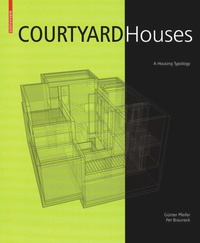
Courtyard Houses
Description

To continue developing existing building types in an intelligent way is a crucial task in the field of residential building. A deeper understanding of the underlying types is indispensable for the success of the individual design, as well as for ensuring that tried and tested structures can be utilized, repeated, and varied in a wide variety of situations.
For this typology of residential buildings, the authors have developed systematic new presentations of the most innovative types. Each individual volume lays out the possibilities for using and transforming a particular form of residential structure.
The first volume deals with the various types of the courtyard house, which utilizes the courtyard as an intimate outdoor living space. A presentation of the courtyard as a building block of the city is followed by coverage of the complete spectrum of types - cluster, network, carpet, terraces, etc.
The second volume is devoted to the various types of row house, a particularly widespread form of residential structure. A general discussion of the row as organizing principle - the row as urban building block, linear space, ways of handling corners - is followed by the systematic presentation of the different types.
Within each type, variants are distinguished according to how they organize space, their number of floors, etc. The range of possible solutions is presented in uniform ground plans newly drawn to scale.
More details
Other editions
Additional editions
Persons
Günter Pfeifer is a professor of design and residential building at the Technische Universität Darmstadt (Darmstadt University of Technology). As a practicing architect he has worked with Frank Gehry, Zaha Hadid, Tadao Ando, Alvaro Siza, and others. He taught design and building construction for ten years and is active today in the intelligent, energy-saving, sustainable development of existing building types.
Dipl.-Ing. Per Brauneck is a teacher and researcher at the Technische Universität Darmstadt (Darmstadt University of Technology).
Together they have already published the book Exposed Concrete: Technology and Design (Birkhäuser Verlag).
Content
Foreword
Introduction
Systematical presentation of different types by means of 50 projects
Appendix:
bibliography
illustration credits
