

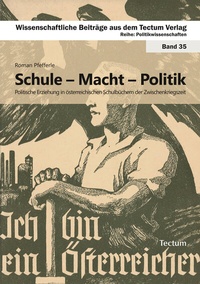
Schule - Macht - Politik
Politische Erziehung in österreichischen Schulbüchern der Zwischenkriegszeit
1st Edition
Published on 20. August 2013
218 pages
978-3-8288-5644-8 (ISBN)
Description

Die Inhalte und Wertungen von Schulbüchern prägen das gesellschaftliche und politische Bewusstsein ganzer Generationen. Was die Großelterngeneration im Schulranzen mit sich herum trug, verrät viel darüber, wie sie sozialisiert wurde, welches selektierte Grundwissen sie mit auf den Weg bekam, wie nachhaltige Grundhaltungen und politische Einstellungen entstanden. Schulbuchforschung ist somit politische Kulturforschung. In der Zeit zwischen den Weltkriegen waren die Schulbücher in Österreich je nach dem herrschenden politischen System sehr unterschiedlich in Inhalt und Ausrichtung. Roman Pfefferle zeichnet in diesem Buch anschaulich nach, was die politischen Eliten der Ersten Republik und jene des Austrofaschismus für die Jugend wollten und wie sie es propagierten.
More details
Other editions
Additional editions
Roman Pfefferle
Schule - Macht - Politik
Politische Erziehung in österreichischen Schulbüchern der Zwischenkriegszeit
Book
12/2010
1st Edition
Tectum Wissenschaftsverlag
€24.90
No shipping information available
Content
- Intro
- Impressum
- Inhalt
- Vorwort
- Einleitung
- Teil I
- 1 Politische Kultur
- 1.1 Begriff
- 1.2 Ursprungskonzept der politischen Kultur
- 1.3 Kritik am Ursprungskonzept
- 1.4 Weiterentwicklung des Konzepts
- 1.5 Forschungsrichtungen und Forschungsstand
- 1.6 Methoden politischer Kulturforschung
- 2 Politische Sozialisation
- 2.1 Begriff
- 2.2 Instanzen politischer Sozialisation
- 2.2.1 Familie als politische Sozialisationsinstanz
- 2.2.2 Politische Sozialisation in Gleichaltrigengruppen
- 2.2.3 Politische Sozialisation durch Massenmedien
- 2.2.4 Politische Sozialisation in der Schule
- Teil II
- 3 Schulbuchforschung als politische Kulturforschung
- 3.1 Begriff und Funktion des Schulbuchs
- 3.2 Felder der Schulbuchforschung
- 3.3 Schulbücher als Analysegegenstand politischer Kulturforschung
- 3.3.1 Schulbücher als Politikum
- 3.3.2 Exkurs: Approbation von Schulbüchern: 1918-1945
- 3.3.3 Schulbücher als Begleiter im politischen Sozialisationsprozess
- 3.3.4 Schulbücher als Spiegel der politischen Mentalitätsgeschichte
- 3.4 Methoden der Schulbuchforschung
- 4 Analyserahmen
- 4.1 Ebene der Inhalte
- 4.2 Ebene der Werte
- 4.3 Ebene der Vermittlung
- Teil III
- 5 Die Erste Republik
- 5.1 Verfassung und politische Entwicklungen
- 5.1.1 Republik Deutschösterreich
- 5.1.2 Republik Österreich
- 5.1.2.1 Die "Kompromissverfassung" von 1920
- 5.1.2.2 Konkurrenzdemokratie, Zentrifugaldemokratie und Verfassungsnovellen
- 5.1.2.3 Das Ende der Demokratie
- 5.2 Schulpolitik und politische Erziehung
- 5.2.1 Schulpolitische Ausgangslage 1918
- 5.2.2 Sozialdemokratische Initiativen
- 5.2.3 Kernelemente der Schulreform unter Otto Glöckel
- 5.2.4 Neue Inhalte politischer Erziehung
- 5.2.5 Schulpolitische Entwicklungen 1920-1933
- 5.2.6 Modifizierte Inhalte politischer Erziehung
- 5.3 Schulbuchanalyse Erste Republik
- 5.3.1 Ebene der Inhalte
- 5.3.1.1 Räume der Politik
- 5.3.1.2 Akteure der Politik
- 5.3.2 Ebene der Werte
- 5.3.2.1 Politische Tugenden
- 5.3.2.2 Konsens und Konflikt in der Politik
- 5.3.3 Ebene der Vermittlung
- 5.4 Synthese: Politische Kultur und politische Erziehung in der Ersten Republik
- 6 Die Periode des austrofaschistischen Staates
- 6.1 Verfassung und politische Entwicklungen im Austrofaschismus
- 6.1.1 Konstitutionalisierung
- 6.1.2 Charakteristika des Austrofaschismus
- 6.2 Schulpolitik und politische Erziehung im Austrofaschismus
- 6.2.1 Schulpolitische Entwicklungen 1933-1938
- 6.2.2 Inhalte politischer Erziehung
- 6.3 Schulbuchanalyse Austrofaschismus
- 6.3.1 Ebene der Inhalte
- 6.3.1.1 Räume der Politik
- 6.3.1.2 Akteure der Politik
- 6.3.2 Ebene der Werte
- 6.3.2.1 Politische Tugenden
- 6.3.2.2 Konflikt und Konsens in der Politik
- 6.3.3 Ebene der Vermittlung
- 6.3.4 Exkurs: Gegenüberstellung politischer Erziehung im Austrofaschismus und im Nationalsozialismus
- 6.4 Synthese: Politische Kultur und politische Erziehung im Austrofaschismus
- 7 Resümee
- 8 Bibliographie
- 8.1 Sekundärliteratur
- 8.2 Primärliteratur
- 8.2.1 Schulbücher Erste Republik
- 8.2.2 Schulbücher Austrofaschismus und Nationalsozialismus
