

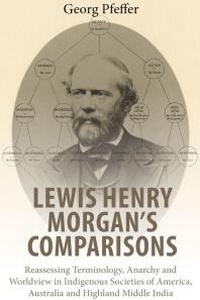
Lewis Henry Morgan's Comparisons
Reassessing Terminology, Anarchy and Worldview in Indigenous Societies of America, Australia and Highland Middle India
1st Edition
Published on 11. July 2019
236 pages
978-1-78920-318-9 (ISBN)
Description

About 150 years ago Lewis Henry Morgan compared relationship terminologies, societal forms and ideas of property to recognize the interdependence of the three domains. From a new perspective, the book re-examines, confirms and criticizes Morgan's findings to conclude that reciprocal affinal relations determine most 'classificatory' terminologies and regulate many non-state societies, their property notions and their rituals. Apart from references to American and Australian features, such holistic socio-cultural constructs are exemplified by elaborate descriptions of little known contemporary Indigenous societies in Highland Middle India, altogether comprising many millions of members.
Reviews / Votes
"This book is the result of a lifetime's work on the kinship systems of the indigenous people of Highland Odisha... For me [its] two key merits are the thoughtful reappraisal of Morgan it offers and the new data it presents on a much-neglected region of India." * Chris Gregory, Australian National UniversityMore details
Edition
1. Auflage
Language
English
Place of publication
Oxford
United Kingdom
Target group
Professional and scholarly
Illustrations
Bibliography; Index; 30 Illustrations
ISBN-13
978-1-78920-318-9 (9781789203189)
DOI
10.3167/9781789203172
Copyright in bibliographic data and cover images is held by Nielsen Book Services Limited or by the publishers or by their respective licensors: all rights reserved.
Schweitzer Classification
Other editions
Additional editions
Georg Pfeffer
Lewis Henry Morgan's Comparisons
Reassessing Terminology, Anarchy and Worldview in Indigenous Societies of America, Australia and Highland Middle India
Book
07/2019
1st Edition
Berghahn Books
€147.00
Shipment within 3-4 weeks
Person
Georg Pfeffer (1943-2020) was Professor of Social and Cultural Anthropology at the Freie Universitaet Berlin from 1985 to 2008. He participated in two long-term Orissa Research Projects of the German Research Foundation (DFG) to conduct extended ethnographic fieldwork in several indigenous societies of the Indian provinces Odisha and Jharkhand. He was also part of the group which founded the European Association of Social Anthropologists (EASA) in 1989.
Content
List of Figures and Tables
Acknowledgements
Introduction
Chapter 1. Life and Work of Lewis Henry Morgan (1818-1881)
Chapter 2. Tools and Types
Chapter 3. Seneca Revisited
Chapter 4. Omaha Skewing Reconsidered
Chapter 5. Highland Middle Indian (HMI) Terminologies
Chapter 6. Schneider, Relatedness, "Malayan", and General Comparison
Chapter 7. Social Evolution and the Australian Anomaly
Chapter 8. Order in Anarchy: HMI Gentile Organization Compared
Chapter 9. Bridewealth and Gender in Highland Middle India
Chapter 10. The Dark Side of the Moon
Conclusion: For the Record
Glossary
References
Index
Acknowledgements
Introduction
Chapter 1. Life and Work of Lewis Henry Morgan (1818-1881)
Chapter 2. Tools and Types
Chapter 3. Seneca Revisited
Chapter 4. Omaha Skewing Reconsidered
Chapter 5. Highland Middle Indian (HMI) Terminologies
Chapter 6. Schneider, Relatedness, "Malayan", and General Comparison
Chapter 7. Social Evolution and the Australian Anomaly
Chapter 8. Order in Anarchy: HMI Gentile Organization Compared
Chapter 9. Bridewealth and Gender in Highland Middle India
Chapter 10. The Dark Side of the Moon
Conclusion: For the Record
Glossary
References
Index
