

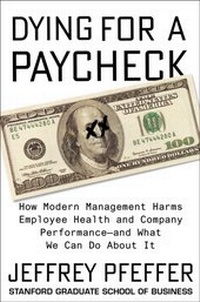
Dying for a Paycheck
Description

In one survey, 61 percent of employees said that workplace stress had made them sick and 7 percent said they had actually been hospitalized. Job stress costs US employers more than $300 billion annually and may cause 120,000 excess deaths each year. In China, 1 million people a year may be dying from overwork. People are literally dying for a paycheck. And it needs to stop.
In this timely, provocative book, Jeffrey Pfeffer contends that many modern management commonalities such as long work hours, work-family conflict, and economic insecurity are toxic to employees?hurting engagement, increasing turnover, and destroying people's physical and emotional health?and also inimical to company performance. He argues that human sustainability should be as important as environmental stewardship.
You don't have to do a physically dangerous job to confront a health-destroying, possibly life-threatening, workplace. Just ask the manager in a senior finance role whose immense workload, once handled by several employees, required frequent all-nighters?leading to alcohol and drug addiction. Or the dedicated news media producer whose commitment to getting the story resulted in a sixty-pound weight gain thanks to having no down time to eat properly or exercise. Or the marketing professional prescribed antidepressants a week after joining her employer.
In Dying for a Paycheck, Jeffrey Pfeffer marshals a vast trove of evidence and numerous examples from all over the world to expose the infuriating truth about modern work life: even as organizations allow management practices that literally sicken and kill their employees, those policies do not enhance productivity or the bottom line, thereby creating a lose-lose situation.
Exploring a range of important topics including layoffs, health insurance, work-family conflict, work hours, job autonomy, and why people remain in toxic environments, Pfeffer offers guidance and practical solutions all of us?employees, employers, and the government?can use to enhance workplace wellbeing. We must wake up to the dangers and enormous costs of today's workplace, Pfeffer argues. Dying for a Paycheck is a clarion call for a social movement focused on human sustainability. Pfeffer makes clear that the environment we work in is just as important as the one we live in, and with this urgent book, he opens our eyes and shows how we can make our workplaces healthier and better.
Based on extensive evidence, this book provides a vital toolkit for leaders, managers, and employees to build healthier organizations:
- Human Sustainability: Why creating a people-centric corporate culture is just as critical as environmental stewardship and is key to long-term success.
- The High Cost of Workplace Stress: A data-driven look at how toxic environments lead to higher turnover, lower engagement, and billions in avoidable healthcare costs.
- Economic Insecurity and Layoffs: An exposé on why downsizing policies often fail to improve performance and the devastating impact they have on employee wellbeing.
- Long Work Hours and Work-Family Conflict: Practical solutions for addressing the "always-on" culture that leads to employee burnout and destroys work-life balance.
All prices
More details
Other editions
Additional editions
Person
Jeffrey Pfefferis the Thomas D. Dee II Professor of Organizational Behavior at the Graduate School of Business, Stanford University. He is the author or coauthor of fifteen books, including Leadership B.S., Power, The Human Equation, Managing with Power, and The Knowing-Doing Gap. Pfeffer has led seminars in thirty-nine countries and for numerous US companies, associations, and universities. He has won many awards for his writing, has an honorary doctorate from Tilburg University in the Netherlands, and was listed in the top 25 management thinkers by Thinkers50, and as one of the Most Influential HR International Thinkers by HR Magazine. He lives in Hillsborough, California.
