

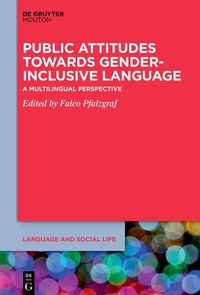
Public Attitudes Towards Gender-Inclusive Language
Description

The (potential) use of gender-inclusive language is being discussed controversially in the public sphere. Opinions on it have increasingly been voiced by individuals as well as organisations. These include state institutions, private associations, subject specialists such as linguists, and private individuals / laypeople. Views of and attitudes towards the use of gender-inclusive language cover a broad spectrum between extreme ends, and even subject specialists hold conflicting views. Research on gender-inclusive language is very much a current trend in linguistics, including the so-called 'genderless' languages. However, the focus is mostly on structural issues, while sociolinguistic research on attitudes towards the use of gender-inclusive language is mostly missing. Some scattered work in this area has been published, but a more thorough understanding and conceptualisation of attitudes is still needed. Furthermore, a multilingual, comparative perspective is still missing. This edited volume will address these shortcomings.
More details
Other editions
Additional editions
Person
Falco Pfalzgraf , Queen Mary University of London, UK.
