

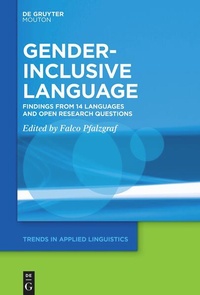
Gender-Inclusive Language
Description

This book provides a comprehensive and comparative overview of current research and desiderata related to the use of gender-inclusive language across 14 major European languages. It also addresses minority languages and foreign language teaching. Methodologically, the book innovatively bridges Linguistics, Applied Linguistics, Multilingual Communication, Translation Studies, Modern Languages, and Psychology. It has the potential to become essential reading for researchers and educators in Linguistics, Translation, Modern Language Studies, and Applied Linguistics, as well as for policymakers and language professionals navigating the challenges of inclusive communication in a multilingual world.
More details
Other editions
Additional editions
Person
Falco Pfalzgraf , Queen Mary University of London, United Kingdom.
Content
- Intro
- Contents
- List of figures
- List of tables
- Introduction and findings: Gender-inclusive language - Research and desiderata
- 1 Origins and motivation
- 2 Scope, audience, and multidisciplinary approach
- 3 A multidisciplinary, comparative approach across languages
- 4 Existing research relating to the content of this volume
- 5 Contributions to this volume
- 6 Comparative analysis
- 6.1 Trends and variations in current research
- 6.2 Research desiderata: cross-linguistic priorities
- 6.3 Closing words
- References
- Gender inclusive Czech language: The renaissance of collectives?
- 1 Introduction
- 2 The Way to a Gender-Inclusive Czech Language
- 2.1 Gender-balanced language
- 2.2 Inclusion of non-binarity
- 2.3 Desiderata in research on gender inclusive Czech language
- 3 Collectives in Czech language
- 3.1 Use of collectives by Prague Pride
- 3.2 Use of collectives by Trans?parent
- 4 Conclusion
- References
- Gender-inclusive language in Dutch
- 1 Introduction
- 2 Grammatical gender in Dutch
- 3 Personal nouns in Dutch from a grammatical perspective
- 4 Debates on gender-inclusive language in Dutch
- 5 Research on personal nouns in Dutch
- 5.1 Corpus studies on the use of personal nouns
- 5.2 Experimental studies on the interpretation of personal nouns
- 6 Research on 3rd person pronouns for personal reference in Dutch
- 7 Conclusion and avenues for future research
- References
- Esimies or esihenkilö? Investigating the use of gender-exclusive and gender-inclusive occupational titles in Finnish
- 1 Introduction
- 2 Background
- 3 Data and methods
- 3.1 Study design and data collection
- 3.2 Participants
- 3.3 Methods
- 4 Results
- 4.1 Explaining use of occupational titles
- 4.2 A closer look at variation
- 5 Discussion and conclusions
- References
- Joys and perils of gender inclusivity: How the French Senate passed a bill to ban écriture inclusive
- 1 Introduction
- 2 Policing the French language: Historical background and legislative framework
- 2.1 Policing gender in language: feminising the language
- 3 Gender in French grammar: structures and implications
- 3.1 The status of the masculine in the French language system
- 3.2 Non-binary French
- 4 Analysing the debate
- 4.1 Introducing the French Senate
- 4.2 Organisation of session and vote
- 4.3 Examining the Bill's proposals
- 4.4 The political timing of the debate
- 4.5 Gruny's preamble and ad hominem attacks
- 4.6 The English threat
- 4.7 Fallacies
- Unsubstantiated claims - EI makes reading difficult
- Cherry-Picking (Suppressed Evidence) - grammatical gender is purely arbitrary
- Logical fallacy - causative link between gender in language and oppression of women
- The need for new legislation - a ban is needed as EI is spreading
- Co-opting literary figures
- 5 Concluding remarks
- References
- Gender-fair language in German: Current situation and ongoing research
- 1 Introduction
- 2 Linguistic features of German and gender-fair person denotation
- 2.1 German as a grammatical gender language
- 2.2 Gender-fair language use and recent suggestions for improvement
- 3 Public debate, normative issues and legal interventions
- 4 Recent advances in research and outlook
- References
- Gender language practices in Greek: Reform, uptake and metapragmatic stancetaking
- 1 Introduction
- 2 Four decades of Greek feminist linguistics and the Greek linguo-cultural landscape
- 3 Gender asymmetries in Greek grammar
- 4 Terminology: gender inclusive/non-sexist language, or what?
- 5 Framework: post-variationist sociolinguistics and stancetaking
- 6 Dataset
- 7 Analysis
- 7.1 Gender language practices in higher education contexts
- 7.1.1 Female representation in official communication
- 7.1.2 Gender inclusive language practices within student union and Gender Equality Committee communication
- 7.2 Metalinguistic stances: Dismissing non-sexist language
- 7.3 The (in)visibility of women in popular culture
- 8 Conclusions: where have we come from, where do we stand, and where are we possibly heading towards?
- References
- Italian: Schwa-washing in activism, the media and publishing
- 1 Introduction
- 2 Language activism(s) and mainstreamisation
- 3 Schwa: attitudes, beliefs and ideologies
- 4 Mainstream uses and misuses of schwa and other gender-inclusive forms
- 5 Gender-inclusive forms in publishing
- 6 Conclusions
- References
- Gender inclusive language in Norwegian (Bokmål): How (not) to encode referential gender
- 1 Introduction
- 2 Grammatical and referential gender in Norwegian (Bokmål)
- 3 The representation of gender in role nouns
- 4 The representation of gender in pronouns
- 5 Directions for future research
- 5.1 The possibility of unintended side effects of a neutralisation strategy
- 5.2 Mental representation of non-binary gender as an evolving field
- 5.3 Need for a broader data basis
- 6 Conclusion
- References
- From tradition to inclusion: The pitfalls of generic gender grammar in Polish
- 1 Introduction
- 2 Grammatical gender
- 3 Dependency between grammatical and referential gender
- 4 Masculine as generic gender
- 5 The gender of professions, titles and functions
- 5.1 State legislation
- 5.2 Referential duality of job titles
- 6 Feminization of generic-masculine nouns
- 6.1 Implicit feminization
- 6.2 Feminization through deferential forms
- 7 Feminine as generic gender
- 8 Gender-specific forms
- 9 Conclusion
- Appendix: Abbreviations not included in the Leipzig glossing rules
- References
- An overview of gender-inclusive aspects concerning Romanian
- 1 Introduction
- 2 Romanian and its gender-inclusive challenges
- 2.1 Grammatical gender and gender agreement patterns
- 2.2 Present efforts and recommendations: Agreement, pair forms, and beyond
- 2.3 A note on Romanian pronouns
- 2.3.1 Strategies based on lexical innovation
- a. Nonce borrowings
- b. Blends based on the neo-suffix -x
- 2.3.2 Strategies based on revival and semantic extension
- 3 A focus on Romanian role-nouns
- 3.1 Role-nouns and "motional" suffixes
- 3.2 Research and recent discussions concerning the feminization of Romanian role-nouns
- 4 Specialist attitudes to gender-inclusive Romanian
- 4.1 "Natural" Romanian and the use of feminine role-nouns
- 4.2 "Unnatural" language: Representations of non-binary Romanian
- 5 Concluding remarks and desiderata
- References
- Gender-inclusive language in Spanish: Where it is now and where it is headed
- 1 Introduction
- 2 Alternatives to sexist language in Spanish: An overview of their evolution
- 3 From theory to practice: Two case studies on gender stereotypes vs. grammatical norm in Spanish
- 3.1 Gendered language processing in Spanish: Case study 1
- 3.2 Gendered language and automatic translation: Case study 2
- 4 Main contributions and final words
- References
- Gender-inclusive pronouns and gender conceptualization in Swedish. The role of the politicization of gender
- 1 Introduction
- 2 Gender as a politically polarized issue
- 3 The interrelation between gender, language, and cognition
- 4 Decreasing gender bias in language
- 5 Gender-inclusive pronouns and gender conceptualization
- 6 Dual nature of gender-inclusive pronouns
- 7 Ideological influence on gender conceptualization
- 8 Conclusions
- References
- Gender-neutral language in situations of minoritization: Some examples from Catalan and Breton
- 1 Introduction
- 2 Catalan
- 2.1 Catalan normative gender expression
- 2.2 Catalan gender-neutral proposals
- 2.3 Reactions from institutions, media, and users
- 3 Breton
- 3.1 Repurposed traditional terms
- 3.2 Borrowings from English
- 3.3 Neologisms and innovations
- 3.4 English as the referential language
- 4 Conclusions
- References
- Index
