

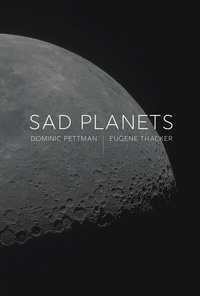
Sad Planets
Description

In this series of meditations, Dominic Pettman and Eugene Thacker explore some of the key "negative affects" - both eternal and emergent - associated with climate change, environmental destruction, and cosmic solitude. In so doing they unearth something so obvious that it has gone largely unnoticed: the question of how we should feel about climate change. Between the information gathered by planetary sensors and the simple act of breathing the air, new unsettling moods are produced for which we currently lack an adequate language. Should we feel grief over the loss of our planet? Or is the strange feeling of witnessing mass extinction an indicator that the planet was never "ours" to begin with? Sad Planets explores this relationship between our all-too-human melancholia and a more impersonal sorrow, nestled in the heart of the cosmic elements.
Spanning a wide range of topics - from the history of cosmology to the "existential threat" of climate change - this book is a reckoning with the limits of human existence and comprehension. As Pettman and Thacker observe, never before have we known so much about the planet and the cosmos, and yet never before have we felt so estranged from that same planet, to say nothing of the stars beyond.
More details
Other editions
Additional editions
Persons
Dominic Pettman is the author of numerous books, including Infinite Distraction and Peak Libido, and teaches at The New School.
Eugene Thacker is the author of numerous books, including In The Dust of This Planet and Infinite Resignation, and teaches at The New School.
Content
Sequence 1: In Space No One Can Hear You Weep
Sequence 2: Dark Star
Sequence 3: Planetary Sorrow
Sequence 4: Comets, Importing Change
Sequence 5: Last Life
Sequence 6: Unearthly
Sequence 7: Entropology
Sequence 8: Omen of the World
Sequence 9: Shapes of Sorrow
Sequence 10: Liquid Sky
Sequence 11: Dark Crystals
Sequence 12: Prayers for Rain
Sequence 13: Quiet Despair
Sequence 14: The Last Philosopher
Sequence 15: Solastalgia
Sequence 16: The Clever Beasts
Sequence 1
In Space No One Can Hear You Weep
Opportunity Knocked
"My battery is low. And it's getting dark." Many of us felt a heart-spasm when we first read these words - the last transmission from the Opportunity robot, stranded on the surface of Mars. A diligent non-human NASA employee, which had been doing its job so conscientiously for fifteen years, was now succumbing to a kind of mechanical mortality. The pathos was pure, even if the rover's last words were condensed for poetic effect. The robot, also known as Opportunity - or "Oppy," for short - surprised its makers in terms of its resilience on the red planet, so far from home, as well as for its work ethic. Long after scientists assumed it would have succumbed to rust, radiation, or some other interstellar malady, Oppy continued to forage, explore, sample, and send missives home. It was like some kind of plucky character from a Pixar movie. Except it was real. In the end, a massive dust storm was the thing that did the rover in. As Abigail Fraeman, one of the project managers, explained: "By Thursday, we knew that it was bad. And then, by Friday, we knew it was really bad, but there was nothing we could do but watch. And then it was Sunday, we actually got a communication from the rover and we were shocked . It basically said we had no power left." Apparently Oppy was overcome with a kind of awe at the sight of the approaching wall of rust-colored dust, about to engulf all its sensors like a sublime tsunami. Indeed, the rover's last words essentially said, "the skies are incredibly dark . no sunlight is getting through. It's night time during the day."1 Before its battery died, Opportunity managed to send back a last image, a distorted and grainy image of shadowy gray, half-truncated as the transmission was cut off.
Is the pang many of us felt at this story merely a viral case of the pathetic fallacy, so potent that even scientists were not immune from it? Or is there something objectively sad about a machine with a purpose, left to face its end on its own, perhaps the only moving thing on the planet - exposed to the alien elements in a way, and on a scale, that no human has yet to experience? No doubt, the philosophers can argue about whether the pathetic fallacy is in fact a fallacy or not until philosophy itself faces the same entropic fate as the Mars rover. But we would submit that there is indeed something powerfully poignant about such a scenario as this, not isolated to - or explained away by - the eye of the human beholder. Perhaps there is a seam of sorrow threaded through the universe to which humans may be the most sensitive - or maybe not - but in any case affects the universe in different ways, even where, and when, life is absent. (Perhaps partly because of this absence.) Creatures no doubt experienced sad situations long before there were humans around to witness or record them. Trees, after all, certainly fell in the forest many millions of years before Homo sapiens came along to question the sound that these timber giants most definitely made. Who are we to presume that trees don't mourn the collapse of one of their neighbors? (After all, we've only recently discovered the extent to which trees communicate and cooperate through "the world wood web.") Perhaps it's a form of arrogance to assume that only humans can experience what Spinoza called "the sad passions" and what Virgil called "the sadness in things." Perhaps even a courageous laborer, made of the world's most expensive nuts and bolts, is imbricated in an affective atmosphere as much as an elemental one.
Then Again
Then again, we could just as well propose the opposite hypothesis. That the cosmos is not a cold and sorrowful void but an inviting plenum on which glittering jewels of possibility are scattered across the heavens like warming embers. This would be the true pulse of the universe that the mystics attempt to find and channel through their ecstatic whirling or their immobile meditation. This is the subterranean ocean of tranquility beneath all our suffering and sadness: a wretchedness that, these same mystics insist, is just an illusion (from one view), or (from another) a series of necessary tests, on the path out of Sa?sara to Nirvana. Melancholia would then, contrary to the alchemical or astrological tradition, be unconnected to the motion or music of the spheres and instead be a slimy film that humans alone leave in their wake - viscous evidence of their heavy and gloomy passage through this world. Human sadness as material excretion, manifest in our poetry as much as in our plastic, and in our sparkling new mega-churches or supermarkets as much as in our ruins. This heavy psychic, or even spiritual, baggage marks our species in sharp contrast to all the other creatures, who flow through life "like water in water,"2 and who only know sadness when humanity introduces it to them. (An introduction no living thing can now fully avoid, given our genius for leaving the calling card of our own misery inside every crevice and infusing our own bitter tears into every toxic droplet.)
An Inventory of Affects
Climate seems at once distant or remote and at the same time the most intimate and immediate. The vast weather systems that form hurricanes, wildfires, or tsunamis operate at a scale beyond the comprehension of the individual human beings, and yet it is individuals that are also directly impacted by such events. A downstream effect occurs as those of us not directly impacted bear witness to the effects of extreme weather and are in turn affected indirectly. The experience of climate events - at whatever level - then opens onto other, more abstract, more ambivalent dispositions. As instances of climate migration increase around the planet, at what point will human beings find themselves exiled from the planet itself? Behind the climate event lurks the specter of human extinction, the haunting image of an uninhabitable Earth, a planet indifferent to the human inhabitants that have occupied it for a comparably brief moment in deep time. A rift begins to grow between the planet and its now temporary human inhabitants.
A culture of climate, a confusion of affects. Is it going to happen soon or is it happening now? To feel climate and to feel about climate. The weather "out there" and the weather right here, at my doorstep. The devastation wrought by extreme weather events - themselves becoming more regular, more normalized - cannot but produce emotional and affective responses. At the same time it can be difficult to know how or what to feel about something that operates at a scale that so far exceeds that of the individual human being. No doubt this is why, in recent years, a new vocabulary has emerged in the public discourse surrounding climate change. Psychologists discuss "eco-grief," the grieving expressed by those directly impacted by climate events. This is often distinguished from "environmental grief," or the indirect grief felt by those of us who witness the devastation of climate events for human beings, but also for animal and planetary life as well (the term has also been applied to the mourning of the loss of species). The plethora of information about the near-term impacts of climate change has also had an impact on our relationship to the future and our ability (or inability) to plan for it, given the unstable and tenuous character of climate events themselves. This has led psychiatrists to talk about "climate anxiety," the feeling of uncertainty and instability linked to climate change, which in some cases may inhibit an individual's ability to make future life decisions at all. Related to this is what journalists sometimes call "climate angst," or the frustration felt by individuals at the inertia and apathy of political leaders and government organizations to adequately respond to the "existential threats" of climate change. The troubling sense of the inevitability of it all is linked to what philosophers and sociologists have termed "solastalgia," or the irretrievable sense of a loss of home, be it one's actual home, one's place of residence, or one's country - in some cases scaled up to the planet itself.
In short, a new affective vocabulary concerning climate change has emerged, existing in the shadows of the more official, more public discourses of science, policy, and politics. While each of these terms is different from the others, they all bear witness to a unique emotional terrain for which there may not be adequate words. Not yet, that is. It will likely be a matter of time before this new vocabulary enters the official, institutional taxonomy of the Diagnostic and Statistical Manual (DSM). Many of these unofficial diagnoses take terms usually applied to individuals ("anxiety," "grief") and apply them to the species as a whole, terms denoting something about the planet that so far exceeds the individual we can only use generalities ("climate," "ecology," "environment"). Are we already witnessing a near future in which doctors can diagnose patients with "climate anxiety" or "geotrauma"? What are the treatment options for "climate angst," much less a pandemic of...
