

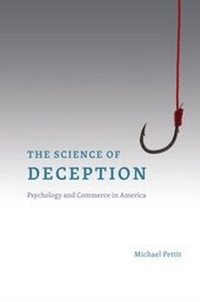
The Science of Deception
Psychology and Commerce in America
1st Edition
Published on 22. December 2022
323 pages
978-0-226-92375-8 (ISBN)
Description

During the late nineteenth and early twentieth centuries, Americans were fascinated with fraud. P. T. Barnum artfully exploited the American yen for deception, and even Mark Twain championed it, arguing that lying was virtuous insofar as it provided the glue for all interpersonal intercourse. But deception was not used solely to delight, and many fell prey to the schemes of con men and the wiles of spirit mediums. As a result, a number of experimental psychologists set themselves the task of identifying and eliminating the illusions engendered by modern, commercial life. By the 1920s, however, many of these same psychologists had come to depend on deliberate misdirection and deceitful stimuli to support their own experiments.
The Science of Deception explores this paradox, weaving together the story of deception in American commercial culture with its growing use in the discipline of psychology. Michael Pettit reveals how deception came to be something that psychologists not only studied but also employed to establish their authority. They developed a host of tools-the lie detector, psychotherapy, an array of personality tests, and more-for making deception more transparent in the courts and elsewhere. Pettit's study illuminates the intimate connections between the scientific discipline and the marketplace during a crucial period in the development of market culture. With its broad research and engaging tales of treachery, The Science of Deception will appeal to scholars and general readers alike.
The Science of Deception explores this paradox, weaving together the story of deception in American commercial culture with its growing use in the discipline of psychology. Michael Pettit reveals how deception came to be something that psychologists not only studied but also employed to establish their authority. They developed a host of tools-the lie detector, psychotherapy, an array of personality tests, and more-for making deception more transparent in the courts and elsewhere. Pettit's study illuminates the intimate connections between the scientific discipline and the marketplace during a crucial period in the development of market culture. With its broad research and engaging tales of treachery, The Science of Deception will appeal to scholars and general readers alike.
All prices
More details
Other editions
Additional editions
Book
01/2013
University of Chicago Press
€61.90
Article not available at the moment
Person
Michael Pettit is assistant professor of the history and theory of psychology at York University in Toronto.
Content
- Intro
- Contents
- Acknowledgments
- Introduction
- Chapter 1. "Graft Is the Worst Form of Despotism": Swindlers, Commercial Culture, and the Deceivable Self
- Chapter 2. Hunting Duck-Rabbits: Illusions, Mass Culture, and the Law of Economy
- Chapter 3. "Not Our Houses but Our Brains Are Haunted": The Arts of Exposure at the Boundaries of Credulity
- Chapter 4. The Unwary Purchaser: Trademark Infringement, the Deceivable Self, and the Subject of Consumption
- Chapter 5. Diagnosing Deception: Pathological Lying, Lie Detectors, and the Normality of the Deceitful Self
- Chapter 6. Studies in Deceit: Personality Testing and the Character of Experiments
- Conclusion. Barnum's Ghost Gives an Encore Performance
- Notes
- Bibliography
- Index

