


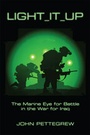
Light It Up
The Marine Eye for Battle in the War for Iraq
Published on 10. January 2016
240 pages
978-1-4214-1786-8 (ISBN)
Description

Examines the U.S. Marines' visual culture of combat in the Iraq War.
American military power in the War on Terror has increasingly depended on the capacity to see the enemy. The act of seeing-enhanced by electronic and digital technologies-has separated shooter from target, eliminating risk of bodily harm to the remote warrior, while YouTube videos eroticize pulling the trigger and video games blur the line between simulated play and fighting.
Light It Up examines the visual culture of the early twenty-first century military. Focusing on the Marine Corps, which played a critical part in the invasion and occupation of Iraq, John Pettegrew argues that U.S. military force in the Iraq War was projected through an "optics of combat." Powerful military technology developed in the Iraq and Afghanistan wars has placed war in a new posthuman era.
Pettegrew's interviews with marines, as well as his analysis of first-person shooter videogames and combat footage, lead to startling insights into the militarization of popular digital culture. An essential study for readers interested in modern warfare, policy makers, and historians of technology, war, and visual and military culture.
American military power in the War on Terror has increasingly depended on the capacity to see the enemy. The act of seeing-enhanced by electronic and digital technologies-has separated shooter from target, eliminating risk of bodily harm to the remote warrior, while YouTube videos eroticize pulling the trigger and video games blur the line between simulated play and fighting.
Light It Up examines the visual culture of the early twenty-first century military. Focusing on the Marine Corps, which played a critical part in the invasion and occupation of Iraq, John Pettegrew argues that U.S. military force in the Iraq War was projected through an "optics of combat." Powerful military technology developed in the Iraq and Afghanistan wars has placed war in a new posthuman era.
Pettegrew's interviews with marines, as well as his analysis of first-person shooter videogames and combat footage, lead to startling insights into the militarization of popular digital culture. An essential study for readers interested in modern warfare, policy makers, and historians of technology, war, and visual and military culture.
More details
Language
English
Place of publication
Baltimore
United States
Target group
Professional and scholarly
Illustrations
7 s/w Abbildungen, 3 s/w Abbildungen, 1 s/w Zeichnung
1 Line drawings, black and white; 3 Illustrations, black and white; 7 Illustrations, black and white
File size
1,96 MB
ISBN-13
978-1-4214-1786-8 (9781421417868)
DOI
10.1353/book.42521
Copyright in bibliographic data and cover images is held by Nielsen Book Services Limited or by the publishers or by their respective licensors: all rights reserved.
Schweitzer Classification
Other editions
Additional editions
Book
01/2016
Johns Hopkins University Press
€35.35
Shipment within 10-20 days
Person
John Pettegrew, an associate professor of history and director of the American Studies Program at Lehigh University, is the author of Brutes in Suits: Male Sensibility in America, 1890-1920.
Content
Preface
Acknowledgments
Introduction. Force Projection and the Marine Eye for Battle
1. Shock and Awe and Air Power
Network-Centric Warfare, Sensors, and Total Situational Awareness
Achieving Rapid Dominance in Iraq
Kill Boxes, LITENING Pods, and the Third Marine Aircraft Wing
"Keep Your Eyes Out," Fair Fighting, and Memories of Killing
2. Of War Porn and Pleasure in Killing
Pornography Is the Theory, and Killing the Practice
Classic Hollywood Combat Films
Marine Moto on YouTube
The Iraq War on Television
3. Fallujah, First to Fight, and Ludology
Ender's Game and the Rise of Simulation in Military Training, 1995-2005
From Combat Films to Video Games
The Value Added to Military Training
Fighting in the Digitized Streets of Beirut
4. Counterinsurgency and "Turning Off the Killing Switch"
Empathy, General Mattis, and the Profound Paradox of Marine Humanitarianism
Haditha, Acute Stress, and the Excesses of Occupying Force
USMC Literary Culture and Warrior Ethos
"Which Way Would You Run?"
5. Posthuman Warfighting
Marines in Science Fiction and in Space
The Postmasculinist Marines and New Optics of Combat
The Gladiator Robot and the Critique of Remote Warfare
6. Synthetic Visions of War
Biopolitics and the Costs of War
Digital Culture and the Computational Marine
Subjectivity Lives and Dies
Notes
Essay on Primary Sources
Index
Acknowledgments
Introduction. Force Projection and the Marine Eye for Battle
1. Shock and Awe and Air Power
Network-Centric Warfare, Sensors, and Total Situational Awareness
Achieving Rapid Dominance in Iraq
Kill Boxes, LITENING Pods, and the Third Marine Aircraft Wing
"Keep Your Eyes Out," Fair Fighting, and Memories of Killing
2. Of War Porn and Pleasure in Killing
Pornography Is the Theory, and Killing the Practice
Classic Hollywood Combat Films
Marine Moto on YouTube
The Iraq War on Television
3. Fallujah, First to Fight, and Ludology
Ender's Game and the Rise of Simulation in Military Training, 1995-2005
From Combat Films to Video Games
The Value Added to Military Training
Fighting in the Digitized Streets of Beirut
4. Counterinsurgency and "Turning Off the Killing Switch"
Empathy, General Mattis, and the Profound Paradox of Marine Humanitarianism
Haditha, Acute Stress, and the Excesses of Occupying Force
USMC Literary Culture and Warrior Ethos
"Which Way Would You Run?"
5. Posthuman Warfighting
Marines in Science Fiction and in Space
The Postmasculinist Marines and New Optics of Combat
The Gladiator Robot and the Critique of Remote Warfare
6. Synthetic Visions of War
Biopolitics and the Costs of War
Digital Culture and the Computational Marine
Subjectivity Lives and Dies
Notes
Essay on Primary Sources
Index
