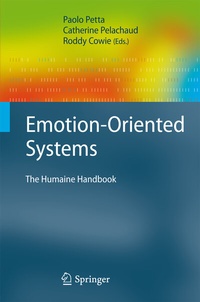
Emotion-Oriented Systems
Description

Emotion pervades human life in general, and human communication in particular, and this sets information technology a challenge. Traditionally, IT has focused on allowing people to accomplish practical tasks efficiently, setting emotion to one side. That was acceptable when technology was a small part of life, but as technology and life become increasingly interwoven we can no longer ask people to suspend their emotional nature and habits when they interact with technology.
The European Commission funded a series of related research projects on emotion and computing, culminating in the HUMAINE project which brought together leading academic researchers from the many related disciplines. This book grew out of that project, and its chapters are arranged according to its working areas: theories and models; signals to signs; data and databases; emotion in interaction; emotion in cognition and action; persuasion and communication; usability; and ethics and good practice.
The fundamental aim of the book is to offer researchers an overview of the related areas, sufficient for them to do credible work on affective or emotion-oriented computing. The book serves as an academically sound introduction to the range of disciplines involved - technical, empirical and conceptual - and will be of value to researchers in the areas of artificial intelligence, psychology, cognition and user-machine interaction.
More details
Other editions
Additional editions