

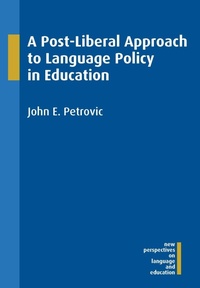
A Post-Liberal Approach to Language Policy in Education
Published on 2. December 2014
136 pages
978-1-78309-286-4 (ISBN)
Description

This provocative defense of language diversity works through the strengths and weaknesses of liberal political theory to inform language policy. The book presents the argument that policy must occupy the space between 'linguistics of community' and 'linguistics of contact' in a way that balances individual autonomy and group recognition while not reifying 'language'. Drawing on the importance of the language/identity link, the author distinguishes between language negative liberalism and language positive liberalism, arguing against the former. This distinction orients consideration of increasingly specific language policy issues, such as official languages, language rights, bilingual education, and uses of language varieties within classrooms.
Reviews / Votes
The author presents an imposing body of carefully crafted critique in favor of a post-liberal politics of language. This volume must become an ultimate reference for anybody wanting to go beyond what liberal thought can offer a political philosophy of language. -- Christopher Stroud, University of Western Cape, South Africa In this provocative book, John Petrovic offers a trenchant critique of current approaches to language policy that tend to be based on a linguistics of community rather than a linguistics of contact. Readers of this book may find plenty to disagree with, but few book-length treatments of language policy are as thorough and probing as this one in dealing with fundamental questions of politics, language, democracy, identity, and education. -- Dr. Thomas Ricento, University of Calgary, Canada This volume provides a measured, philosophical and critical analysis of some of the major themes in the field of language policy today. With emphasis on status and acquisition planning, it offers an important and thoughtful treatment of issues related to linguistics human rights, while considering the problematic relationship between language and identity, as well as issues related to language policy in education. This volume will be of interest to scholars and serious students in the field, but it is clearly written and accessible for those newer to the field. -- Prof. Terrence G. Wiley, President, Center for Applied Linguistics and Professor Emeritus, Arizona State University, USA Petrovic approaches the issue of language policy in education from a political and philosophical perspective, addressing the relationship between language and identity and well as that of liberalism and language policy. Consequently, it is oriented and interesting to a wide readership. -- Haicui Zheng, Inner Mongolia University, Mongolia * Journal of Language and Politics, Vol. 16:5 (2017) * What is also striking among many other achievements of the book is its accessibility. If the author's aim was to reach a wider audience beyond the language policy and education community, he has succeeded. His reader-supportive approach to academic language and writing is indeed commendable. The book deserves to be read by people with an interest in languages, language problems and language and speech communities. -- Obaidul Hamid, University of Queensland, Australia * Lang Policy, DOI 10.1007/s10993-015-9360-4 * What is also striking among many other achievements of the book is its accessibility. If the author's aim was to reach a wider audience beyond the language policy and education community, he has succeeded. His reader-supportive approach to academic language and writing is indeed commendable. The book deserves to be read by people with an interest in languages, language problems and language and speech communities. -- M. Obaidul Hamid, University of Queensland, Australia * Language Policy (2016) 15 *More details
Series
Language
English
Place of publication
Bristol
United Kingdom
Publishing group
Channel View Publications Ltd
Target group
Professional and scholarly
Product notice
Reflowable
ISBN-13
978-1-78309-286-4 (9781783092864)
Copyright in bibliographic data and cover images is held by Nielsen Book Services Limited or by the publishers or by their respective licensors: all rights reserved.
Schweitzer Classification
Other editions
Additional editions
John E. Petrovic
A Post-Liberal Approach to Language Policy in Education
Book
12/2014
Multilingual Matters
€118.50
Shipment within 10-20 days
Person
John E. Petrovic is a Professor of Educational Leadership and Foundations of Education at The University of Alabama, USA. His research interests include the philosophy of education, education policy, language policy, and issues of diversity in education. He is the series editor of Studies in the Philosophy of Education, by Information Age Publishing.
Content
1. Language Policy, Identity, and Liberalism: Some Foundational Connections
2. Formalist Liberalism and Language Policy
3. Saving Liberalism: Communities, Language, and Schooling
4. The Promise and Problem in Linguistic Human Rights
5. Post Linguistic Human Rights?
6. Post-Liberal Language in Education Policy
7. A Post-Liberal Approach: Broadening Language and Narrowing Policy
2. Formalist Liberalism and Language Policy
3. Saving Liberalism: Communities, Language, and Schooling
4. The Promise and Problem in Linguistic Human Rights
5. Post Linguistic Human Rights?
6. Post-Liberal Language in Education Policy
7. A Post-Liberal Approach: Broadening Language and Narrowing Policy
