

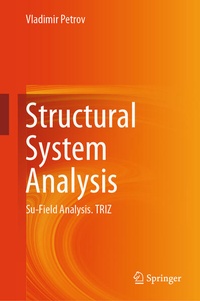
Structural System Analysis
Description

This book provides a comprehensive exploration of SU-Field Analysis, a groundbreaking framework that delves into the intricate realms of fields, substances, and interactions. It commences with an introduction to the fundamental concepts (Chapter 1), followed by an elucidation of the basic configurations (Chapter 2) and an in-depth examination of various SU-Field systems (Chapter 3). Within Chapter 3, the text delves into the SU-Field model for fields, types of SU-Field systems for measurement and detection, and various SU-Field models. Subsequently, the book delves into the critical subject of eliminating harmful interactions (Chapter 4), discussing trends, introducing innovative solutions like S3, and exploring the use of substances and fields to decelerate detrimental effects. In Chapter 5, the focus shifts to finding desired effects, while Chapter 6 unveils the Law of Increasing Degree of SU-Field, elucidating its general trends and the forcing of substances and fields. Further insights into this law are presented in Chapter 6.4. Additionally, the book touches upon SU-Field Analysis in the context of information systems (Chapter 7) and introduces a new SU-Field structure (Chapter 8). The latter includes discussions on general concepts, parametric analysis, patterns of control elements, energy and information control, knowledge development, and structural analysis of information processing systems. Throughout, the book offers readers a comprehensive and detailed understanding of SU-Field Analysis, making it an invaluable resource for those seeking to explore this groundbreaking field.
More details
Other editions
Additional editions
Person
He has a master's degree in the specialty of an engineer in automatic control of systems. The author has been involved in TRIZ since 1972. He was a student, colleague, and friend of TRIZ author Genrich Altshuller. Together with Altshuller, he conducted numerous TRIZ training seminars in various cities of the USSR. He co-organized the Leningrad Scientific School of TRIZ with Voluslav Mitrofanov and organized and delivered lectures in many TRIZ courses in the former USSR, Bulgaria, Czechoslovakia, South Korea, and Israel. He also assisted in organizing TRIZ schools in Germany, Bulgaria, Czechoslovakia, Slovakia, Vietnam, and Israel. He is a versatile TRIZ specialist with broad
scientific interests. He dedicates a lot of attention to the development of laws and patterns of system development, forecasting, systemic research, ARIZ, field
analysis, information resources, teaching methods of TRIZ for all age groups, and fostering inventive thinking in adults and children. He has delivered over 50,000 hours of TRIZ lectures to adult and children audiences. He has trained several thousand students. He has solved over 5,000 inventive problems and completed over 500 projects for leading companies in the USA, Canada, Germany, Czech Republic, Slovakia, Poland, and Israel, including Samsung, Intel, Ford Motor Company, General Motors Corp., Boeing, Gillette, Johnson & Johnson, BMW, BOSCH, CompAir, Philips Semiconductors, HP, Applied Materials, Google, Microsoft, and more. He is the author of over 30 books on TRIZ, more than 300 printed works on TRIZ, and holds 48 patents. In total, he has authored over 400 printed works.
Content
