

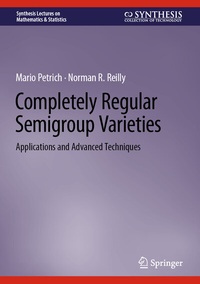
Completely Regular Semigroup Varieties
Description

This book presents further developments and applications in the area of completely regular semigroup theory, beginning with applications of Polák's theorem to obtain detailed descriptions of various kernel classes including the K-class covers of the kernel class of all bands. The important property of modularity of the lattice of varieties of completely regular semigroups is then employed to analyse various principal sublattices. This is followed by a study of certain important complete congruences on the lattice; the group, local and core relations. The next chapter is devoted to a further treatment of certain free objects and related word problems. There are many constructions in the theory of semigroups. Those that have played an important role in the theory of varieties of completely regular semigroups are presented as they apply in this context. The mapping that takes each variety to its intersection with the variety of bands is a complete retraction of the lattice of varieties of completely regular semigroups onto the lattice of band varieties and so induces a complete congruence for which every class has a greatest member. The sublattice generated by these greatest members is then investigated with the help of many applications of Polák's theorem. The book closes with a fascinating conjecture regarding the structure of this sublattice.
Reviews / Votes
"The book is well equipped with powerful results with detailed methodology and illustrative examples and also a new fascinating conjecture regarding the structure of the aforesaid sublattice. The book has an updated and insightful reference list at the end." (Sanjib Kumar Datt, zbMATH 1567.20003, 2025)
More details
Other editions
Additional editions
Persons
Mario Pettrich received his PhD from the University of Washington in 1961 and held positions in many universities across Austria, Canada, France, Germany, Italy, Portugal, Spain, the UK and the US, including Pennsylvania State University, University of Western Ontario, University of Vienna, University of St Andrews, Simon Fraser University, and University of Montpellier. He was a Founding Editor of Semigroup Forum. Dr. Petrich has published over 260 articles, seven monographs and one Research Note. The principal focus of his work was in the field of semigroup theory.
Norman Reilly received his PhD from Glasgow University in 1965 and has held positions at Glasgow University, Tulane University, and Simon Fraser University. Dr. Reilly has published over 100 articles and two books. He is a long time editor of Semigroup Forum and the International Journal of Algebra and Computation. The focus of his research has been on algebraic systems, including ordered algebraic systems, witha main focus on the theory of semigroups.
Content
General Sublattices of L(CR).- Neutrality and Intervals.- Free Objects.- Constructions.- Canonical Varieties.
