

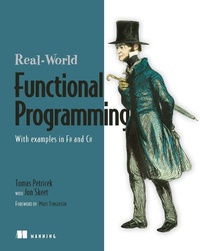
Real-World Functional Programming
With examples in F# and C
1st Edition
Published on 30. November 2009
560 pages
978-1-63835-379-9 (ISBN)
Description

Functional programming languages like F#, Erlang, and Scala are attractingattention as an efficient way to handle the new requirements for programmingmulti-processor and high-availability applications. Microsoft's new F# is a truefunctional language and C# uses functional language features for LINQ andother recent advances.
Real-World Functional Programming is a unique tutorial that explores thefunctional programming model through the F# and C# languages. The clearlypresented ideas and examples teach readers how functional programming differsfrom other approaches. It explains how ideas look in F#-a functionallanguage-as well as how they can be successfully used to solve programmingproblems in C#. Readers build on what they know about .NET and learn wherea functional approach makes the most sense and how to apply it effectively inthose cases.
The reader should have a good working knowledge of C#. No prior exposure toF# or functional programming is required.
Purchase of the print book comes with an offer of a free PDF, ePub, and Kindle eBook from Manning. Also available is all code from the book.
Real-World Functional Programming is a unique tutorial that explores thefunctional programming model through the F# and C# languages. The clearlypresented ideas and examples teach readers how functional programming differsfrom other approaches. It explains how ideas look in F#-a functionallanguage-as well as how they can be successfully used to solve programmingproblems in C#. Readers build on what they know about .NET and learn wherea functional approach makes the most sense and how to apply it effectively inthose cases.
The reader should have a good working knowledge of C#. No prior exposure toF# or functional programming is required.
Purchase of the print book comes with an offer of a free PDF, ePub, and Kindle eBook from Manning. Also available is all code from the book.
More details
Other editions
Additional editions
Book
01/2010
Manning Publications
€47.00
Article exhausted; check different version
Persons
Tomas Petricek contributed to the development of the F# language at Microsoft Research and is active on StackOverflow. He's the author of Real-World Functional Programming (Manning).
Jon Skeet is a Senior Software Engineer at Google, and a highly visible participant of newsgroups, user groups, international conferences, and the Stack Overflow Q&A site. Jon spends much of his day coding in Java, but his heart belongs to C#.
Jon Skeet is a Senior Software Engineer at Google, and a highly visible participant of newsgroups, user groups, international conferences, and the Stack Overflow Q&A site. Jon spends much of his day coding in Java, but his heart belongs to C#.
Content
- Intro
- Copyright
- Brief Table of Contents
- Table of Contents
- Foreword
- Preface
- Acknowledgments
- About this Book
- About the Cover Illustration
- Part 1. Learning to think functionally
- Chapter 1. Thinking differently
- Chapter 2. Core concepts in functional programming
- Chapter 3. Meet tuples, lists, and functions in F# and C#
- Chapter 4. Exploring F# and .NET libraries by example
- Part 2. Fundamental functional techniques
- Chapter 5. Using functional values locally
- Chapter 6. Processing values using higher-order functions
- Chapter 7. Designing data-centric programs
- Chapter 8. Designing behavior-centric programs
- Part 3. Advanced F# programming techniques
- Chapter 9. Turning values into F# object types with members
- Chapter 10. Efficiency of data structures
- Chapter 11. Refactoring and testing functional programs
- Chapter 12. Sequence expressions and alternative workflows
- Part 4. Applied functional programming
- Chapter 13. Asynchronous and data-driven programming
- Chapter 14. Writing parallel functional programs
- Chapter 15. Creating composable functional libraries
- Chapter 16. Developing reactive functional programs
- Appendix. Looking ahead
- Appendix. Resources
- Appendix. Quick Reference - Functional Programming Concepts
- Appendix. Quick Reference - F# Language Constructs
- Index
- List of Figures
- List of Tables
- List of Listings
