

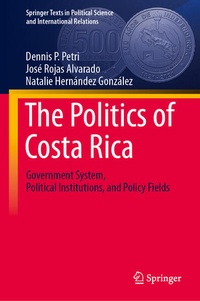
The Politics of Costa Rica
Description

This textbook provides a comprehensive overview of the Costa Rican political system. It covers political history, the government system and its elements (political regime, electoral system, party system), political institutions (four branches: executive, legislative, judiciary and electoral) and includes an in-depth analyses of a selection of policy fields: economic development policy, health policy, education policy, security policy, environmental policy, and religious policy.
This textbook is intended for upper undergraduate and graduate courses in the Costa Rican political system and includes lecture slides and discussion questions for instructors.
More details
Other editions
Additional editions
Persons
Dennis P. Petri, PhD, is Professor in International Relations at the Latin American University of Science and Technology (ULACIT, Costa Rica). He is the International Director of the International Institute for Religious Freedom; Founder and scholar-at-large of the Observatory of Religious Freedom in Latin America; and Executive Director of the Foundation Platform for Social Transformation. He holds a PhD in Political Philosophy from Vrije Universiteit Amsterdam as well as a Master in Political Science and a Research Master in Comparative Politics, specializing in Latin America, from the Institute of Political Studies in Paris (Sciences Po). He has published on freedom of religion, religion and politics, social dialogue, parliamentary reform and democracy assistance. He has testified as an expert in various parliaments and international forums.
José Rojas Alvarado is a political scientist and international development specialist. He works at the University of Oxford, where he supports collaboration between researchers and policy professionals to inform public policy with world-class research. He has lectured in the areas of International Political Economy in Latin America, International Organizations, and Qualitative Research at the Latin American University of Science and Technology (ULACIT, Costa Rica). He read Political Science at the University of Costa Rica and holds a Master of Science in International Development from the University of Bristol. His research explores the influence of international governance standards on domestic policy, and he has published on labour migration, Christian Democracy, and the political system of Costa Rica.
Natalie Hernández González is an undergraduate student in International Relations at the Latin American University of Science and Technology (ULACIT, Costa Rica). Her academic interests include political science, foreign policy, human rights, and the peaceful resolution of conflicts. She currently serves as a Data Analyst and has conducted research on Costa Rica's role in international diplomacy, particularly its involvement in the negotiations of the Treaty on the Non-Proliferation of Nuclear Weapons. She was recognized as Best Delegate at a Model United Nations conference.
Content
History of the Political System of Costa Rica.- Features of the Political System.- Branches of government.- Beyond Representative Democracy.- Policy Fields.- Epilogue: The Resilience of Costa Rican Democracy.
