

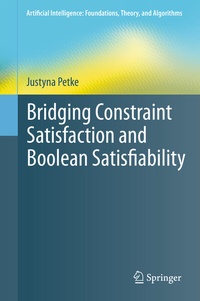
Bridging Constraint Satisfaction and Boolean Satisfiability
Description

This book provides a significant step towards bridging the areas of Boolean satisfiability and constraint satisfaction by answering the question why SAT-solvers are efficient on certain classes of CSP instances which are hard to solve for standard constraint solvers. The author also gives theoretical reasons for choosing a particular SAT encoding for several important classes of CSP instances.
Boolean satisfiability and constraint satisfaction emerged independently as new fields of computer science, and different solving techniques have become standard for problem solving in the two areas. Even though any propositional formula (SAT) can be viewed as an instance of the general constraint satisfaction problem (CSP), the implications of this connection have only been studied in the last few years.
The book will be useful for researchers and graduate students in artificial intelligence and theoretical computer science.
More details
Other editions
Additional editions
Person
Justyna Petke received her D.Phil. from the University of Oxford. She is a Research Associate at the Centre for Research on Evolution, Search and Testing (CREST) in the Dept. of Computer Science, University College London. Her research interests include the connections between constraint satisfaction and search-based software engineering, including genetic improvement and combinatorial interaction testing.
Content
Introduction.- Background.- Solver Performance on Tractable CSPs: Empirical Evaluation.- SAT Encodings.- From CSP to SAT: Width Restrictions.- From CSP to SAT: Language Restrictions.- SAT Encodings of a Classical Problem: A Case Study.- Conclusions.
