

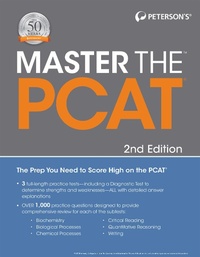
Master the PCAT
2nd Edition
Published on 1. October 2020
1070 pages
978-0-7689-4565-2 (ISBN)
Description

So, you want to be a pharmacist? In addition to taking courses in the sciences and volunteering or working with a pharmacy to get valuable experience, anyone hoping to get into a pharmacy school must take the PCAT® (Pharmacy College Admission Test), a standardized exam that measures the aptitude and skills of pharmacy school applicants.
Peterson's Master the PCAT®, 2nd Edition for 2018-2019 offers state-of-the-art essential test prep information for each of the subtests on the redesigned PCAT®, including:
- Writing
- Biological Processes
- Chemical Processes
- Biochemistry
- Critical Reading
- Quantitative Reasoning.
In this PCAT study guide you'll find:
- Recent test changes are discussed as well as information on how pharmacy schools use your PCAT scores in the selection process.
- Find over 1,000 practice questions, expert test-taking advice, and thorough subject reviews.
- Review details about the PCAT®, such as registration dates and information, scoring, and reporting of scores.
- Three full-length multiple-choice practice tests provide test-taking experience and detailed answer explanations to help test-takers score high on the exam.
Peterson's® Master the(TM) PCAT® provides preparation techniques and knowledge that test-takers can utilize to improve their scores. Be confident and well-prepared on test day!
More details
Other editions
Additional editions
Book
05/2018
2nd Edition
Peterson's Guides,U.S.
€47.22
Article exhausted; check different version
Content
- Cover
- Title Page
- Copyright
- Contents
- Before You Begin
- How This Book is Organized
- Special Study Features
- Using This Book To Prepare for the Computer-Based PCAT
- You Are Well On Your Way To Success
- Find Us on Facebook
- Give Us Your Feedback
- Top 10 Strategies To Raise Your Score
- Part I: Pcat Basics
- 1 All About the PCAT
- The PCAT Structure and Testing Format
- Your PCAT Scores
- Reporting Scores to Pharmacy Schools
- How Pharmacy Schools Use PCAT Scores
- Registering for the PCAT
- PCAT Fees and Special Accommodations
- What You Should Know for Test Day
- Summing It Up
- 2 PCAT Questions-A First Look
- Format of the Test
- Writing Subtest
- Biological Processes Subtest
- Chemical Processes Subtest
- Critical Reading Subtest
- Quantitative Reasoning Subtest
- Top Test-Taking Strategies for the PCAT
- Summing It Up
- Part II: Diagnosing your Strengths and Weaknesses
- 3 Practice Test 1: Diagnostic
- Practice Test 1: Diagnostic Answer Sheets
- Section 1: Writing
- Section 2: Biological Processes
- Section 3: Chemical Processes
- Section 4: Critical Reading
- Section 5: Quantitative Reasoning
- Answer Keys and Explanations
- Part III: Critical Reading Skills
- 4 Critical Reading Skills
- The Passages
- Reading the Passages
- The Question Types
- A Critical Reading Study Plan
- Critical Reading Strategies for the PCAT
- Sharpening Your Critical Reading Skills Every Day
- Practice Questions
- Answer Key and Explanations
- Summing It Up
- Part IV: Biological Processes
- 5 General Biology
- Classification
- Cell Structure
- Enzymes
- Energy
- Cellular Metabolism
- DNA Structure and Replication
- Protein Synthesis
- The Cell Cycle and Cell Division
- Genetics
- Evolution
- Practice Questions
- Answer Key and Explanations
- Summing It Up
- 6 Microbiology
- Microorganisms
- Bacteria
- Viruses
- Fungi
- Practice Questions
- Answer Key and Explanations
- Summing It Up
- 7 Anatomy and Physiology
- The Nervous System
- The Skeletal and Muscular Systems
- The Cardiovascular System
- The Lymphatic and Immune Systems
- The Endocrine System
- The Respiratory System
- The Digestive System
- The Urinary System
- The Reproductive System
- Practice Questions
- Answer Key and Explanations
- Summing It Up
- Part V: Chemical Processes
- 8 General Chemistry
- Matter
- Atomic Theory
- Detailed Atomic Structure
- The Periodic Table of Elements
- Ions, Molecules, and Compounds
- Chemical Bonding
- Chemical Equations and Reactions
- Gases
- Solids and Liquids
- Solutions
- Acid-Base Reactions
- Redox Reactions and Electrochemistry
- Thermochemistry
- Chemical Kinetics and Equilibrium
- Practice Questions
- Answer Key and Explanations
- Summing It Up
- 9 Organic Chemistry
- Atomic Bonding and Structure
- Nomenclature and Functional Groups
- Reaction Mechanisms
- Methodology
- Spectroscopy
- Practice Questions
- Answer Key and Explanations
- 10 Biochemistry
- Carbohydrates
- Lipids
- DNA and RNA
- Proteins
- Practice Questions
- Answer Key and Explanations
- Summing it Up
- Part VI: Quantitative Reasoning
- 11 Arithmetic
- Number Types
- Number Operations
- Fractions
- Ratios
- Proportions
- Decimals
- Percents
- Moving Between Fractions, Decimals, and Percents
- Logarithms
- Practice Questions
- Answer Key and Explanations
- Summing It Up
- 12 Algebra
- Exponents and Radicals
- Algebraic Expressions
- Polynomials
- Equations
- Inequalities
- Functions
- Common Word Problems
- Practice Questions
- Answer Key and Explanations
- Summing It Up
- 13 Probability and Statistics
- Probability of a Single Event
- Probability of Compound Events
- Measures of Central Tendency: Mean, Median, and Mode
- Measures of Variation: Range, Standard Deviation, and Variance
- Graphical Representations
- Practice Questions
- Answer Key and Explanations
- Summing It Up
- 14 Precalculus
- Graphs
- Exponential and Logarithmic Equations
- Logarithmic and Exponential Functions
- Trigonometric Functions
- Vectors
- Complex Numbers
- Practice Questions
- Answer Key and Explanations
- Summing It Up
- 15 Calculus
- Limits
- Differentiation
- Applications of the Derivative
- Integration
- Practice Questions
- Answer Key and Explanations
- Summing It Up
- Part VII: Writing
- 16 Writing Skills
- Understand the Scoring Rubrics
- Know and Practice the Task
- Take It Step By Step
- Common Writing Errors
- Follow a Model
- Essay Prompt
- Model Responses, Scoring, and Analysis
- A Writing Study Plan
- Sharpening Your Writing Skills Every Day
- Summing It Up
- A Quick Review of Common Errors in Grammar, Usage, and Mechanics
- Sentence Faults
- Subject-Verb Agreement
- A Few Additional Words of Advice
- Rhetorical Skills
- Model Essay Prompt
- Part VIII: Two Practice Tests
- Practice Test 2
- Practice Test 2: Answer Sheets
- Section 1: Writing
- Section 2: Biological Processes
- Section 3: Chemical Processes
- Section 4: Critical Reading
- Section 5: Quantitative Reasoning
- Answer Keys and Explanations
- Practice Test 3
- Practice Test 3: Answer Sheets
- Section 1: Writing
- Section 2: Biological Processes
- Section 3: Chemical Processes
- Section 4: Critical Reading
- Section 5: Quantitative Reasoning
- Answer Keys and Explanations
- Appendix
- Pharmacy Career Options
- Pharmacy Careers
- Academic Pharmacist
- Ambulatory Care Pharmacist
- Community Pharmacist
- Consultant Pharmacist
- Hospital and Institutional Pharmacist
- Managed Care Pharmacist
- Nuclear Pharmacist
- Oncology Pharmacist
- Pharmacy Informaticist
- U.S. Public Health Service Pharmacist
