

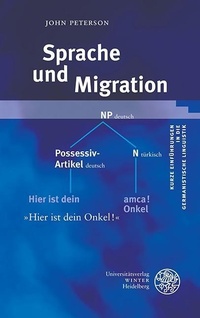
Sprache und Migration
Published on 14. November 2016
X, 101 pages
978-3-8253-7687-1 (ISBN)
Description

Das Thema Sprache und Migration - und damit auch Mehrsprachigkeit - spielt inzwischen eine zentrale Rolle in der Diskussion um die Integration hier lebender Menschen mit Migrationshintergrund. Unser Verständnis der Mehrsprachigkeit bildet die Basis für alle bildungspolitischen Entscheidungen zu diesem Thema, Entscheidungen, die oft weitreichende Folgen haben.
Der vorliegende Band richtet sich speziell an Studierende philologischer und sprachwissenschaftlicher Fächer ab dem dritten Fachsemester, die über Grundkenntnisse der Bereiche Phonologie, Morphologie, Syntax und Orthographie verfügen. Das Buch befasst sich zunächst mit einigen heute noch weit verbreiteten Mythen über Mehrsprachigkeit und zeigt die komplexen Beziehungen zwischen Sprache, Ethnie, Nationalität und Register auf. Zu den weiteren Themen gehören u.a. Codeswitching, d.h. die Verwendung von zwei oder mehr Sprachen während eines Gesprächs, "Kiezdeutsch", die Rolle von Mehrsprachigkeit beim Schriftspracherwerb, mehrsprachiger Unterricht u.v.m.
More details
Other editions
Additional editions
John Peterson
Sprache und Migration
Book
03/2015
1st Edition
Universitätsverlag Winter
€16.00
Available immediately
Content
- Cover
- Titel
- Impressum
- Vorwort
- Inhaltsverzeichnis
- 1. Einleitung
- 1.1 Mehrsprachigkeit: Der "gesunde Menschenverstand" und die Wissenschaft
- 1.2 Mythos 1: Doppelte Halbsprachigkeit
- 1.3 Mythos 2: Sprachen ohne Grammatik
- 1.4 Mythos 3: Jeder hat eine Muttersprache
- 1.5 Mythos 4: Die sollten ihre Sprache einfach aufgeben!
- 1.6 Interdisziplinarität in der Migrationsforschung
- 1.7 Zusammenfassung
- 2. Allgemeine Grundlagen
- 2.1 Ab wann ist man "mehrsprachig
- 2.2 Sprache und Nationalstaat
- 2.3 Was heißt hier "deutsch"? Sprache, Ethnie und Nationalität
- 2.4 Deutsch als Zweitsprache, Deutsch als Fremdsprache
- 2.5 Zusammenfassung
- 3. "Deutsch" ist nicht gleich "deutsch
- 3.1 Sprache als Regelsystem
- 3.2 Sprache als dynamischer Prozess
- 3.3 Sprache und Geographie: "Deutsch" und seine Dialekte
- 3.4 Sprache und Gesellschaft: Register und Stil
- 3.5 Sprache und Medium: Gesprochene und geschriebene Sprache
- 3.6 Sprache und Struktur: Orat und literat
- 3.7 Zusammenfassung
- 4. Codeswitching & Co. - Jonglieren mit zwei Sprachen
- 4.1 Begriffsklärung: Codeswitching, Codemixing und Entlehnungen
- 4.2 Beispiele für Codeswitching, I: Deutsch und Englisch
- 4.3 Beispiele für Codeswitching, II: Deutsch und Russisch
- 4.4 Beispiele für Codeswitching, III: Deutsch und Türkisch
- 4.5 Funktionen von Codeswitching
- 4.6 Deutsches Türkisch und "Türkendeutsch": Mehrsprachigkeit in beide Richtungen
- 4.7 Zusammenfassung
- 5. Schreiben (nicht nur) im Kontext der Migration
- 5.1 Begriffsklärung: Orthographie, Graphematik und Schriftsprache
- 5.2 Orthographie als modulares System
- 5.3 Orthographie und Mehrsprachigkeit
- 5.4 Register und Mehrsprachigkeit
- 5.5 Zusammenfassung
- 6. Mehrsprachigkeit und Schule
- 6.1 Ein- versus mehrsprachiger Unterricht
- 6.2 Codeswitching in der Schule: Mehrsprachigkeit als Ressource
- 6.3 Zusammenfassung
- Literatur
- Glossar
- Sachregister
- Back Cover
