

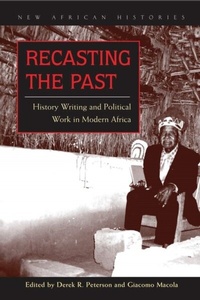
Recasting the Past
History Writing and Political Work in Modern Africa
1st Edition
Published on 15. August 2009
280 pages
978-0-8214-4336-1 (ISBN)
Description

The study of intellectual history in Africa is in its infancy. We know very little about what Africa's thinkers made of their times. Recasting the Past brings one field of intellectual endeavor into view. The book takes its place alongside a small but growing literature that highlights how, in autobiographies, historical writing, fiction, and other literary genres, African writers intervened creatively in their political world.
The past has already been worked over by the African interpreters that the present volume brings into view. African brokers-pastors, journalists, kingmakers, religious dissidents, politicians, entrepreneurs all-have been doing research, conducting interviews, reading archives, and presenting their results to critical audiences. Their scholarly work makes it impossible to think of African history as an inert entity awaiting the attention of professional historians. Professionals take their place in a broader field of interpretation, where Africans are already reifying, editing, and representing the past.
The essays collected in Recasting the Past study the warp and weft of Africa's homespun historical work. Contributors trace the strands of discourse from which historical entrepreneurs drew, highlighting the sources of inspiration and reference that enlivened their work. By illuminating the conventions of the past, Africa's history writers set their contemporary constituents on a path toward a particular future. History writing was a means by which entrepreneurs conjured up constituencies, claimed legitimate authority, and mobilized people around a cause. By illuminating the spheres of debate in which Africa's own scholars participated, Recasting the Past repositions the practice of modern history.
The past has already been worked over by the African interpreters that the present volume brings into view. African brokers-pastors, journalists, kingmakers, religious dissidents, politicians, entrepreneurs all-have been doing research, conducting interviews, reading archives, and presenting their results to critical audiences. Their scholarly work makes it impossible to think of African history as an inert entity awaiting the attention of professional historians. Professionals take their place in a broader field of interpretation, where Africans are already reifying, editing, and representing the past.
The essays collected in Recasting the Past study the warp and weft of Africa's homespun historical work. Contributors trace the strands of discourse from which historical entrepreneurs drew, highlighting the sources of inspiration and reference that enlivened their work. By illuminating the conventions of the past, Africa's history writers set their contemporary constituents on a path toward a particular future. History writing was a means by which entrepreneurs conjured up constituencies, claimed legitimate authority, and mobilized people around a cause. By illuminating the spheres of debate in which Africa's own scholars participated, Recasting the Past repositions the practice of modern history.
Reviews / Votes
"As a group, the contributors and editors of Recasting the Past constitute one of the most impressive cohorts of scholars brought together in a collective volume project in the past three decades. This work will be required reading for any individual venturing into serious study of Africa's past." "Collectively the authors of Recasting the Past are to be saluted, as are their editors. As an assertion of the vibrancy of Christian Africa's history of ideas in the twentieth century, this collection could hardly be richer." (International Journal of African Historical Studies) "This collection accomplishes what no monograph could because these nuanced inquiries each require deep expertise. The variety of questions posed here suggests many ways that professional historians could appreciate more fully the production of historical knowledge in Africa. Students of African intellectual history will come away better able to appreciate the deep and multiple roots that generate the production of culture in Africa." (American Historical Review) "Despite the study of Africa's intellectual history being curiously underdeveloped, the work in (Recasting the Past) confronts the idea that the study of African history is solely the preserve of professional historians." (Political Studies Review) "This lively volume focuses on what the editors call Africa's homespun historians: non-professionals who, throughout the twentieth century, devoted passionate and painstaking intellectual labor to recreating the past, often in vernacular languages....(Recasting the Past) makes a welcome intervention in African intellectual history. In many ways, it is a model of the genre." (Journal of African History) "These are magnificent essays. What this collection shows with great power and verve is that starting early in the last century Africans constructed their own historical accounts using various methods, frameworks, and analytical tools. It adds a dimension to our understanding of the African past-and the African understanding of the African past-that is long overdue."More details
Series
Language
English
Place of publication
Athens
United States
Target group
College/higher education
Professional and scholarly
ISBN-13
978-0-8214-4336-1 (9780821443361)
Copyright in bibliographic data and cover images is held by Nielsen Book Services Limited or by the publishers or by their respective licensors: all rights reserved.
Schweitzer Classification
Other editions
Additional editions
Derek R. Peterson | Giacomo Macola
Recasting the Past
History Writing and Political Work in Modern Africa
Book
08/2009
Ohio University Press
€53.47
Shipment within 10-20 days
Derek R. Peterson | Giacomo Macola
Recasting the Past
History Writing and Political Work in Modern Africa
Book
08/2009
Ohio University Press
€90.00
Shipment within 10-20 days
Persons
Derek R. Peterson is Ali Mazrui Collegiate Professor of History and African Studies at the University of Michigan. He is the author of Creative Writing: Translation, Bookkeeping, and the Work of Imagination in Colonial Kenya, and editor of The Invention of Religion: Rethinking Belief in Politics and History.
Giacomo Macola is associate professor in African history at Sapienza Universita di Roma and research fellow in the Centre for Africa Studies of the University of the Free State. The author of Liberal Nationalism in Central Africa: A Biography of Harry Mwaanga Nkumbula, he has also coedited (with Derek Peterson) Recasting the Past: History Writing and Political Work in Modern Africa.
Giacomo Macola is associate professor in African history at Sapienza Universita di Roma and research fellow in the Centre for Africa Studies of the University of the Free State. The author of Liberal Nationalism in Central Africa: A Biography of Harry Mwaanga Nkumbula, he has also coedited (with Derek Peterson) Recasting the Past: History Writing and Political Work in Modern Africa.
Content
- Intro
- Acknowledgments
- Introduction: Homespun Historiography and the Academic Profession
- 1: I. B. Akinyele and Early Yoruba Print Culture
- 2: The War of the Books: Petros Lamula and the Cultural History of African Nationalism in Twentieth-Century Natal
- 3: "When You Shake a Tree": The Precolonial and the Postcolonial in Northern Namibian History
- 4: Imagining the Nation: Harry Mwaanga Nkumbula between Politics and History
- 5: Law, Polities, and Inference
- 6: Asante Origins, Egypt, and the Near East: An Idea and Its History
- 7: In Pursuit of the "Higher Medievalism": Local History and Politics in Kilimanjaro
- 8: States of Mind: Political History and the Rwenzururu Kingdom in Western Uganda
- 9: A Community of Suffering: Narratives of War and Exile in the Zambian Lumpa Church
- 10: Merging Ethnic Histories in Senegal: Whose Moral Community?
- 11: The King of the Mijikenda and Other Stories about the Kaya: Heritage, Politics, and Histories in Multiparty Kenya
- 12: Writing Competitive Patriotisms in Eastern Africa
- Contributors
- Index
