

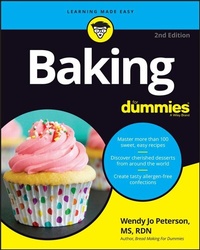
Baking For Dummies
Description

Baking For Dummies is your go-to source for basic instructions and easy-to-follow recipes. Learn to make delicious and impressive cookies, cakes, breads, cupcakes, frostings, pies, muffins, cobblers, quiches, and beyond. Elevate your next get together by crafting a dessert charcuterie board or serving decadent individual quiches, savory scones, and homemade rolls--it's a step up from store bought cookies and cakes, for sure. In this low-key Dummies guide, you'll find lists of basic ingredients and essential equipment, plus explanations of baking techniques and definitions of baking terms and techniques you'll need to know. This book also covers basic kitchen prep, time-saving tricks, kid-friendly baking recipes, allergy and dietary modifications--this book has it all.
* Learn to bake impressive desserts and wonderful breads, even if you're a first timer
* Start at the beginning with clear explanations of how to master the basics
* Discover great ideas for special-occasion goodies and stylish presentations
* Bake gluten-free, egg-free, and dairy-free recipes--something for everyone
For anyone new to baking or ready to level up, Baking For Dummies is the go-to guide.
More details
Other editions
Additional editions
Person
Content
Part 1: Baking Essentials 5
Chapter 1: Bake, For Goodness' Sake! 7
Chapter 2: Stocking Up 11
Chapter 3: Going Over the Gear 39
Part 2: Basic Training for Baking 63
Chapter 4: Familiarizing Yourself with Your Oven 65
Chapter 5: Focusing on Basic Techniques 71
Chapter 6: Considering Allergies and Insensitivities When Baking 87
Chapter 7: Getting Ready to Bake 93
Part 3: Ready, Set, Bake! 107
Chapter 8: Understanding the Ins and Outs of Baking Cookies 109
Chapter 9: Baking Moist Cakes 149
Chapter 10: Fixing Fabulous Frostings 183
Chapter 11: Preparing Perfect Pies and Tarts 205
Chapter 12: Creating Crisps, Cobblers, and Other Delights 237
Chapter 13: Making Quick Breads, Muffins, and Biscuits 247
Chapter 14: Rising with Yeast Breads 269
Chapter 15: Going Savory with Baked Goods 295
Chapter 16: Baking with Mixes and Premade Doughs 309
Part 4: Dealing with Other Important Stuff 319
Chapter 17: Storing Your Creations 321
Chapter 18: Making the Ordinary Extraordinary 333
Part 5: The Part of Tens 341
Chapter 19: Ten Ways to Boost Nutrition When Baking 343
Chapter 20: Ten Ways to Get Kids Baking 347
Appendix A: Glossary of Baking Terms 351
Appendix B: Metric Conversion Guide 357
Index 361
Chapter 2
Stocking Up
IN THIS CHAPTER
Understanding the virtues of having a well-stocked pantry
Making a list of what to have on hand
Knowing substitutions you can use in a pinch
A well-stocked pantry really makes a difference when it comes to baking for several reasons:
- It's a huge time-saver because it eliminates a trip to the grocery store.
- It enables you to create delicious treats whenever the mood strikes.
- If you happen to run out of one ingredient, a well-stocked pantry will ensure that you have a substitute or an extra ingredient on hand.
You don't need a lot of room to have a good pantry, but you need to be organized and store your ingredients well to maximize not only space but also the ingredients' shelf life. This chapter presents a list of staples you should have on hand when you begin baking. Of course, you don't have to purchase everything all at once, but you may be surprised at how quickly you'll build your pantry and how accommodating it will be to have a well-stocked kitchen for future baking.
STORING BULK FOODS
If your supermarket or natural-foods store has a bulk section, purchasing ingredients there is an economical choice. However, never store items in the plastic bags for more than a week. Instead, save your jars and containers! Washed, clean jars or containers from spaghetti sauce, salsa, yogurt, peanut butter, and applesauce make great containers to hold items you purchase in bulk. Baby food jars, in particular, recycle into great spice jars. Don't forget to mark your jars with masking tape and permanent marker. (Don't use nonpermanent marker - it can rub off, and you'll be left wondering what you put in those jars!) You may someday need a reminder of what's in them and when you bought it! Labeling and dating each product as you get it is a good idea.
When shopping for your pantry, be a smart shopper. Look for items on sale at your local grocery store. If space is not an issue, buy two or three popular items when they go on sale (my theory is you can never have enough baking soda or sugar). Also, take a look in discount stores and those ever-popular dollar stores. Recently, I found nonstick cooking spray at the dollar store and stocked up, because one can costs double or triple that amount in my local grocery store. This also goes for spices; I almost always purchase spices "loose" at a local store that sells them prebagged. I never spend more than 75 cents for what most people pay $3 to $4 in a supermarket. You may be surprised at how inexpensively you can stock your pantry when you shop around.
If you hope to bake a lot or the holidays are coming, it is good to purchase flour, sugar, chocolate, and nuts in bulk at warehouse clubs. Of course, do this only if you will go through the ingredients quickly. If you're a part-time baker, I find that the "bulk section" of my food store is good if I need smaller amounts of ingredients. I can purchase just what I need, and there is no waste - perfect for unusual spices you may only need during holiday baking, too!
Your dry pantry can be in the cabinets, on shelves, in a cupboard or in a designated pantry or closet. Make sure to keep the floor clean. Remove everything and wipe down the shelves at least twice a year (spring and fall are good times for this type of cleaning). And, of course, if you spill anything, clean it up right away to avoid any sort of animal or insect infestation.
Flour: Focusing on the Main Ingredient
Flour is the primary ingredient for most cakes, cookies, pastries, and breads. Although it is one of the most basic baking ingredients, it also can be the most confusing, because of the wide variety available on grocery store shelves. Some flours are perfect for bread baking but disastrous for piecrusts or tender pastries. What makes a flour good for one recipe and bad for another? The amount of protein it contains. The more protein a flour has, the more gluten it will produce when it's kneaded. And the more gluten you have, the less tender your baked good will be.
Gluten is the protein that forms weblike structures present in wheat and other flours. When the flour is moistened and the bread is kneaded, or doughs and batters are mixed together, gluten forms and adds an elastic and cohesive nature to the food. This elasticity allows the dough to expand and trap the carbon dioxide, produced by the leavening, which makes the dough rise and stretch. Gluten makes it all possible!
Here I touch on flour using in baking and what you need to know about storing your flour.
Identifying the main types of flour
Several different kinds of flour are available for baking; all-purpose, cake, bread, self-rising, and whole wheat flour are just a few. Become acquainted with three basic types of flour: all-purpose flour, cake flour, and bread flour.
-
All-purpose flour: It's a blend of hard and soft wheat flours. The presence of more and tougher gluten in the hard wheat results in a rather elastic product. This produces the texture you want for cakes and cookies.
Bleached and unbleached all-purpose flours can be used interchangeably, but unbleached flour has a higher nutritional value. Southern flours, such as White Lily, are made with a softer wheat, which means that they have cake flour-like qualities. Southern flour is great for tender biscuits and piecrusts.
- Cake flour: This flour is made with soft wheat, producing less gluten when mixed, so your cake will be more delicate, with a slightly crumbly texture. When purchasing cake flour, don't buy self-rising cake flour unless the recipe specifically calls for it. If you do buy it by mistake, omit the baking powder or baking soda and salt from the recipe.
- Bread flour: It has a higher gluten-forming protein content, making the dough nice and elastic. This makes it ideal for making bread.
GOING BEYOND WHEAT FLOUR
In the United States wheat is king, and it's the only flour type you'll find in many grocery stores. However, should you travel to Europe, you can find a large section of flours, from spelt, rye, einkorn, and semolina within each grocery store you visit. Each of these flours are used in cakes, cookies, and breads all throughout Europe, yet for some reason this appreciation of old-world grains was lost in the United States during the Industrial Revolution.
In this new edition I have added suggestions in some recipes on how to use or integrate more of these flours into your recipes. Rye is technically a grass and lower in gluten. Spelt, or dinklmehl in Germany, is also a lower gluten old-world grain. That means these grains will yield more dense baked goods.
If you're curious about adding in more of these grains and having a wider variety of grain baked goods, start by cutting ¼ to ½ of the wheat-based flours and adding in ¼ to ½ of a different grain flour. For instance, if you're making the Peanut Butter Cookies from Chapter 8, try using half spelt flour in the recipe or replacing ¼ cup all-purpose flour with ¼ cup rye flour. Look for these suggestions throughout the book and give them a whirl!
If you're baking gluten-free, you can try using a gluten-free oat flour or a gluten-free all-purpose flour blend, now available at many grocery stores or online, such as Bob's Red Mill Gluten Free Flour.
In addition to grain-based flours, nut flours like almond flour, hazelnut flour, and peanut flour are now being used in cakes and cookies. Check out the Lebkuchen recipe in Chapter 8 or the Gluten-Free Chocolate Hazelnut Cake in Chapter 9. Nut flours are full of flavor and offer a delicious grainy texture in each bite.
If your recipe calls for cake flour and you have only all-purpose flour on hand, you can substitute 1 cup minus 2 tablespoons all-purpose flour for 1 cup of cake flour. If you need all-purpose flour and have only cake flour on hand, substitute 1 cup plus 2 tablespoons of cake flour for 1 cup of all-purpose flour. The texture will be different, but if you have no other choice, using it is okay. If you have instant flour on hand, such as Wondra, combine 2 tablespoons in the cup measure, then add enough all-purpose flour to make 1 cup (which would be about ¾ cup plus 2 tablespoons). That will also give you a flour-like cake flour.
Storing flour
Don't store any of your flours in the paper sacks you buy them in. Instead, transfer them into airtight canisters and store them in a cool, dry place to make sure your flour won't absorb any odors or off-flavors. Label the containers to ensure that you can tell the difference between the different varieties (they tend to look the same out of their bags). Flour can last up to six months if stored properly in the pantry and indefinitely if stored in the freezer. If you bought the flour from a natural food store, place it in the freezer for a few days to make sure nothing will hatch.
If you use flour slowly, you can store your flour in the freezer. Double-bag the flour in sealable freezer bags and be sure to label it. Flour stored in the freezer can last for several years.
Sugar: Getting Sweet
Sugar, another basic in baking, gives tenderness and sweetness to doughs and batters. Sugar also causes browning because it...
